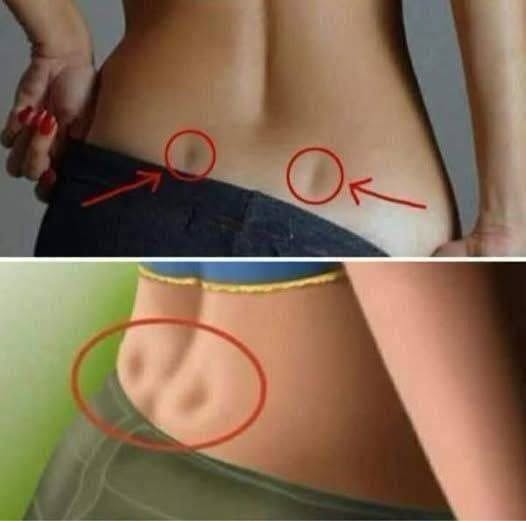
If You Have These Two Small “Holes” in Your Lower Back, It Means You Don’t… See More
Have you ever noticed two small dimples near the lower part of your back and wondered what they mean?
You may have seen social media posts claiming that these little indentations reveal something surprising about your body, personality, fitness, or even your relationships. Headlines often turn an ordinary anatomical feature into a mysterious secret, encouraging people to click because they want to discover what it supposedly means.
The truth is much simpler.
Those small indentations are commonly called back dimples, dimples of Venus, or simply sacral dimples depending on their exact location and appearance. In many people, they are completely normal variations in body structure.
They are not evidence of a hidden personality trait or secret physical characteristic.
The appearance of these dimples is largely related to anatomy and genetics.
The lower back contains the pelvis, sacrum, muscles, connective tissues, and skin. The way these structures are shaped and connected can create small indentations that become visible on the surface of the skin.
Some people have very noticeable dimples.
Others have extremely subtle ones.
Some people don’t have them at all.
None of these variations automatically indicate that something is wrong.
Body shape also affects how visible the dimples appear. Changes in weight, muscle development, posture, and body composition can make them more or less noticeable over time.
That means someone might have had barely visible dimples for years and suddenly notice them more clearly after changing their exercise routine or losing weight.
Social media has contributed to a great deal of confusion about these features.
A photograph can make ordinary anatomy look unusual, especially when an image is cropped or presented with dramatic text.
A headline such as “If you have these two holes in your back, it means you don’t…” creates curiosity by deliberately leaving the sentence unfinished.
Readers naturally want to know what comes next.
But the missing information is often much less dramatic than the headline suggests.
Anatomical features don’t usually have secret meanings.
Your body contains countless variations that are determined by genetics, development, posture, and the structure of your bones and soft tissues.
Two people can have completely different body shapes while both being perfectly healthy.
The dimples themselves are not actually “holes” in the sense of openings into the body.
They are indentations in the skin.
That distinction is important because the word “hole” can make the feature sound alarming.
If the indentations are symmetrical, longstanding, painless, and otherwise unremarkable, they are often simply part of a person’s normal anatomy.
There is another reason people become curious about lower-back dimples: the appearance of the skin in this region can vary significantly from person to person.
Some people have visible pelvic contours.
Others have deeper muscle definition.
Some have naturally smooth skin.
Others have small folds or indentations.
Genetics plays a major role.
Just as genetics can influence height, facial features, hair texture, and body proportions, it can also influence how the lower back and pelvis appear.
Exercise can affect visibility as well.
Strength training that develops the muscles around the hips, glutes, and lower back may change the contours of the area.
However, exercise doesn’t necessarily “create” the underlying anatomical structure.
It may simply make an existing feature easier to see.
Posture can have an effect too.
The position of the pelvis and spine changes the way the skin and soft tissues sit over the underlying structures. A person standing naturally may show different contours from the same person sitting or bending forward.
This is another reason photographs can be misleading.
A single image captures one position at one moment.
It cannot tell you everything about someone’s anatomy.
There is, however, an important distinction between ordinary lower-back dimples and a true sacral dimple that appears as a small pit in the skin, particularly if it is present from birth.
Most sacral dimples are harmless.
But certain characteristics can warrant medical evaluation, especially when a dimple is unusually deep, located higher on the back, associated with a patch of hair, skin discoloration, swelling, drainage, or other unusual changes.
In babies and young children, healthcare professionals may examine sacral dimples as part of routine care.
That doesn’t mean every dimple is dangerous.
It simply means that unusual physical findings should be assessed in context rather than diagnosed through social media.
For adults, a new indentation that suddenly appears alongside pain, swelling, redness, drainage, numbness, weakness, or other symptoms deserves appropriate medical attention.
Again, the important point is not to panic.
Most ordinary body variations are exactly that: variations.
The internet often encourages people to believe that a physical feature must have a hidden explanation.
Someone notices a small mark and immediately searches for what it “means.”
They discover a dramatic headline.
The headline leads to another claim.
Soon, a completely ordinary anatomical feature has been transformed into a supposed secret.
This is how misinformation spreads.
A better approach is to ask whether there is a reliable anatomical or medical explanation.
In the case of lower-back dimples, there usually is.
They are commonly related to the structure of the pelvis and the way soft tissue attaches around that region.
They do not automatically reveal whether someone is athletic.
They do not determine personality.
They do not predict compatibility with another person.
And they certainly do not provide a secret measurement of someone’s health.
Your body does not need to match an internet trend to be normal.
People sometimes become self-conscious after seeing highly edited photographs online. They compare their own bodies with images that may have been carefully posed, filtered, or selected because they show a particular feature.
That comparison can create unnecessary insecurity.
It’s worth remembering that real bodies are diverse.
Some people have visible dimples.
Some have scars.
Some have stretch marks.
Some have asymmetry.
Some have features that are barely noticeable.
None of these differences automatically determine a person’s worth, attractiveness, or health.
So the next time you see the claim, “If you have these two holes in your back, it means you don’t…,” take a moment before believing it.
Look beyond the dramatic headline.
Ask what the anatomical feature actually is.
Ask whether the claim is supported by credible medical information.
And remember that sometimes the explanation isn’t mysterious at all.
Those two small indentations may simply be part of the unique way your body is built.
No secret message.
No hidden personality test.
No extraordinary diagnosis.
Just human anatomy.
And perhaps that is the most interesting fact of all: every person’s body contains small variations that make them different from everyone else, and many of those differences are completely normal.