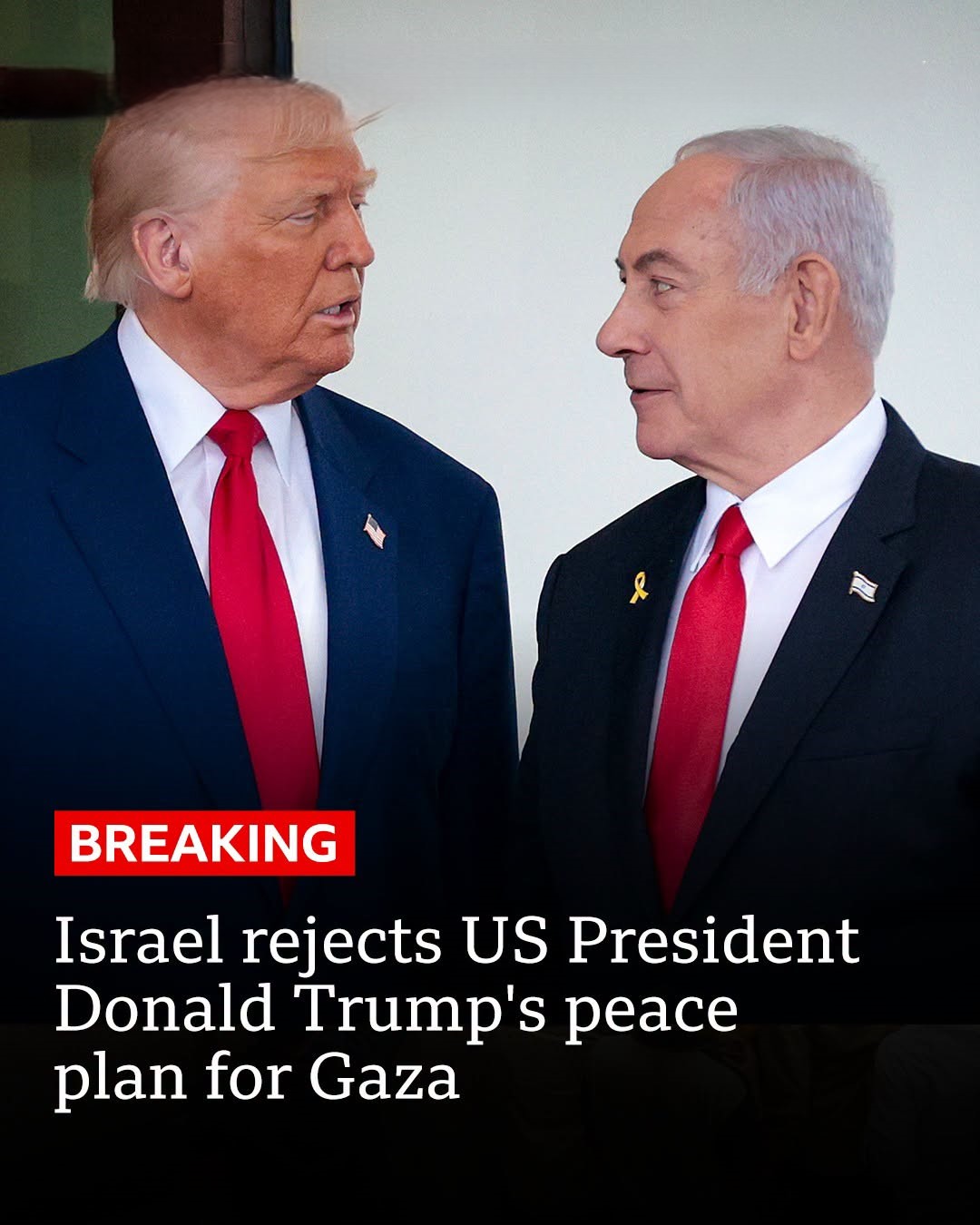
Netanyahu Rejects Trump’s 15-Point Gaza Plan, Insisting Hamas Must Be Fully Disarmed
A major disagreement has emerged between the Israeli government and the administration of U.S. President Donald Trump over the next stage of efforts to end the war in Gaza.
Israeli Prime Minister Benjamin Netanyahu has rejected the latest U.S.-backed 15-point proposal, saying Israel will not withdraw its military forces from Gaza until Hamas is genuinely and completely disarmed.
The statement represents a significant obstacle to an agreement that Washington has presented as a possible path toward ending the conflict and establishing a new security and governing structure for Gaza.
Netanyahu’s position is straightforward: Israel cannot be expected to withdraw its forces while Hamas continues to possess weapons capable of threatening Israeli troops or civilians. He has emphasized that disarmament must be real rather than symbolic, with Israel seeking the removal of both heavy and lighter weapons.
The disagreement places the United States, Israel, Hamas, and other mediating countries in a difficult diplomatic position.
A Dispute Over the Meaning of Disarmament
At the center of the dispute is a fundamental question: what exactly does it mean for Hamas to be disarmed?
The U.S.-backed framework envisions a phased process in which Hamas would surrender its weapons to a new Palestinian administration, while international forces and a new Palestinian security structure would help maintain order.
Under that approach, Israeli forces would gradually withdraw as the agreed conditions were fulfilled.
But Netanyahu has rejected the idea that Israeli withdrawal should happen before complete disarmament.
He has argued that Israel must be certain Hamas no longer possesses weapons that could be used to launch attacks.
This distinction may appear technical, but it is one of the most important issues in the negotiations.
For Hamas, surrendering weapons represents an existential decision. For Israel, allowing an armed Hamas to remain in Gaza represents a continuing security threat.
That leaves negotiators trying to bridge two positions that remain fundamentally different.
Trump’s Proposal
The latest proposal is part of President Trump’s broader effort to establish a framework for ending the conflict and creating a postwar arrangement for Gaza.
The plan envisions Hamas disarming while Gaza moves toward a different form of civilian governance. An international stabilization force would work alongside a new Palestinian police force, with the stated goal of providing security while the territory transitions away from militant rule.
The concept is ambitious.
Ending the fighting is only one part of the challenge.
The parties must also determine who governs Gaza, who provides security, how weapons are removed, how reconstruction takes place, and how future attacks are prevented.
Each of those questions carries enormous political consequences.
Netanyahu’s Red Line
Netanyahu’s latest comments make clear that complete Hamas disarmament remains one of his central conditions.
He has previously emphasized several principles for the end of the war, including the disarmament of Hamas, the demilitarization of Gaza, Israeli security responsibility, and a civilian administration that is neither Hamas nor the Palestinian Authority.
His current position is therefore consistent with a broader strategy he has repeatedly presented to the Israeli public.
For Netanyahu, the issue is not simply whether fighting stops.
It is whether the conditions that led to renewed conflict can be prevented from returning.
Israeli officials argue that a withdrawal followed by Hamas rebuilding its military capabilities could simply create another cycle of violence.
That fear is central to Israel’s insistence on verification and enforcement.
Hamas Faces Its Own Dilemma
Hamas, meanwhile, faces a completely different calculation.
The organization has indicated support for elements of the broader roadmap but has linked its willingness to surrender weapons to conditions involving an Israeli military withdrawal and an end to Israeli attacks.
That creates a difficult sequence problem.
Israel says it wants disarmament before a full withdrawal.
Hamas wants Israeli forces to withdraw and the fighting to stop before giving up its weapons.
Neither side wants to make the first concession without guarantees from the other.
That is precisely where international mediators are attempting to intervene.
The Human Cost
Behind the diplomatic language are millions of civilians whose lives have been profoundly affected by the conflict.
Gaza has experienced enormous destruction, displacement, shortages, and loss of life since the war began.
Recent reporting cited by The Associated Press says Israeli military operations have killed more than 1,250 people in Gaza since the October 2025 ceasefire, according to Gaza’s Health Ministry, while more than two million people have been displaced.
These figures underline why negotiators face pressure to reach an agreement.
Every delay can have consequences for civilians.
A ceasefire that does not last could lead to renewed fighting. But an agreement that leaves unresolved security questions could also collapse later.
The challenge is therefore not merely reaching a document.
It is creating an arrangement that can survive after the headlines disappear.
A Difficult Role for Washington
The dispute also creates an uncomfortable moment for the United States.
Trump has invested significant political attention in the effort to end the conflict. His administration has promoted the plan as a major step toward resolving the Gaza crisis.
But Netanyahu’s rejection demonstrates that American influence has limits.
Israel is one of Washington’s closest allies, yet the Israeli government has made clear that it will not automatically accept every U.S. proposal.
Netanyahu himself emphasized that Israel is discussing the issues with American officials and that some American ideas are acceptable while others are not.
That language suggests negotiations are not necessarily finished.
A rejection of the current document does not automatically mean that diplomacy has ended.
Instead, it could lead to another round of negotiations over the terms.
The Question of Israeli Withdrawal
The withdrawal issue may prove to be one of the hardest problems to solve.
Any Israeli withdrawal would have major security and political implications.
Israel wants guarantees that territory vacated by its military cannot immediately become a base for renewed attacks.
Hamas and its supporters, meanwhile, are unlikely to view an indefinite Israeli military presence in Gaza as compatible with a genuine end to the conflict.
The two sides therefore have competing definitions of security.
Israel’s priority is preventing future attacks.
For Palestinians, a lasting arrangement must involve an end to military occupation and continued fighting, as well as a viable political future.
Reconciling those expectations will require more than military negotiations.
It will require political decisions.
The Palestinian Question
Another major issue is the future political status of Gaza and the Palestinians.
Netanyahu has continued to oppose the creation of a Palestinian state under his leadership. Recent reporting says he reiterated that position while discussing the current proposal.
That puts him at odds with international actors who view Palestinian statehood as an important part of a long-term solution.
Even if Hamas were completely disarmed, the political question would remain.
Who represents Palestinians in Gaza?
Who governs?
Who controls security?
Who pays for reconstruction?
What relationship would Gaza have with the West Bank?
And what happens to the broader Israeli-Palestinian conflict?
These questions cannot easily be solved through military arrangements alone.
What Happens Next?
For now, negotiations appear far from finished.
The United States continues to push for a framework that can move Gaza toward disarmament, reconstruction, and a new political order.
Israel is demanding stronger guarantees before withdrawing its forces.
Hamas faces pressure to surrender weapons while seeking assurances that Israel will stop military operations and leave Gaza.
Mediators will therefore have to find language that all sides can accept.
That may require changing the sequence of events.
Instead of one side completely fulfilling its demands before the other acts, negotiators could attempt a series of simultaneous, verified steps.
Weapons could be surrendered in stages.
Israeli forces could withdraw from designated areas in stages.
International monitors could verify compliance.
A new Palestinian security force could gradually assume responsibility.
Reconstruction could proceed alongside the political transition.
Such an arrangement would still be extremely difficult.
But diplomacy often succeeds by finding ways to replace absolute demands with carefully monitored commitments.
A Critical Moment
Netanyahu’s rejection of Trump’s 15-point proposal is therefore more than a disagreement over a diplomatic document.
It highlights the central problem that has repeatedly complicated efforts to end the Gaza conflict: both sides fear that compromise could leave them vulnerable.
Israel fears a future in which Hamas retains the ability to attack.
Palestinians fear a future in which Israeli forces remain in Gaza indefinitely.
The United States wants an agreement capable of ending the fighting and creating a stable postwar order.
And civilians on both sides want an end to the destruction and uncertainty.
Whether a revised agreement can bridge those competing demands remains uncertain.
For now, Netanyahu’s message is unmistakable: Israel will not accept a military withdrawal unless it believes Hamas has been genuinely disarmed.
That condition is likely to remain at the center of every negotiation that follows.
The coming weeks could determine whether the latest disagreement becomes another failed attempt at peace—or the beginning of a difficult renegotiation that ultimately produces a workable path forward.