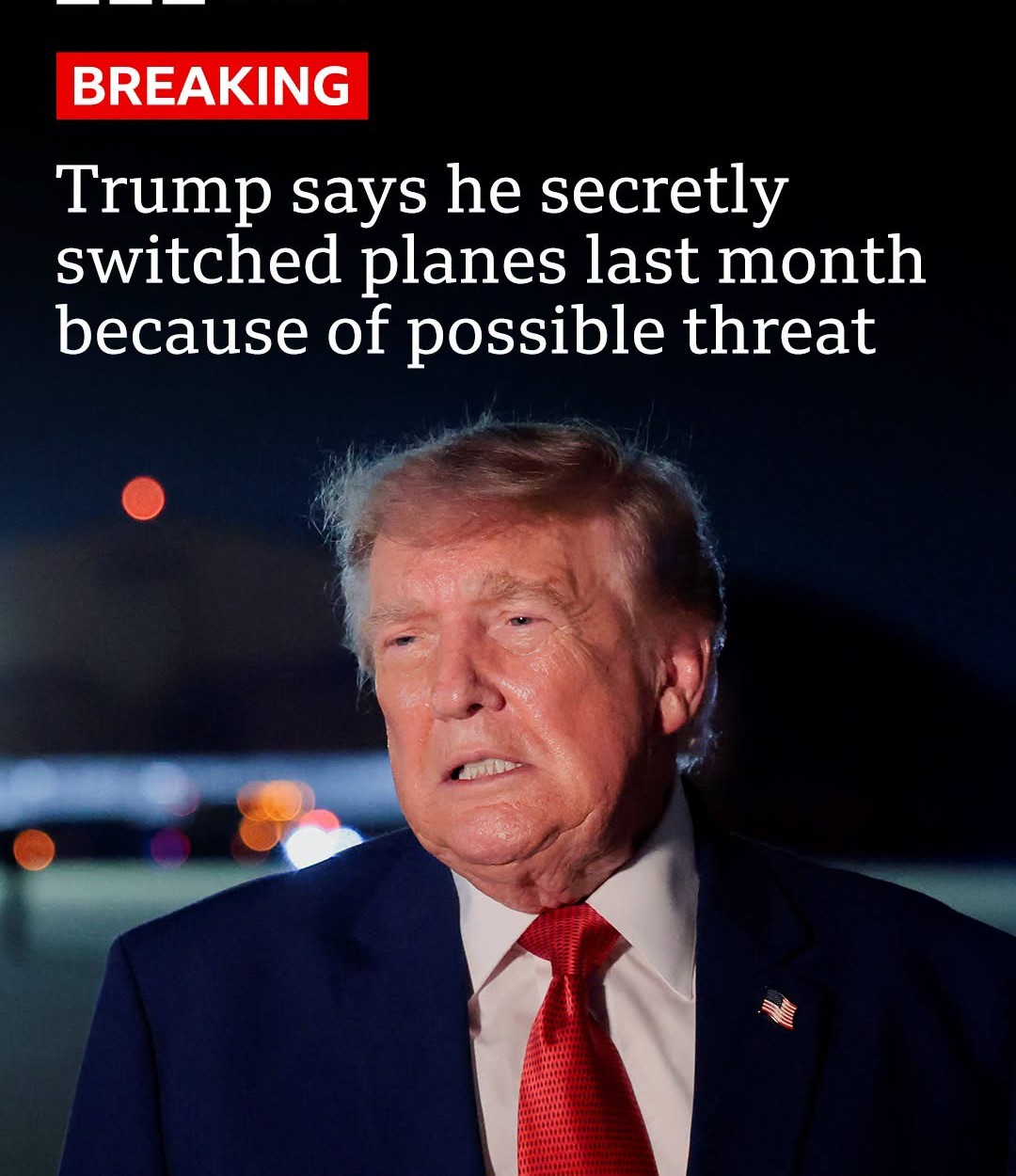
Trump Says He Secretly Switched Planes After NATO Summit Because of a Possible Threat
A previously undisclosed security operation involving U.S. President Donald Trump has drawn international attention after Trump confirmed that he secretly switched aircraft while leaving Turkey following a NATO summit in July.
According to reports, the unusual decision was made because U.S. security officials believed there could be a serious threat to the president’s aircraft. Trump said he followed the advice of the Secret Service and military officials, who determined that changing planes was the safest option under the circumstances.
The revelation has raised questions about what happened behind the scenes during the president’s departure from Ankara and why such an elaborate security measure was considered necessary.
Trump had traveled to Turkey for the NATO summit aboard a newer aircraft provided by Qatar. The plane had attracted considerable attention because of its luxurious interior and its potential future role in presidential transportation. However, according to reports, the aircraft did not yet have all of the advanced defensive capabilities associated with the traditional presidential fleet.
When the time came for Trump to leave Turkey, the public was led to believe that he would depart aboard one aircraft. Instead, security officials secretly arranged for him to board another.
The operation was reportedly designed to keep potential adversaries from knowing exactly where the president was traveling.
That kind of uncertainty can be an important part of presidential security. A president’s movements are normally protected by layers of planning, intelligence, surveillance, and advance security. When officials believe that an aircraft or travel route could become a target, changing plans at the last minute can make it considerably more difficult for anyone attempting to track the president.
In this case, the deception reportedly went even further.
Trump was secretly moved from one aircraft to another using an airport catering vehicle. The unusual method allowed the president to leave without attracting the attention that would normally accompany a presidential transfer. Reports said that the original aircraft remained visible, creating the impression that Trump was still aboard.
For those involved in the operation, secrecy was clearly the priority.
Trump later explained that he had not personally decided to make the change simply because he preferred one aircraft over another. Instead, he said he listened to the Secret Service and military personnel responsible for protecting him.
“I go by Secret Service, military,” Trump said when discussing the decision, emphasizing that he generally follows the recommendations of the professionals responsible for presidential security.
The reported threat was connected to tensions involving Iran. American officials had previously been concerned about possible threats against Trump following escalating military tensions in the region. Reports indicated that intelligence agencies had warned about potential dangers to the president or his aircraft.
Trump’s confirmation therefore brought renewed attention to the seriousness of the security environment surrounding his trip.
Presidential travel is never an ordinary journey. Even when an American president boards an aircraft for what appears to be a routine flight, security teams must consider dozens of potential dangers. Aircraft can be monitored. Flight schedules can be studied. Airport movements can be observed. A known departure time and known aircraft can potentially provide valuable information to anyone attempting to cause harm.
That is why presidential travel plans are sometimes deliberately concealed.
The most remarkable aspect of this incident was that people traveling with the president were reportedly not given the full picture. Journalists and some White House personnel believed that Trump remained aboard the aircraft they were expecting him to use. Meanwhile, the president had already been transferred elsewhere.
Such a maneuver demonstrates how seriously security officials can treat a potential threat.
It also illustrates the unusual circumstances surrounding Trump’s international travel during a period of heightened tensions.
The decision has generated debate in Washington over whether the security operation was justified and whether enough information should have been provided to people traveling with the president.
Supporters of the operation argue that protecting the president must come before convenience or transparency during an immediate security threat. From that perspective, misleading observers about Trump’s location could have been exactly what was needed to prevent a potential attack.
Critics, however, have questioned the implications of keeping journalists and other people aboard the original aircraft unaware of the president’s actual location. Some lawmakers have called for additional information about how the operation was organized and what intelligence prompted it.
Trump himself appeared relatively unconcerned about the unusual nature of the operation.
He said he trusted the people responsible for his protection and followed their instructions. That attitude reflects a fundamental reality of presidential security: the president may be one of the most powerful people in the world, but when it comes to immediate protective decisions, trained security professionals often have the final say.
Interestingly, Trump also acknowledged that switching planes did not necessarily mean the alternative aircraft was automatically safer in every respect. If an adversary discovered which plane carried him, that aircraft could potentially become the target. The effectiveness of the maneuver therefore depended heavily on secrecy and uncertainty.
The incident has also drawn attention because of the aircraft involved.
Trump had arrived in Turkey aboard the newer Qatari-donated aircraft, while the traditional presidential aircraft remained part of the broader security picture. The newer plane has generated controversy even apart from this incident because questions remain about its modifications, security systems, and eventual use as a presidential aircraft.
The secret transfer showed why technical security matters just as much as physical protection.
A plane can be luxurious, modern, and impressive, yet still require additional systems before it can meet the extraordinary security standards expected for presidential travel.
The episode also demonstrates how quickly public perceptions can change when previously hidden information becomes available.
At first, the plane change appeared to be an ordinary logistical decision. Trump had even suggested publicly that returning on an older aircraft was partly about familiarity and “old time’s sake.” Later reports revealed that the decision was connected to security concerns.
That revelation transformed a seemingly routine travel decision into a story about intelligence, presidential protection, and potential international threats.
For the public, perhaps the most striking image is the idea of a president being moved discreetly through an airport inside a catering vehicle while people nearby believed he was still aboard another aircraft.
It sounds like something from a political thriller.
Yet according to the reporting surrounding the incident, it was a real security maneuver.
The full details of the threat remain classified or undisclosed, meaning the public may never know precisely what intelligence officials saw or how imminent the danger was. It is also important not to assume that a reported threat automatically means an attack was about to occur. Intelligence assessments involve probabilities, warnings, and uncertain information. Security officials must often make decisions before they know exactly what an adversary intends to do.
That is the difficult responsibility of protecting a president.
Officials must balance secrecy with logistics, speed with caution, and uncertainty with potentially catastrophic consequences.
Trump’s decision to reveal that he had switched planes therefore provides only a glimpse into a much larger security operation that took place behind the scenes.
The incident serves as a reminder that presidential travel is carefully choreographed, particularly when international tensions are high. What the public sees is often only a small portion of what security teams are doing.
The NATO summit in Turkey was intended to focus on international alliances and security cooperation. Yet the president’s departure became an unexpected security story of its own.
A hidden aircraft switch, a disguised airport transfer, and concerns about a possible threat combined to create one of the more unusual presidential travel episodes in recent memory.
For now, the most important fact is that Trump says he followed the advice of the Secret Service and military officials. Whatever disagreements may exist about the secrecy surrounding the operation, the episode highlights the extraordinary measures that can be taken when officials believe the president could be at risk.
And perhaps that is the most revealing part of the story.
The president’s journey may look ordinary from the outside, but behind closed doors, every aircraft, route, movement, and minute can become part of a carefully calculated security plan.
What appeared to be a simple flight home from Turkey was, in reality, a complex operation designed to keep the president’s location uncertain.
Only after the danger had passed did the public learn what had happened.
And the revelation has left many people wondering just how much of the president’s daily security remains hidden from view.