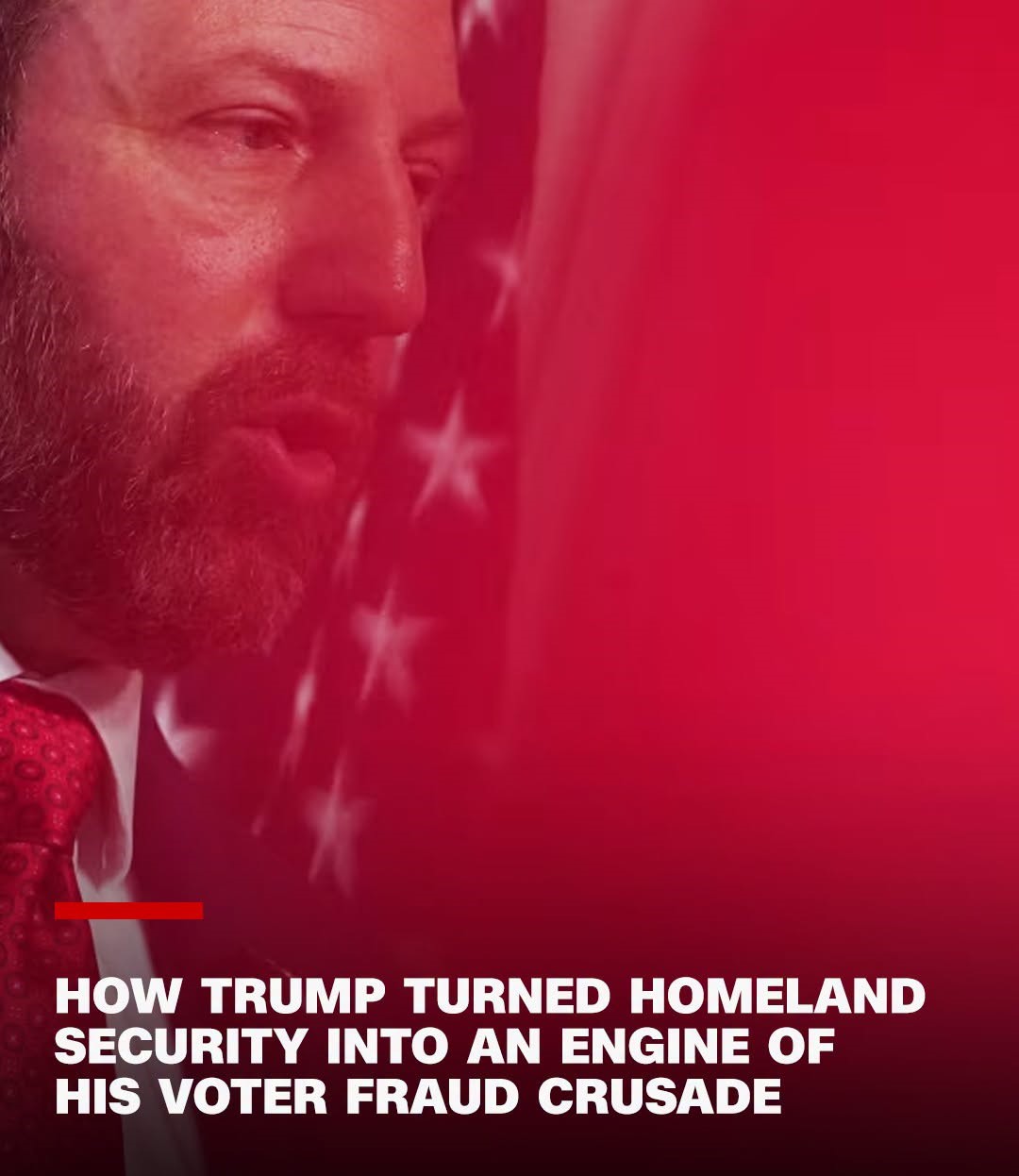
DHS Takes a Larger Role in Trump’s Election-Fraud Campaign]
Since Markwayne Mullin became secretary of the Department of Homeland Security in March 2026, the agency has taken a much more prominent role in President Donald Trump’s campaign to strengthen election security and investigate what the administration describes as vulnerabilities in the nation’s voting system.
Mullin, a former Republican senator from Oklahoma and longtime Trump ally, was sworn in as DHS secretary on March 24, replacing Kristi Noem. His appointment placed him at the head of one of the federal government’s largest agencies, with responsibilities ranging from border security and immigration enforcement to cybersecurity, disaster response and counterterrorism.
But elections have increasingly become part of that portfolio.
The development is significant because elections in the United States are primarily administered by states and local governments. Federal officials have traditionally played important supporting roles, particularly in cybersecurity and protection against foreign interference, but direct federal involvement in voter-list administration has long been politically sensitive.
Under Mullin, DHS has moved more aggressively into that debate.
The administration argues that stronger federal involvement is necessary to ensure that only eligible citizens participate in federal elections. Critics counter that the administration is expanding federal authority into an area traditionally controlled by states while relying on data that may contain errors.
At the center of the controversy is the administration’s effort to identify potential noncitizens on state voter-registration lists.
In July, Mullin announced that DHS had identified large numbers of people it said might be noncitizens appearing on voter rolls in several states. The administration subsequently cited a combined figure of roughly 250,000 potential noncitizens across California, Pennsylvania, New Jersey and Nevada.
The wording is important.
Being identified as a potential noncitizen on a voter list does not necessarily mean that the individual illegally voted. A person can appear on a voter-registration database because of outdated records, mismatched information, database errors or problems with how government systems compare records.
That distinction has become one of the central arguments surrounding the administration’s claims.
State election officials have challenged some of DHS’s findings and requested more information about how the department reached its conclusions. Officials in Nevada and California, for example, have questioned the methodology and reliability of the data used by the federal government.
The controversy goes beyond statistics.
It raises a fundamental question about the relationship between Washington and the states: How much authority should the federal government have over election administration?
Trump has made election integrity a major political issue throughout his career, particularly since the 2020 presidential election. He has repeatedly argued that the American election system contains serious vulnerabilities, while numerous election officials and courts have rejected claims that widespread fraud changed the outcome of the 2020 election.
Mullin has attempted to frame his approach somewhat differently.
During his confirmation process, he said his focus would be on making future elections more secure rather than simply revisiting the past. In July, he similarly argued that the current effort was about examining what happened and preventing similar problems from occurring again.
Nevertheless, his leadership has placed DHS directly in the middle of the administration’s broader election campaign.
The agency’s expanded role began taking shape even before Mullin formally took office. During his confirmation hearing, senators questioned him about whether DHS personnel could become involved in investigations related to the 2020 election.
Senator Ruben Gallego questioned Mullin about reports that Homeland Security Investigations agents had been diverted to investigate allegations concerning the 2020 election in Arizona. Mullin said he was not familiar with everything done by his predecessor but argued that reviewing past problems could help strengthen future elections.
The issue became even more controversial because Mullin had previously voted against certifying the 2020 election results and had supported Trump’s claims about election irregularities.
During his confirmation hearing, Senator Elissa Slotkin pressed Mullin about who won the 2020 presidential election. Rather than directly answering the question, Mullin emphasized his responsibility to ensure that future elections are fair and trusted.
Those exchanges foreshadowed the conflict that would later emerge.
Supporters of the administration say the federal government has a legitimate responsibility to protect elections from fraud and foreign interference. They argue that checking voter rolls is a basic safeguard and that citizens should have confidence that election systems are accurate.
Mullin has repeatedly presented the issue in those terms.
He has said election security should not be a partisan question and that Americans, regardless of political affiliation, should be confident that their votes count.
Critics see the situation differently.
They worry that aggressive federal investigations could undermine public confidence rather than strengthen it, particularly if inaccurate voter databases are used to identify eligible voters as suspicious.
A bipartisan group of senators warned DHS in April about the potential consequences of using inaccurate or outdated citizenship information. The lawmakers specifically raised concerns about the administration’s efforts to create state-level citizenship lists and warned that flawed data could potentially result in eligible voters being disenfranchised.
The dispute also involves funding.
Mullin has warned states that they could face consequences if they refuse to participate in federal election-security requirements. Reports have described the administration’s efforts to make certain security measures conditions for receiving or being reimbursed for federal election-related funding.
That approach has intensified the disagreement between Washington and state officials.
State governments maintain that they already have systems for maintaining voter rolls and preventing ineligible voting. They argue that errors are regularly corrected through established procedures and that the federal government should not use questionable data to pressure states into changing their election systems.
The Trump administration, meanwhile, argues that existing safeguards are insufficient.
This disagreement is likely to become even more important as the 2026 midterm elections approach.
The question of whether federal immigration and homeland-security agencies could appear at polling locations has already generated controversy. Mullin has said DHS personnel would only be present if a specific security threat required their involvement, rather than for routine immigration enforcement or voter intimidation.
That distinction is crucial.
American voters generally expect polling places to be safe and orderly environments where people can cast ballots without fear. The presence of federal law-enforcement officers could reassure some voters if there were a genuine emergency, but critics fear that unnecessary deployments could intimidate voters or create the perception that federal authorities are monitoring political participation.
Mullin’s challenge is therefore much larger than simply investigating voter databases.
He must balance the administration’s desire for aggressive election-security measures with constitutional questions, federalism, data accuracy and public trust.
At the same time, DHS has numerous other responsibilities demanding the secretary’s attention. Mullin is overseeing immigration enforcement, border operations, disaster preparedness, cybersecurity and counterterrorism. His department is also facing political pressure from both supporters and opponents of the administration.
The election issue has consequently become another major test of his leadership.
For Trump, however, election integrity remains one of the administration’s defining political themes.
The president has repeatedly argued that the country needs stronger safeguards and greater verification. By placing DHS at the center of those efforts, the administration has transformed an agency traditionally associated with homeland security and immigration into an increasingly visible participant in the national debate over voting.
Whether that strategy ultimately strengthens public confidence remains uncertain.
The administration will point to investigations, data reviews and new security requirements as evidence that it is taking election vulnerabilities seriously. Critics will continue demanding proof that alleged problems represent actual illegal voting rather than database errors or administrative mistakes.
That distinction could determine how the public interprets the entire campaign.
There is a major difference between finding someone who appears on a voter list but is not eligible to vote and proving that person actually cast an illegal ballot. There is also a difference between identifying weaknesses in an election system and demonstrating that those weaknesses were exploited on a scale large enough to change an election outcome.
As DHS expands its role, those distinctions will likely receive increasing attention.
Markwayne Mullin has made clear that he believes election security belongs among the government’s most important responsibilities. His supporters say he is confronting vulnerabilities that have been ignored for too long. His critics fear that DHS is being drawn into a political campaign built around claims that remain disputed or unsupported.
Either way, the department’s involvement represents a significant change in the political landscape.
The coming months will show whether Mullin can convince states and the public that DHS’s expanded role is about protecting elections rather than controlling them.
And as the 2026 midterms approach, the debate will become even more consequential.
For millions of Americans, the central question is simple: Can they trust the election system?
For Mullin and the Trump administration, the answer increasingly depends on whether they can persuade the country that stronger federal intervention will make elections more secure without undermining the very trust they say they are trying to restore.