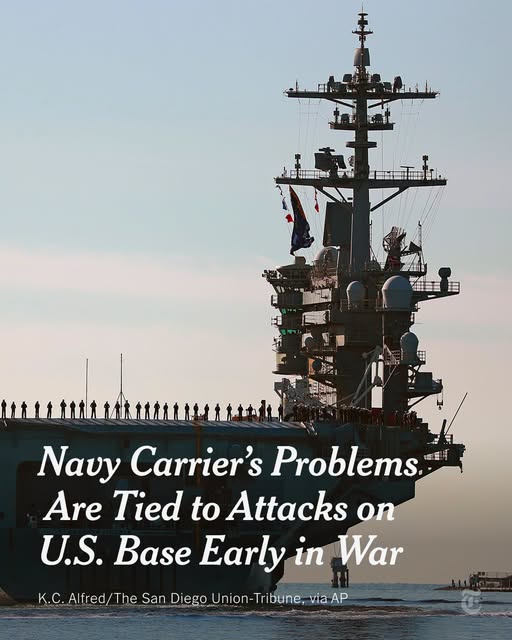
The USS Abraham Lincoln’s Long War at Sea: How 5,000 Sailors Were Pushed to the Limit
For the roughly 5,000 sailors and Marines aboard the USS Abraham Lincoln, the problems did not begin months into their deployment. They began almost immediately after the United States entered the war with Iran.
What was supposed to be a military deployment became an extraordinary test of endurance. The aircraft carrier has spent more than 250 consecutive days at sea, supporting U.S. military operations in the Middle East while its crew faced long working hours, limited opportunities to leave the ship and growing concerns about supplies, maintenance and mental health.
The Abraham Lincoln is designed to operate for long periods away from home. That is part of what makes an aircraft carrier such a powerful military platform. Thousands of people live and work aboard the ship, aircraft operate from its deck, and the carrier can remain at sea while supporting combat operations thousands of miles from the United States.
But even a ship built for endurance has limits.
According to reports from sailors’ families and military publications, the Lincoln’s unusually long deployment has placed significant pressure on the crew. Families have described shortages involving food and water, disruptions to mail, long working days and limited opportunities for rest. The ship has also gone an unusually long time without the port visits that normally provide crews with replenishment, maintenance and a break from life aboard the carrier.
For sailors, the absence of a predictable return date can be particularly difficult.
A deployment is easier to endure when service members know when they are going home. In this case, however, the Lincoln’s mission continued far beyond the schedule originally expected.
The carrier left San Diego in November 2025. Its deployment was originally expected to end in May 2026, but it was extended as U.S. military operations involving Iran continued. By August, the crew had spent more than eight months continuously deployed, setting a modern record for consecutive days at sea.
That extraordinary length of time has raised questions about the physical and psychological condition of the sailors.
One of the most serious concerns involves mental health.
Military Times reported that multiple sailors aboard the carrier had attempted to go overboard during the extended deployment, according to family members. In one reported incident, a sailor’s shipmate intervened and pulled the individual back onto the deck before they went over the side.
The Navy has not provided a precise number of sailors who have attempted to go overboard or engaged in self-harm during the deployment.
Navy officials have emphasized that the ship has mental-health resources available, including counselors, chaplains and medical professionals. The Navy has also said leadership is continually assessing the psychological readiness of its personnel.
Still, the reports from families have created serious concern.
Families say some sailors have struggled with exhaustion, isolation and uncertainty. Communication between sailors and relatives has also reportedly been difficult at times, adding another layer of stress for people who are already separated from their loved ones.
For a sailor’s family, receiving only occasional communication can be frightening.
They may know that their loved one is serving aboard a warship involved in military operations, but they may not know exactly what conditions are like on the ship. They cannot simply visit the carrier or check on the sailor in person.
That uncertainty can become overwhelming.
The physical environment also presents challenges.
An aircraft carrier is essentially a floating city. Thousands of people require food, fresh water, medical care, sanitation, spare parts, fuel and other supplies. Under normal circumstances, port visits and logistics networks help maintain those systems.
But the war disrupted those arrangements.
Reports indicate that attacks on U.S. facilities in the region damaged important logistical infrastructure, including facilities associated with the U.S. Fifth Fleet in Bahrain. That forced the Navy to find alternative ways of supporting the Lincoln and meeting the basic needs of its crew.
This illustrates an important reality of modern warfare: the battlefield is not limited to the place where missiles or aircraft are launched.
Logistics matter.
A carrier can have aircraft, weapons and thousands of highly trained personnel, but those people still need food, water, medical support and replacement equipment.
When the surrounding infrastructure is damaged, the effects can eventually reach the ship itself.
The Abraham Lincoln’s situation therefore became more complicated as the war continued.
At the same time, the carrier remained an important part of the U.S. military presence in the region.
That created a difficult balance for military leaders. The ship needed to remain operational because of its strategic importance, but the people aboard it also needed adequate rest and support.
Typical carrier deployments can last six to nine months, although wartime circumstances can extend them. The Lincoln’s deployment has gone substantially beyond its expected schedule.
The growing controversy eventually reached Washington.
Democratic lawmakers called for greater scrutiny of conditions aboard the carrier. Senator Richard Blumenthal raised concerns about reports involving food, sanitation, medical care and the mental health of sailors.
Defense Secretary Pete Hegseth, however, rejected descriptions of the ship’s conditions as severely deteriorating, saying reports had been “completely misrepresented.” The Navy has also defended its support systems and emphasized the dedication of the crew.
President Donald Trump took an even more dismissive position regarding the length of the deployment.
On August 14, Trump said the carrier’s more than 260-day mission was “not nearly long enough.” He also said the ship would be replaced.
For families worried about their loved ones, however, the question is not simply how long the Navy believes the carrier can remain at sea.
The question is how long the sailors can continue operating under those conditions.
The Navy has begun preparing for the Lincoln to be relieved by another carrier, the USS George Washington. The replacement is intended to allow the Lincoln and its crew to return after an exceptionally long deployment.
That relief may bring enormous emotional significance for the crew.
Coming home after months at sea is more than simply reaching a port.
It means seeing family members again.
It means sleeping in a familiar place.
It means having access to normal routines that are impossible aboard a carrier.
For sailors who have spent months watching the ocean, the first sight of home can represent the end of an exhausting chapter.
Yet the experience aboard the Lincoln will likely remain an important case study for the U.S. Navy.
The deployment raises questions about how military forces should manage prolonged wartime operations, how crews should receive mental-health support, and how much strain can reasonably be placed on sailors when strategic circumstances require a ship to remain deployed.
It also highlights the human side of military power.
A carrier may look like an enormous machine from the outside. Its aircraft, radar systems, weapons and propulsion systems represent extraordinary technological capability.
But inside are thousands of human beings.
They become tired.
They worry about their families.
They need food and water.
They need medical treatment.
They need rest.
And they need to know that eventually they will be allowed to go home.
The Abraham Lincoln’s extended deployment demonstrates what happens when those human needs collide with the demands of a major military operation.
The sailors have continued doing their jobs despite the extraordinary circumstances. They have operated aircraft, maintained equipment, stood watches and supported U.S. operations in a dangerous region.
Their endurance is a significant part of the story.
But endurance should not mean that concerns are ignored.
The reports surrounding the Lincoln have prompted an important national conversation about the responsibilities of military leadership toward the people who serve.
As the USS George Washington prepares to replace the Lincoln, attention will turn toward bringing the carrier’s crew home safely.
After more than eight months at sea, thousands of sailors and Marines are waiting for that moment.
They have spent months serving their country far from their families.
Now, perhaps more than anything else, they are waiting for the simplest thing a sailor can hear:
It is time to come home.