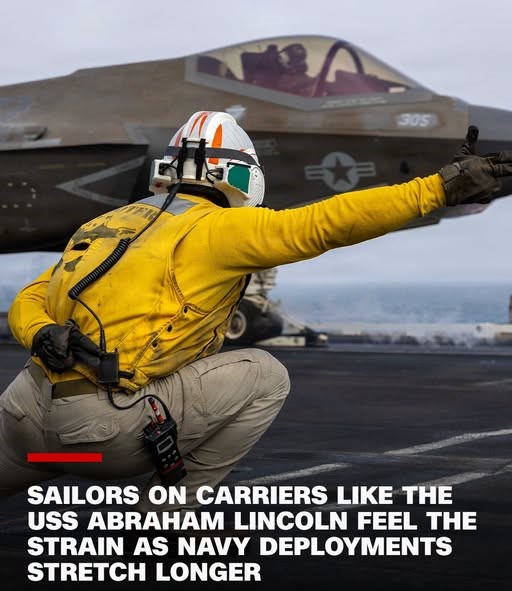
USS Abraham Lincoln Faces Record-Setting Deployment as Sailors Struggle With Morale and Mental Health Concerns
The USS Abraham Lincoln has become the center of growing concern inside the U.S. Navy after spending an extraordinary length of time at sea without a major port visit.
The aircraft carrier, carrying roughly 5,000 sailors and Marines, has been deployed for more than eight months and has spent more than 250 consecutive days at sea. What began as a demanding military mission has developed into a serious test of endurance for the people aboard the ship.
The Lincoln was originally scheduled for a deployment of roughly seven months. Instead, the ship remained at sea as the United States became increasingly involved in military operations connected to Iran.
For the sailors aboard, the uncertainty has been particularly difficult.
A normal deployment is already demanding. Service members spend months away from their families, work long shifts and live in a confined environment. But sailors can generally expect periodic port visits, opportunities to communicate with loved ones and a clear understanding of when their deployment is expected to end.
The Lincoln’s current mission has disrupted much of that routine.
Reports from family members and military news organizations describe concerns about shortages of supplies, plumbing problems, water issues, delayed mail and deteriorating morale. Families have told officials that some sailors are exhausted and increasingly worried about their mental health.
The most troubling reports involve sailors attempting to go overboard.
Military Times reported that multiple sailors aboard the carrier had attempted to go overboard during the extended deployment, although the Navy has not provided a precise number of incidents or confirmed all of the accounts publicly. Navy officials have said that psychological readiness is being continuously assessed and that counselors, chaplains and medical professionals are available aboard the ship.
For families waiting thousands of miles away, those reports have been deeply frightening.
Some relatives have questioned whether the prolonged deployment has gone too far and whether sailors are receiving everything they need to remain physically and emotionally healthy.
The concerns eventually reached senior Navy officials.
Family members participated in meetings with Navy leadership and described their worries about the conditions aboard the carrier. The conversations reportedly included concerns about mental health, supplies and the extraordinary length of the deployment.
The controversy has also reached Congress.
Lawmakers have demanded greater information about the conditions aboard the Lincoln, particularly regarding food, sanitation, medical care and the psychological wellbeing of the crew.
But Navy and Pentagon officials have pushed back against some of the most serious descriptions.
Defense Secretary Pete Hegseth said reports about poor conditions aboard the carrier had been “completely misrepresented.” The Navy has similarly emphasized that the crew continues to receive support and that leadership is monitoring sailors’ wellbeing.
That disagreement has created two very different pictures of life aboard the ship.
One picture comes from official military leadership, which says sailors are being supported and that the carrier remains operational despite the unusual circumstances.
The other comes from family members and reports from military publications, which describe exhaustion, declining morale and serious concerns about living conditions.
Both perspectives are important when trying to understand what is happening.
There is no question that aircraft carriers are designed to remain at sea for extended periods. The USS Abraham Lincoln is a nuclear-powered carrier built specifically to operate far from home and support military operations around the world.
But an aircraft carrier is also a community.
Thousands of people live aboard the ship. They need food, water, medical care, sanitation, spare parts and regular opportunities to communicate with their families.
When a ship stays at sea for an unusually long period, maintaining those systems becomes more difficult.
Port visits normally provide an opportunity to replenish supplies, conduct maintenance and give sailors some time away from the ship. Without those visits, the crew has fewer opportunities to reset physically and mentally.
The psychological effects can be particularly serious.
Military experts have warned that long deployments with uncertain end dates can create intense stress. Sailors may become increasingly isolated from their families while working long hours in a confined environment.
The problem is not simply being away from home.
It is not knowing exactly when you will return.
That uncertainty can make an already difficult deployment feel endless.
For the Lincoln’s crew, the situation has been further complicated by the fact that the carrier is operating in a wartime environment.
The ship is not merely conducting routine exercises. It has been supporting U.S. military operations in the Middle East during a period of heightened tensions involving Iran.
That means sailors have had to maintain operational readiness while dealing with the pressures of an unusually long deployment.
Every aircraft launch requires preparation.
Every maintenance task matters.
Every watch must be staffed.
Every system has to function.
There is little room for exhaustion to affect performance.
Yet sailors are human beings, and prolonged stress can eventually affect anyone.
The Navy therefore faces a difficult challenge: maintaining military readiness while protecting the health and wellbeing of the people who make that readiness possible.
The situation has also raised questions about the broader strain on the U.S. Navy.
The United States has only a limited number of aircraft carriers, and each ship requires enormous resources to operate. When one carrier remains deployed far beyond its expected schedule, other ships may have to adjust their own schedules.
Maintenance can also become more complicated.
Ships need periodic repairs and inspections. Aircraft require maintenance. Sailors need rest between deployments.
Keeping a carrier continuously operational can therefore have consequences that extend beyond a single ship.
The Navy now appears to be preparing for the Lincoln to be relieved.
The USS George Washington is being sent toward the region to replace the Abraham Lincoln, allowing the Lincoln and its crew to eventually leave the demanding deployment.
For the sailors aboard the Lincoln, that replacement could be enormously significant.
After months at sea, returning to port would mean more than ending a military assignment.
It would mean seeing parents, spouses, children and friends again.
It would mean stepping onto solid ground.
It would mean sleeping without the constant movement of the ocean.
And it would mean finally knowing that the deployment is over.
President Donald Trump, however, recently dismissed concerns about the length of the Lincoln’s mission, saying its more than 260-day deployment was “not nearly long enough.” Trump also indicated that the ship would eventually be replaced.
His comments have added another dimension to the controversy.
For military families already concerned about their loved ones, the debate is not simply about how many days a carrier can technically remain at sea.
It is about what those days mean for the people living aboard it.
A military mission can be strategically important while still placing enormous pressure on service members.
Those two realities can exist at the same time.
The Lincoln’s sailors have continued performing their duties despite the challenges. They have maintained aircraft, operated complex weapons systems, stood watches and supported military operations in a dangerous part of the world.
Their professionalism is a major reason the carrier has remained operational.
But the reports surrounding the deployment also demonstrate why military readiness must include the wellbeing of personnel.
A ship cannot operate effectively forever if its crew is exhausted.
As the USS George Washington prepares to relieve the Lincoln, attention will remain focused on the condition of the sailors and Marines who have spent so many months away from home.
Their experience may eventually become an important lesson for the Navy.
How long should a carrier remain deployed?
How should crews receive mental-health support during prolonged combat operations?
How can supplies and maintenance be maintained when port visits become impossible?
And perhaps most importantly, how can military leaders balance strategic necessity with the human cost of extended deployments?
There are no simple answers.
But one thing is clear: behind the massive hull, aircraft and advanced weapons of the USS Abraham Lincoln are thousands of people.
They are sailors and Marines.
They are parents, children, spouses, friends and loved ones.
They volunteered to serve their country, but they are not machines.
After more than 250 days at sea, their record-setting deployment has become a reminder that military strength is ultimately built on people.
And those people need support, rest and the knowledge that, eventually, they will be coming home.