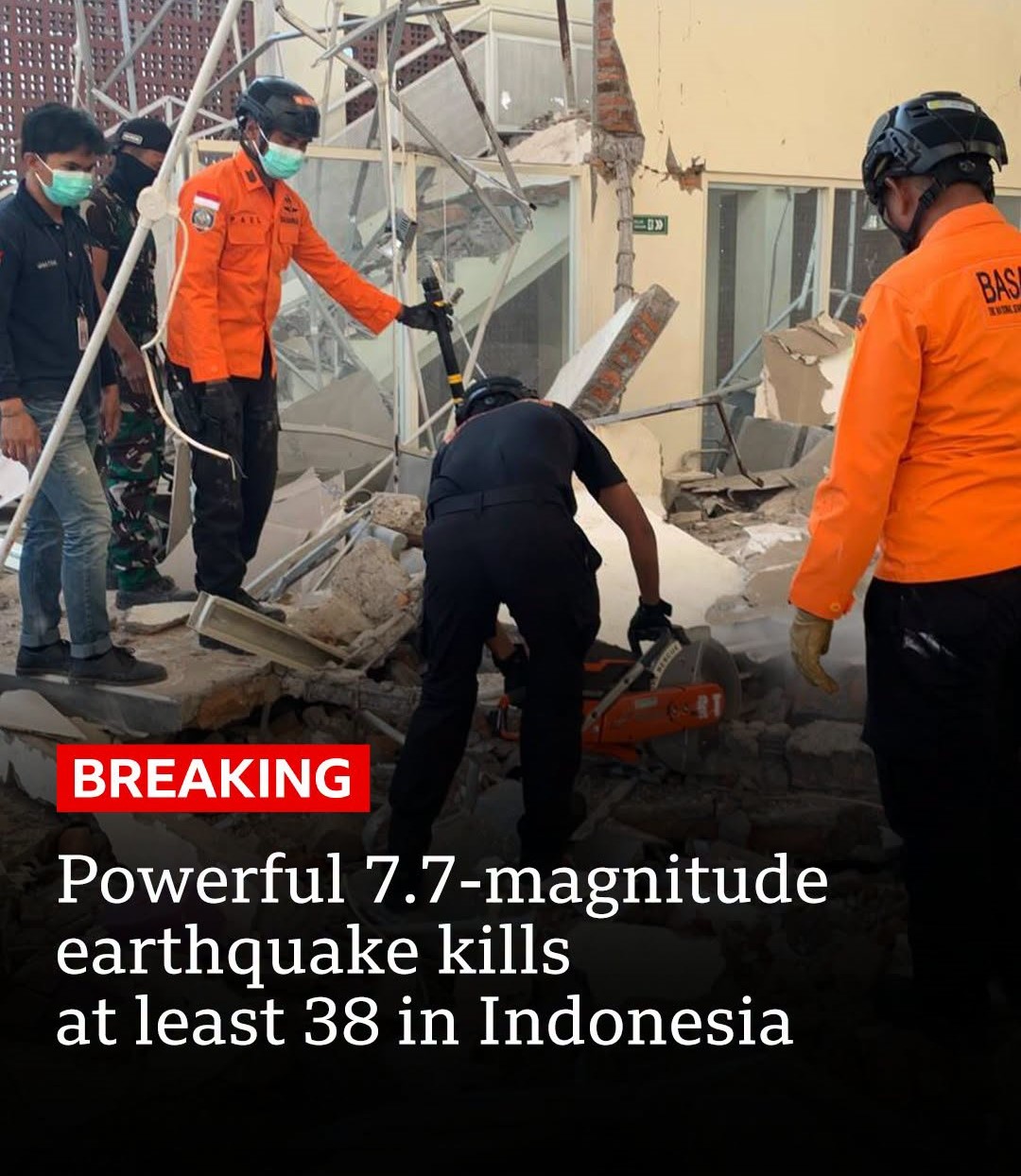
At Least 38 Killed After Powerful 7.7-Magnitude Earthquake Strikes Indonesia
At least 38 people were killed after a powerful magnitude 7.7 earthquake struck eastern Indonesia early Saturday, August 15, 2026, according to the country’s National Disaster Management Agency, known as BNPB. The earthquake struck off Flores Island in East Nusa Tenggara, causing buildings to collapse, triggering landslides and sending thousands of residents fleeing their homes.
The disaster unfolded shortly before 5 a.m. local time, when many residents were still asleep or preparing to begin their day. The powerful shaking was felt across several parts of East Nusa Tenggara, with reports describing people rushing into the streets as buildings shook and debris began falling.
Authorities initially reported a much lower death toll, but the number increased rapidly as rescue teams reached damaged communities and recovered victims from collapsed structures. By Saturday afternoon, BNPB chief Suharyanto said at least 38 people had been confirmed dead. Two people were seriously injured and another 11 suffered minor injuries, according to the agency.
The death toll remained a developing figure as emergency workers continued searching damaged areas.
Communities Hit Hard
Several areas on Flores Island were severely affected, including Sikka, Manggarai and East Manggarai. The epicenter was near Nagekeo Regency, an area where access quickly became one of the biggest challenges facing rescuers.
Landslides blocked roads, communications were disrupted and some communities were difficult to reach. Emergency officials said teams attempting to reach Nagekeo encountered major obstacles, forcing rescuers to consider alternative routes, including travel by ferry.
The damage was widespread.
Preliminary assessments found homes, schools, health facilities, government buildings and other structures damaged or destroyed. Reuters reported that more than 150 homes were heavily damaged, while additional buildings suffered moderate or lighter damage.
In some communities, residents were afraid to return home because aftershocks continued.
That fear was understandable.
After a major earthquake, damaged buildings can become even more dangerous when additional tremors occur. Walls that survived the initial shaking can collapse later, while landslides can affect roads and communities that initially escaped serious damage.
Thousands Evacuated
Around 2,000 residents in Nagekeo reportedly evacuated their homes and moved toward safer locations. Many people chose to remain outside or in temporary shelters because they were worried that another strong earthquake could strike.
The evacuation created another challenge for emergency authorities: providing people with shelter, food, water and medical assistance while rescue operations were still underway.
Hospitals in affected areas also faced difficult circumstances.
Some medical facilities had to move patients outside because of concerns about structural damage. Doctors and nurses continued treating injured people while authorities assessed whether buildings remained safe.
For many residents, the safest place after the earthquake was not necessarily inside a building.
It was outside, surrounded by family members and neighbors, waiting for the ground to stop shaking.
Tsunami Warning Issued
The earthquake initially triggered a tsunami warning.
Authorities urged people near coastal areas to move away from the shoreline while officials monitored the possibility of dangerous waves. The warning was later lifted after officials determined that the tsunami threat had diminished.
Small tsunami waves were recorded in some locations, with reports indicating that waves remained relatively limited. The warning nevertheless added another layer of fear to an already terrifying situation.
For people who had just experienced a powerful earthquake, the possibility of a tsunami meant that they could not simply focus on damaged homes or injured relatives.
They also had to think about getting to higher ground.
Thousands moved away from coastal areas as a precaution.
Aftershocks Continue
The initial earthquake was followed by numerous aftershocks.
Some were strong enough to cause additional concern among residents and rescuers. Reuters reported that dozens of aftershocks shook the region, including one measuring approximately magnitude 6.1.
Aftershocks can make rescue operations extremely dangerous.
Firefighters and soldiers searching collapsed buildings must work carefully because additional shaking can cause unstable structures to fall. Rescuers may have to stop working temporarily when the ground begins moving again.
For families waiting for missing relatives, every delay can feel unbearable.
But rescuers must protect themselves too.
A rescue worker injured inside a damaged structure becomes another person who needs help.
A Country Familiar With Earthquakes
Indonesia is one of the world’s most earthquake-prone countries because it sits along the Pacific Ring of Fire, a highly active zone where tectonic plates meet.
Earthquakes and volcanic eruptions occur frequently across the Indonesian archipelago.
The country has experienced some of the world’s most devastating seismic disasters.
In 2004, a massive earthquake off Sumatra triggered a tsunami that killed hundreds of thousands of people across the Indian Ocean region. In 2018, a powerful earthquake and tsunami devastated Palu on Sulawesi, killing thousands.
Those memories remain deeply embedded in the national consciousness.
When a strong earthquake strikes Indonesia, residents understand that the danger may not be over when the first shaking stops.
There can be aftershocks.
There can be landslides.
There can be structural collapses.
And, depending on the location, there can be tsunami risks.
Rescue Efforts Continue
Emergency agencies have mobilized to search for survivors, assess damage and provide assistance to affected communities.
Rescue teams have been particularly challenged by damaged roads and landslides. Some areas near the epicenter have been difficult to reach, slowing the collection of information about casualties and destruction.
This means the reported death toll could change.
In major disasters, initial figures are often incomplete because authorities cannot immediately reach every affected community. Some people may remain trapped beneath rubble, while others may be unable to communicate because electricity and telecommunications systems have been damaged.
As roads reopen and rescue teams reach isolated communities, authorities can develop a clearer picture of the disaster.
For now, the priority is finding survivors.
Families Waiting for News
Behind every number in the death toll is a family.
Some families are searching for relatives who have not answered their phones. Others are waiting outside hospitals. Some have already received devastating news.
The emotional impact of an earthquake continues long after the physical shaking ends.
People who survive may lose their homes, businesses or possessions. Children may become frightened by every aftershock. Elderly residents may struggle to leave damaged buildings. Families may suddenly find themselves living in temporary shelters.
Communities also face the difficult task of rebuilding.
The immediate rescue effort is only the first stage.
After survivors are found and the injured are treated, authorities will need to assess damaged infrastructure, restore electricity and communications, clear roads and provide longer-term housing for people who cannot safely return home.
A Disaster Still Unfolding
The magnitude 7.7 earthquake has already become one of the most serious disasters Indonesia has faced this year.
But the full scale of the damage was still being assessed Saturday.
Officials continued collecting information from affected districts while rescue teams worked to reach areas isolated by landslides and damaged roads.
The situation also remained complicated by additional seismic activity.
Later on Saturday, another strong earthquake struck western Sumatra, thousands of kilometers from the Flores region. Initial reports did not immediately indicate comparable damage from that separate event.
The simultaneous earthquakes served as another reminder of the enormous geographic and geological challenges Indonesia faces.
For the people of Flores and surrounding areas, however, the focus remains much closer to home.
They are looking for missing loved ones.
They are helping injured neighbors.
They are clearing rubble.
They are trying to determine whether their houses are safe.
And they are waiting for the ground to become quiet again.
Hope Amid the Destruction
Natural disasters often produce heartbreaking images of destruction, but they also reveal extraordinary acts of courage.
Firefighters enter unstable buildings searching for survivors.
Neighbors help elderly residents escape.
Medical workers continue treating patients despite damaged facilities.
Soldiers and volunteers transport people away from dangerous areas.
Ordinary residents provide food and shelter to strangers.
These actions become especially important during the first hours after a disaster, when professional rescue resources may not yet have reached every community.
The coming days will be critical for Indonesia.
Authorities must continue searching for survivors, supporting displaced residents and assessing the damage.
The death toll of at least 38 is already devastating, but officials have warned that assessments are still underway.
As rescue teams move deeper into the affected areas, more information will emerge.
For the families waiting for news, every minute matters.
For those who survived, the road ahead will be difficult.
And for the communities of Flores and East Nusa Tenggara, recovery will take time.
The earthquake struck suddenly, in the early hours of Saturday morning, changing thousands of lives in seconds.
Homes that had stood for years were damaged.
Families were separated.
Roads were blocked.
People ran into the streets fearing another collapse.
But amid the devastation, rescue workers continue searching.
Their mission is simple:
Find the survivors. Treat the injured. Protect the displaced. And bring hope to those still waiting.
Indonesia’s 7.7-magnitude earthquake is a developing disaster, and authorities continue to assess casualties and damage as emergency operations proceed.