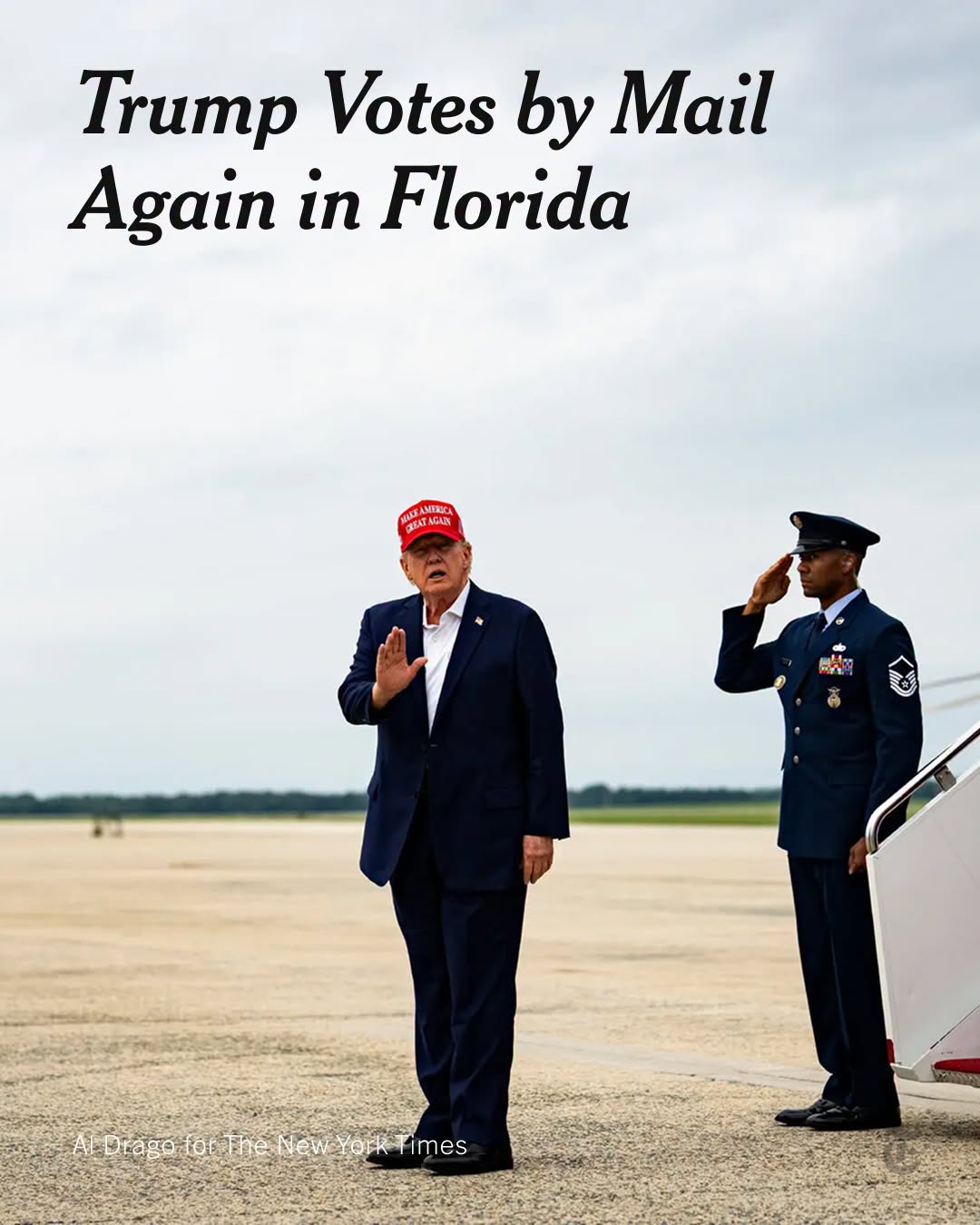
Trump Votes by Mail Despite Years of Criticism … Read More
President Donald Trump’s decision to vote by mail in Florida’s Republican primary has reignited a debate over one of the most controversial issues in American elections: whether voting by mail is a legitimate convenience or a vulnerability that should be heavily restricted.
According to the White House, Trump submitted a mail ballot ahead of Tuesday’s Florida Republican primary. Reports citing voting records indicate that he requested the ballot in late July and returned it on August 13. This was at least the third time Trump has voted by mail, including a 2020 ballot and another mail ballot earlier this year.
The development attracted attention because Trump has spent years criticizing widespread mail-in voting. He has repeatedly argued that mail ballots are vulnerable to fraud and has supported major restrictions on their use.
The White House, however, says there is no contradiction.
A White House spokesperson defended Trump’s decision by pointing out that the president is a Florida resident while spending most of his time in Washington, D.C. The administration has also argued that its proposed voting legislation would allow certain exceptions for people who are traveling, ill, disabled, or serving in the military.
The controversy is therefore about more than one ballot.
It raises a broader question about consistency in election policy.
For years, Trump has encouraged stricter rules surrounding mail voting while emphasizing the importance of voting in person. He has also pushed legislation that would significantly reduce the use of no-excuse mail voting nationwide.
Earlier this year, Trump signed an executive order aimed at tightening federal rules surrounding mail ballots. Federal courts have blocked parts of that effort, and the administration has sought further intervention from the Supreme Court.
Yet Trump’s own circumstances demonstrate why voting systems often contain exceptions.
The president is frequently in Washington because of his responsibilities at the White House. His Florida residence remains his voting address, creating a practical situation in which voting by mail can be more convenient than traveling to Florida solely to cast a ballot.
Palm Beach County itself says that any registered voter can request a vote-by-mail ballot for an election, subject to the state’s rules and deadlines. The county also requires voters to personally cast their ballots and sign the required voter certificate.
That distinction is important.
Voting by mail is not automatically evidence of fraud.
Like in-person voting, mail voting operates under procedures designed to verify voters and ballots. States establish different requirements for requesting, returning, and counting those ballots.
Trump’s critics argue that his decision exposes a contradiction between his personal behavior and his political rhetoric.
Supporters argue that his situation is different from what he describes as universal mail voting. They point to the president’s residence in Florida and his extensive time in Washington as reasons why using a mail ballot is reasonable.
The disagreement reflects a much larger political battle.
Mail voting became especially controversial after the 2020 presidential election. Trump repeatedly questioned the integrity of mail ballots and connected them to his claims about the election. Since then, voting procedures have become one of the defining political issues in the United States.
Republicans and Democrats have often approached the issue differently, although attitudes toward mail voting are not completely divided along party lines.
Florida itself has long allowed voters to cast ballots by mail. The state’s Republican leadership has nevertheless supported tighter rules concerning identification, ballot handling, and election administration.
The current controversy comes at an important political moment.
Florida’s Republican primary includes a closely watched race for governor, with Trump endorsing Congressman Byron Donalds. The winner of the Republican primary will compete in November to succeed term-limited Governor Ron DeSantis.
That makes Trump’s participation particularly significant for his political movement.
Trump remains one of the most influential figures in the Republican Party, and his endorsement can have enormous consequences in Republican primaries.
But the mail-ballot controversy creates an unusual image: a president who is actively promoting restrictions on mail voting using the same voting method himself.
For many critics, that is the central issue.
They argue that if mail voting is inherently unreliable, Trump should not use it.
For Trump’s supporters, however, the argument is different. They say the administration’s position has never been that every mail ballot is fraudulent. Instead, Trump and his allies have argued that widespread, universal mail voting creates opportunities for fraud and should therefore be limited, while certain exceptions should remain available.
That distinction is now receiving renewed attention.
The situation also demonstrates how complicated election policy can become when political statements meet real-life circumstances.
A person may oppose a broad policy while still using an exception to that policy.
The question is whether the exception is legitimate and whether the rules are applied consistently.
For voters, the most important issue is ultimately whether ballots are counted according to established law and whether voters can trust the process.
Florida election officials have detailed procedures governing vote-by-mail ballots, including deadlines, signatures, ballot tracking, and verification.
The Trump controversy is unlikely to end the national debate over mail voting.
Instead, it may intensify it.
As the 2026 midterm elections approach, questions surrounding voter identification, ballot security, mail voting, election administration, and federal authority are likely to remain major political issues.
Trump’s decision to vote by mail has therefore become symbolic of a much bigger conflict.
One side sees mail voting as a convenient and legitimate way for eligible citizens to participate.
The other sees widespread mail voting as a system that requires substantially greater safeguards.
And Trump himself now sits directly in the middle of that debate.
His ballot will be counted according to Florida’s election rules. But the political argument surrounding that ballot is likely to continue long after Tuesday’s primary is over.
For Trump, it was simply a way to participate in a Florida election while primarily living and working in Washington.
For his critics, it is another example of what they see as a contradiction between his personal actions and his public campaign against widespread mail voting.
For his supporters, it is an example of why exceptions exist.
Whatever interpretation voters choose, one fact is clear: Trump’s mail-in ballot has once again put America’s long-running debate over voting by mail in the national spotlight.
Read More