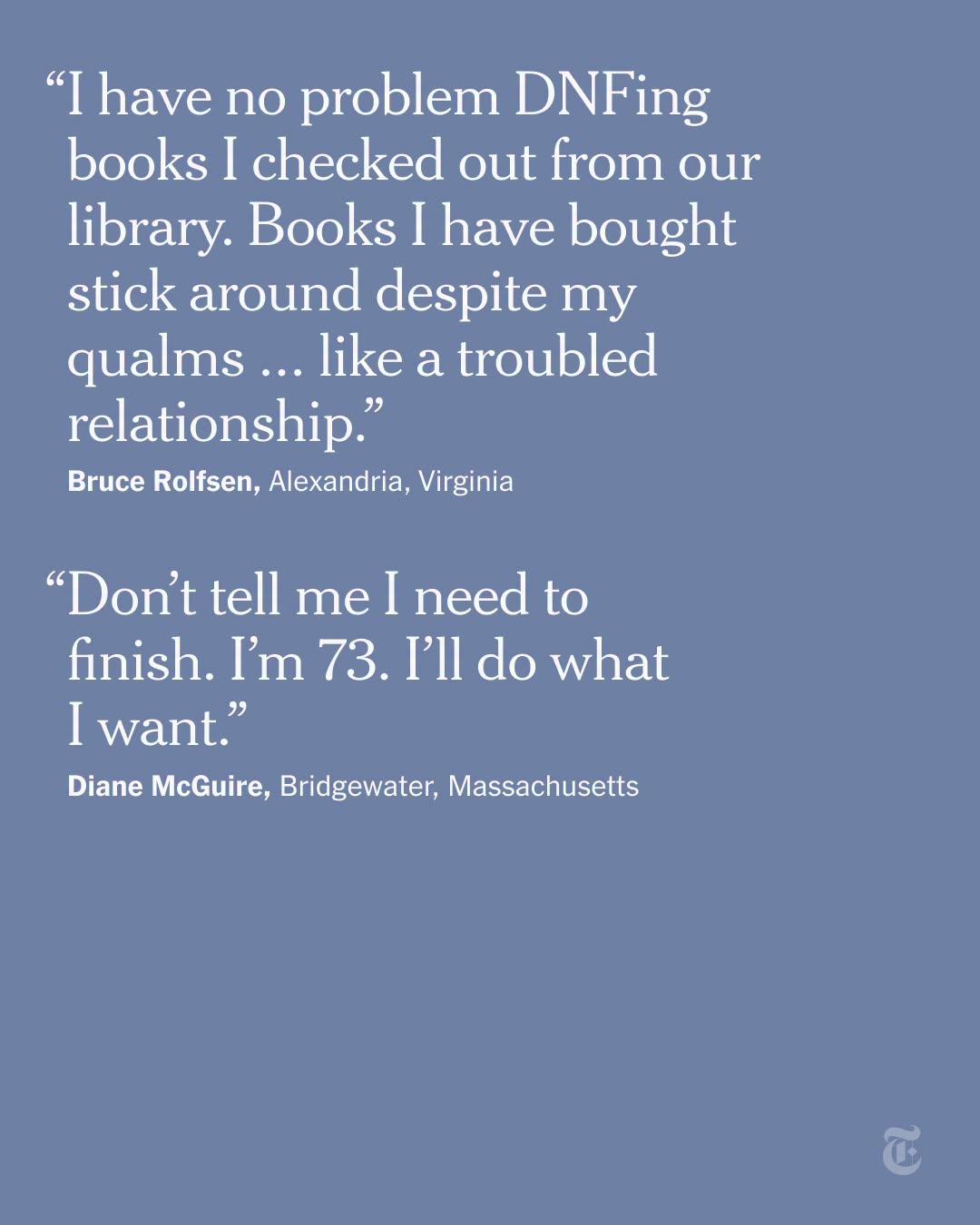
When a Book Isn’t Worth Finishing … See More
For many readers, finishing a book has always felt like a rule.
You start it, you invest your time in it, and somehow you feel obligated to reach the final page—even when the story is no longer interesting, the writing is frustrating, or the experience simply is not worth the hours required to continue.
But reading does not have to work that way.
Sometimes the smartest decision a reader can make is to close the book.
The growing popularity of “Did Not Finish,” or DNF, reflects a simple idea: your reading time is valuable.
There are thousands of books waiting to be discovered. Nobody has unlimited time to read them all. So why spend ten more hours struggling through a book you stopped enjoying after the first hundred pages?
For years, readers often kept their abandoned books private. They might remove a book from their reading list, leave it unfinished on a nightstand, or quietly move on to something else.
Now, the decision not to finish can become part of the reading conversation.
And that can be surprisingly liberating.
A book can be highly praised and still not be right for you.
It can win awards.
It can appear on bestseller lists.
Friends can recommend it enthusiastically.
Millions of people can love it.
And you can still decide:
“This isn’t for me.”
That does not necessarily mean the book is bad.
It may simply mean that the timing is wrong.
Maybe you are not interested in the subject anymore. Maybe the writing style does not connect with you. Maybe the characters feel uninteresting. Maybe the story moves too slowly. Maybe you expected something completely different.
Reading is personal.
The same book that keeps one person awake until two in the morning can leave another person staring at the clock.
That is one reason DNF culture has become so interesting.
Readers are increasingly comfortable admitting that they stopped.
And sometimes, the reasons are surprisingly funny.
A book might have an intriguing beginning but become repetitive halfway through.
Another might introduce twenty characters before you can remember their names.
A mystery might take so long to reveal its central secret that you lose interest before the answer arrives.
A romance might have chemistry that simply does not convince you.
A nonfiction book might promise a groundbreaking idea but repeat the same argument for hundreds of pages.
And sometimes, a book just arrives at the wrong moment.
You may have loved it five years ago.
Today, you cannot get through it.
There is nothing wrong with that.
Our reading tastes change as we change.
The books we love at one stage of life may not be the books we need at another.
That is another important lesson behind the DNF conversation: abandoning a book is not abandoning reading.
In fact, it can sometimes make you a better reader.
When you stop forcing yourself through books you dislike, you have more time to discover books you love.
Instead of spending three weeks trying to finish something that feels like homework, you can pick up another book and immediately rediscover why you enjoy reading.
You might discover a new favorite author.
You might find a story that completely changes your perspective.
You might encounter a character you never forget.
That experience is worth protecting.
Of course, there is also an argument for patience.
Some books are slow at the beginning.
Some novels require time before their characters become meaningful.
Some complicated nonfiction works take several chapters before their central argument becomes clear.
If you abandon everything after ten pages, you might miss something wonderful.
That is why there is no universal DNF rule.
Some readers stop after fifty pages.
Others give a book one hundred pages.
Others finish half the book before deciding they have had enough.
The right decision depends on the reader and the book.
The important thing is that reading should not become a punishment.
You are allowed to stop.
You are allowed to change your mind.
You are allowed to say, “I gave this a chance, and it isn’t working for me.”
That freedom can make reading more enjoyable.
There is also something refreshing about readers sharing their honest opinions.
When people talk about books they did not finish, they are revealing something about their own preferences.
One reader may abandon a long fantasy novel because it contains too much world-building.
Another may love exactly that feature.
One reader may stop a thriller because it is too violent.
Another may consider the same intensity the best part.
One person may find a literary novel beautifully written.
Another may call it slow and confusing.
These disagreements are part of what makes reading communities interesting.
There is no single universal reading experience.
The conversation around DNF books also challenges the idea that finishing everything is automatically an achievement.
Sometimes we confuse completion with value.
We think that because we started something, we must finish it.
But life is full of choices.
We constantly decide what deserves our limited time.
Books are no different.
Finishing a book you hate does not necessarily make you a better reader.
Choosing a better book might.
There is another benefit to being comfortable with DNF: it can help readers explore more widely.
If you know you are allowed to stop, you may be more willing to experiment.
You might try a new genre.
You might pick up an unfamiliar author.
You might read outside your usual comfort zone.
And if you don’t like it?
Move on.
There is another book waiting.
That mindset turns reading into exploration instead of obligation.
It also removes some of the guilt surrounding books.
Many readers have shelves filled with books they intended to read.
They bought them because the covers looked interesting.
Someone recommended them.
They saw a glowing review.
They received them as gifts.
Then months passed.
Nothing happened.
That is okay too.
A personal library does not have to be a checklist.
Reading is not a race.
You do not need to finish a certain number of books to prove that you are a serious reader.
You do not need to read every bestseller.
You do not need to like the books everyone else likes.
Your reading life belongs to you.
Perhaps that is the most important idea behind the DNF movement.
It gives readers permission to make their own choices.
Some books will stay with you forever.
Others will disappear from your memory.
Some will make you laugh.
Others will make you cry.
Some will teach you something.
Others will simply entertain you for a few hours.
And some will make you say, “Nope. I’m done.”
There is nothing wrong with that.
The next book might be exactly what you were looking for.
So if you are currently struggling through a book that feels more like a chore than a pleasure, ask yourself a simple question:
If I weren’t already reading this, would I choose to start it today?
If the answer is no, maybe it is time to turn the page—not to the next chapter, but to the next book.
Because there are too many stories waiting.
Too many ideas waiting.
Too many authors waiting to surprise you.
Your reading time is limited.
Use it on books that give you something back.
And if a book does not?
You have permission to close it.
Did Not Finish does not mean Did Not Try.
Sometimes it simply means you chose your time wisely.
See More