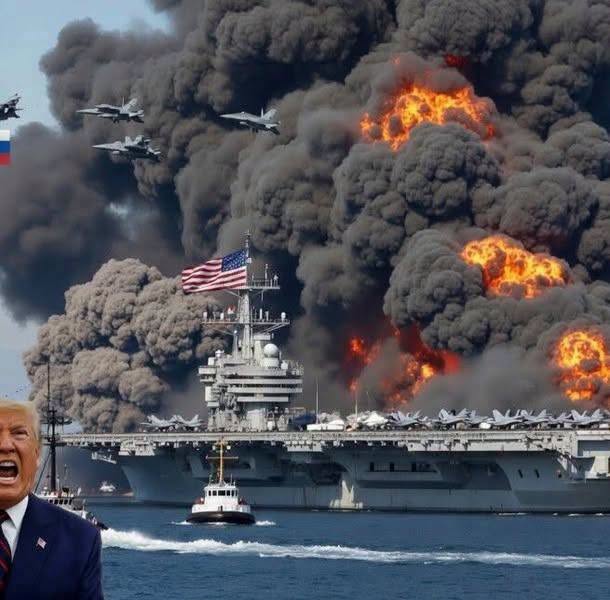
Russian Su-57 Pilot Destroys U.S. Aircraft Carrier Carrying 700 Tanks… See More
A dramatic headline claiming that a Russian Su-57 pilot destroyed a U.S. aircraft carrier carrying 700 tanks has been circulating online, attracting enormous attention because of its extraordinary details. But before treating the claim as breaking news, there is an important distinction to make: there is no credible evidence confirming that this attack actually happened.
Recent searches found versions of the same sensational headline appearing on multiple websites, but those reports do not provide reliable official confirmation of a destroyed U.S. carrier. One version explicitly notes that there is no credible evidence supporting the alleged attack.
The story is a good example of how modern military misinformation can spread.
The headline contains almost every element needed to create an immediate emotional reaction: a Russian stealth fighter, an American aircraft carrier, hundreds of tanks, and the suggestion of a devastating military confrontation.
But a dramatic headline is not the same thing as verified evidence.
If a U.S. aircraft carrier were actually destroyed by a Russian fighter, it would represent an extraordinarily serious international incident. Such an event would almost certainly receive extensive attention from governments, defense ministries, major international news organizations, and military analysts around the world.
Instead, the material currently circulating appears to be connected to sensationalized online content rather than confirmed reporting.
There is another major problem with the claim: the idea that a U.S. aircraft carrier was carrying 700 tanks does not fit the normal role of an aircraft carrier.
Aircraft carriers are enormous warships designed primarily to operate aircraft. Their internal spaces are dedicated to aviation operations, fuel, weapons, maintenance, crew facilities, and other equipment required to support an air wing.
Large numbers of tanks are normally transported using specialized military cargo vessels, roll-on/roll-off ships, amphibious vessels, or other logistics platforms.
One report examining the viral claim specifically points out that the “700 tanks” detail is inconsistent with the normal purpose and design of an aircraft carrier.
That detail alone should make readers pause.
The Su-57 is a real Russian fifth-generation fighter aircraft. It is designed for missions involving air superiority, ground attack, reconnaissance, and other combat roles. But the existence of the aircraft does not prove that it carried out the specific attack described in the viral headline.
This distinction is important.
A real weapon can appear in a fictional story.
A real military vehicle can appear in an unrelated video.
A genuine photograph can be presented alongside a completely false claim.
And a realistic computer simulation can look surprisingly similar to real combat footage.
In fact, one online video associated with the exact headline has been identified as an ARMA 3 military simulation, rather than footage of an actual Russian attack.
That is a critical detail for anyone encountering videos connected to the story.
Military simulation games can create extremely convincing scenes involving aircraft, ships, missiles, explosions, and battlefield operations. When short clips are removed from their original context and presented alongside dramatic captions, viewers may mistakenly believe they are watching real events.
This is one reason sensational military stories spread so rapidly online.
The headline says “13 minutes ago.”
That wording creates urgency.
It encourages people to click immediately rather than stop and investigate.
The reader may think, “If I don’t watch this now, I will miss the biggest story of the day.”
But urgency should never replace verification.
When a major military incident supposedly happens, readers should look for confirmation from credible sources. Official military statements, established international news organizations, satellite imagery, independently verified photographs, and multiple unrelated reports can provide useful evidence.
A single social-media post is not enough.
A video without a verified location and date is not enough.
A dramatic thumbnail is not enough.
And repeating a claim thousands of times does not make it true.
This particular story demonstrates how easily the internet can blur the boundary between entertainment and reality.
The online ecosystem contains military simulations, fictional scenarios, AI-generated images, old footage, training exercises, movies, video-game clips, and genuine battlefield recordings. Without context, these materials can be extremely difficult for casual viewers to distinguish.
The consequences of believing false military reports can also be serious.
A fabricated story about one country destroying another country’s major warship can generate fear, anger, and political arguments. People may share the story with friends and family believing they are helping others stay informed.
Instead, they may unknowingly contribute to misinformation.
That does not mean every unusual military story is false. Real events can be shocking, and genuine military incidents sometimes happen before complete information becomes available.
The correct approach is simply to separate what is confirmed from what is claimed.
At present, the dramatic claim that a Russian Su-57 pilot destroyed a U.S. aircraft carrier carrying 700 tanks should be treated as unverified rather than established fact. Searches for the claim did not produce credible confirmation from authoritative sources.
That doesn’t make the underlying technology uninteresting.
The Su-57 itself remains an important part of Russia’s military aviation program. U.S. aircraft carriers also remain among the world’s most sophisticated military platforms. Their capabilities, defenses, aircraft, sensors, and supporting ships are subjects of extensive military analysis.
But understanding those real capabilities is very different from accepting an unsupported viral story.
The phrase “700 tanks” is especially effective because it creates a dramatic mental picture. It suggests that one strike destroyed an enormous amount of military equipment in a single moment.
Yet the more extraordinary a claim becomes, the more evidence it requires.
That is a useful rule for the modern information age:
The bigger the claim, the stronger the evidence should be.
Before sharing a shocking military headline, ask a few simple questions.
Who originally reported it?
Can the source identify where and when the event happened?
Are there independent reports?
Has an official government or defense organization confirmed it?
Does the video come from a verified source?
Could the footage be from a simulation, exercise, older conflict, movie, or video game?
And do the details of the story actually make sense?
These questions can prevent people from accidentally spreading false information.
The most important thing is not to become the first person to share a breaking story.
It is to become the person who shares accurate information.
In a world where dramatic headlines can reach millions of people within minutes, patience is a powerful tool.
The viral claim about a Russian Su-57 destroying a U.S. aircraft carrier carrying 700 tanks may sound like the beginning of a massive international crisis.
But based on the evidence currently available, it is better understood as an unverified and highly sensational claim, with related video material tied to military simulation content.
The truth matters more than the headline.
And when national security, war, and human lives are involved, checking the facts before pressing “share” is more important than ever.