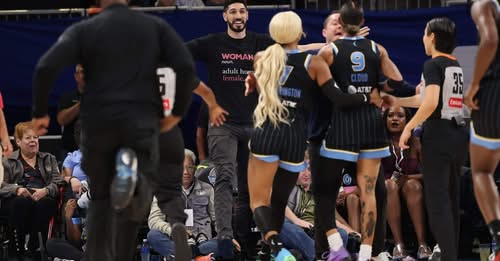
Enes Kanter Freedom Escorted Out of WNBA Game After Heated Courtside Confrontation — See More
What began as a highly anticipated WNBA matchup in Chicago suddenly became the center of a heated controversy when former NBA player Enes Kanter Freedom was escorted out of Wintrust Arena during Sunday night’s game between the Chicago Sky and Indiana Fever.
Freedom was seated courtside wearing a shirt that displayed the words, “WOMAN: adult human female.” His presence and message immediately attracted attention because he has become an outspoken participant in the ongoing debate over transgender athletes and women’s sports.
The situation escalated during the third quarter after Chicago Sky guard Natasha Cloud became involved in a verbal exchange with Freedom. According to multiple reports, the confrontation intensified before security personnel intervened and removed the former NBA center from the arena.
The incident was particularly striking because it occurred during a game that already carried plenty of attention surrounding Indiana Fever star Caitlin Clark and the Chicago Sky.
As cameras captured the developing confrontation, players and people nearby became aware of what was happening. Freedom eventually left his seat and security escorted him away from the arena.
The exact sequence of words exchanged between Freedom and Cloud has been described differently in reports, and the two sides have offered their own perspectives about what happened. Freedom later discussed the incident publicly, saying that he believed he had been removed for expressing his support for women.
Cloud, meanwhile, did not give reporters an extensive account of the confrontation after the game. Sky coach Tyler Marsh expressed support for his player while emphasizing the importance of protecting the team and maintaining focus.
The controversy quickly spread beyond the arena because Freedom has spent years making outspoken statements about political, social and human-rights issues.
During his NBA career, Freedom played for several teams, including the Utah Jazz, Oklahoma City Thunder, New York Knicks, Portland Trail Blazers and Boston Celtics. He was selected third overall in the 2011 NBA Draft and ultimately played 11 seasons in the league.
After his basketball career, however, his public profile increasingly became connected with activism.
Freedom became particularly known for criticizing governments and organizations over issues involving freedom of speech and human rights. He has also become one of the more vocal figures in the debate surrounding biological sex and transgender participation in women’s sports.
That background helps explain why Sunday’s appearance attracted so much attention.
His shirt was not an accidental fashion choice.
It communicated a position.
And Freedom’s presence at the game came at a time when questions about gender eligibility in women’s sports have become increasingly controversial.
Freedom has even announced plans to declare himself eligible for the 2027 WNBA Draft, arguing that the league’s current policies raise questions about eligibility and gender identity. Reports say former NBA player Royce White has also discussed a similar challenge.
The WNBA, however, has never had a transgender woman compete in an official game, and the league has continued to operate under its existing policies.
That makes Freedom’s campaign as much a political and cultural statement as a basketball story.
For supporters, his actions represent a willingness to challenge institutions and speak publicly about women’s sports.
For critics, his presence and behavior at the game represented an attempt to provoke controversy and disrupt a professional sporting event.
The disagreement illustrates just how emotionally charged the subject has become.
Sports have traditionally been places where competition, identity and fairness intersect. Questions about eligibility can therefore produce passionate reactions from athletes, fans and commentators.
But Sunday’s incident demonstrated another important issue: regardless of what someone believes, confrontations inside a sporting arena can quickly become disruptive.
Security personnel ultimately decided that Freedom needed to leave.
The removal itself became one of the biggest stories surrounding the game.
Instead of the evening being remembered solely for basketball, the confrontation dominated social-media discussion.
Video clips circulated widely, with viewers debating who started the exchange, what was said and whether Freedom should have been removed.
Some supporters argued that he was exercising free speech.
Others argued that free speech does not give a spectator the right to disrupt an event or engage in a confrontation with players.
Those two arguments are not necessarily contradictory.
A person can express a political or social opinion while still being expected to follow the rules of a private sporting venue.
That distinction is important when examining what happened.
Freedom’s shirt itself was a statement. Wearing it was an expression of his views. But reports indicate that the reason he was ultimately escorted away involved the confrontation that followed, rather than simply the existence of the shirt.
The situation also placed Natasha Cloud in an uncomfortable position.
Cloud is an experienced WNBA player and has previously spoken openly about social issues. Her supporters praised her for standing up for herself, while critics questioned whether the confrontation should have happened during the game.
The Sky organization largely avoided allowing the controversy to overshadow the basketball itself.
That may have been intentional.
Professional athletes already deal with enormous pressure. Every game involves preparation, competition, media attention and expectations from fans. A confrontation in the stands can quickly become a distraction for an entire team.
For the Indiana Fever, the game itself was significant.
Indiana ultimately defeated Chicago 113-90, according to reports.
But the final score was almost immediately overshadowed by the dramatic incident involving Freedom.
That is perhaps the most remarkable part of the story.
One moment, thousands of fans were watching professional basketball.
The next, cameras were focused on a former NBA player being escorted from the building.
The episode also demonstrates the unusual position Freedom occupies today.
He is no longer an active NBA player, but his name remains familiar to basketball fans. His transition from professional athlete to activist has kept him in the public spotlight, even years after his final NBA appearance.
His willingness to enter controversial political and cultural debates has earned him passionate supporters as well as equally passionate critics.
Sunday’s incident is therefore unlikely to be the final chapter.
Freedom has already indicated that he intends to continue challenging the status quo.
Whether people agree with him or not, his strategy is clear: use public appearances, interviews and social media to keep attention focused on the issues he considers important.
The WNBA, meanwhile, will likely continue attempting to keep the focus on the game itself.
That tension between sports and politics is nothing new.
Athletes have been using sports platforms to express political opinions for decades. Some have been praised for their courage. Others have faced criticism for bringing controversial subjects into sporting environments.
What makes the Freedom incident different is that the confrontation occurred directly between a former male professional basketball player and an active WNBA player in the middle of a game.
That made the moment unusually personal and highly visible.
For fans watching from home, it became another example of how quickly a sporting event can turn into a national conversation.
The larger debate over transgender participation in women’s sports is unlikely to disappear anytime soon. There are arguments involving fairness, inclusion, competitive advantages, eligibility standards and individual rights.
People hold deeply different opinions on those questions.
But whatever position someone takes, incidents like Sunday’s confrontation show why these discussions require careful handling.
A basketball arena should ultimately remain a place where athletes can compete without being subjected to unnecessary disruption.
At the same time, spectators will continue to bring their beliefs into public spaces.
Finding the balance between expression and acceptable conduct will remain a challenge.
For Enes Kanter Freedom, being escorted out of Wintrust Arena has now become another highly public moment in a career that has increasingly moved beyond basketball.
For Natasha Cloud, the incident became an unexpected distraction during a professional game.
And for the WNBA, it became another reminder that the league exists at the intersection of sports, culture and politics.
One thing is certain: the images of Freedom being escorted from the arena will continue to generate debate long after Sunday’s final buzzer.
Some will see the incident as an example of censorship.
Others will see it as a necessary response to disruptive behavior.
And many will simply wonder how a basketball game became the setting for such a dramatic confrontation.
Whatever conclusion people reach, the story has already moved far beyond the court.
See more 👇