Nepal’s Economic Boom Meets a Devastating Natural Disaster — See More
A region in northern Nepal that has been experiencing growing economic activity and increasing connections with China is now facing one of its most devastating disasters in recent memory.
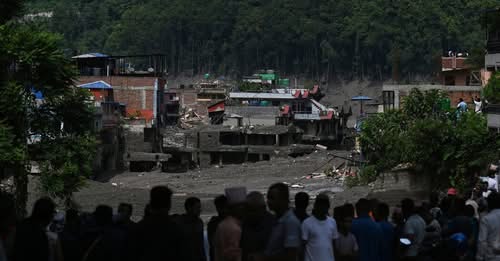
On Wednesday, August 26, catastrophic flash floods swept through communities along the Nepal-Tibet border, killing at least 160 people across Nepal and Tibet while leaving hundreds of others missing. Entire settlements were inundated, roads and bridges were destroyed, and crucial power infrastructure was damaged.
The disaster struck in an area where economic development and cross-border trade have become increasingly important. The rugged Himalayan landscape has traditionally made transportation difficult, but improved roads, hydropower projects, tourism infrastructure and connections with China have helped transform parts of the region.
That development has brought opportunities—but it has also increased the amount of infrastructure and economic activity exposed to the dangers of the mountains.
The latest disaster demonstrates just how quickly nature can overwhelm even rapidly developing communities.
A Wall of Water and Debris
The flooding was extraordinarily destructive because it was not simply a conventional rainstorm flood.
Current investigations indicate that a large section of Himalayan glacier collapsed, sending enormous quantities of ice, rock, mud and water into a river valley. The resulting debris flow moved with tremendous force through the mountainous terrain. Reuters reported that the event produced a powerful surge along the Lhende Khola and Bhote Koshi river systems.
At first, the event was reportedly mistaken for an earthquake because the collapse generated a seismic signal. Later analysis indicated that the tremor was associated with the glacial collapse itself.
The consequences were immediate.
Buildings were engulfed.
Vehicles were swept away.
Bridges disappeared beneath torrents of mud and water.
Roads that connected communities were destroyed.
And people living near the river had very little time to escape.
Officials reported that around 19 bridges and roughly 40 kilometers of roads were washed away in Nepal.
A Region Built Around Opportunity
Northern Nepal has long been shaped by its geography. The mountains attract trekkers, pilgrims and tourists from around the world, while border crossings provide important connections for trade.
The region around Rasuwa, in particular, has become economically significant because of its proximity to Tibet and the Gyirong border crossing.
Tourism is another major source of economic activity.
Mountains that once represented isolation now attract visitors seeking trekking adventures and religious pilgrimages. The broader Himalayan region has become an important destination for international travelers.
But the same geography that attracts tourists also creates enormous natural hazards.
Steep slopes, narrow valleys, glaciers, unstable rock formations and powerful rivers create conditions in which a single geological event can have consequences far beyond the original point of impact.
This week’s catastrophe showed that vulnerability in horrifying fashion.
Hundreds Still Missing
One of the most heartbreaking aspects of the disaster is the uncertainty surrounding the missing.
Nepali authorities initially reported hundreds of people unaccounted for, including foreign nationals. Across the border in Tibet, Chinese authorities also reported hundreds missing. Because communications were disrupted and people were traveling through the region, authorities have warned that the numbers could change as search teams establish who is safe.
Among those missing are tourists and pilgrims from several countries.
Some were traveling toward Mount Kailash, an important religious destination, while others were visiting or working in the region.
This has transformed the disaster from a local tragedy into an international emergency.
Governments have begun monitoring the situation and trying to determine whether their citizens are among those missing.
Why the Economic Boom Matters
It might seem strange to discuss economic growth in the middle of a disaster, but the connection is important.
Economic development can make communities more prosperous and improve people’s lives. Better roads allow farmers and businesses to reach markets. Hydropower projects provide electricity. Tourism creates jobs. Border trade supports local businesses.
But development also creates more infrastructure that can be damaged by extreme events.
A road built through a mountain valley can connect thousands of people—but if a landslide destroys it, the same community can suddenly become isolated.
A bridge can transform transportation—but a powerful flood can remove it in minutes.
Hydropower facilities can generate enormous amounts of electricity, but they are often located near rivers and steep terrain.
The latest disaster damaged power infrastructure badly enough to affect hundreds of megawatts of electricity generation.
That means the economic consequences will continue long after the floodwaters disappear.
Businesses may remain closed.
Transportation may be interrupted.
Families may lose homes and sources of income.
Tourism could decline temporarily.
And rebuilding roads, bridges and power facilities could require enormous financial resources.
Nepal’s Repeated Disaster Problem
This is not an isolated event.
Nepal regularly experiences floods and landslides, particularly during the monsoon season. A recent analysis published by the Kathmandu Post found that major weather-related disasters recorded between 2015 and 2025 caused thousands of deaths and affected millions of people.
The Himalayan environment makes the country especially vulnerable.
Heavy rainfall can rapidly raise river levels. Earthquakes can destabilize mountainsides. Landslides can block rivers before suddenly releasing huge quantities of water. Glaciers are also changing as temperatures rise.
Last year, a deadly flood affected the same broader Bhote Koshi region and disrupted a major bridge connecting Nepal and China. That event was linked to the draining of a glacial lake.
The repetition of disasters raises difficult questions about how communities can prepare for an increasingly unpredictable environment.
A Warning for the Future
Scientists have increasingly warned that climate change is affecting the Himalayan cryosphere.
Glaciers are retreating and thinning in many areas, while melting ice can contribute to unstable lakes and weakened mountain structures. Researchers say warming conditions can increase risks associated with glacial lake outburst floods, landslides and other hazards.
That does not mean every individual flood can be directly attributed to climate change.
Natural geological processes remain powerful.
But a warmer climate can alter the conditions in which those processes occur.
For Nepal, that creates an enormous challenge.
The country must continue developing economically while simultaneously strengthening disaster preparedness.
Early-warning systems can save lives.
Better mapping can identify communities at greatest risk.
Stronger bridges and roads can improve resilience.
Emergency communication systems can help people evacuate before floodwaters arrive.
And cooperation between Nepal, China, India and international organizations can become increasingly important when disasters cross borders.
The Human Cost Comes First
Behind the statistics are families waiting for news.
There are parents searching for children, communities looking for neighbors and rescue workers entering dangerous areas in hopes of finding survivors.
The scale of the destruction makes rescue operations extremely difficult. Roads have been destroyed, rivers remain dangerous and communication networks have been disrupted. Helicopters and emergency teams are being used where possible, but the terrain itself presents enormous obstacles.
For the people who live there, the economic story suddenly becomes secondary.
Homes matter more than markets.
Families matter more than infrastructure.
And finding survivors matters more than rebuilding statistics.
The economic boom that once represented opportunity is now confronting the harsh reality of Himalayan geography.
Nepal’s challenge will be to rebuild without simply restoring what existed before.
The next generation of roads, bridges, towns and power projects will need to account for the possibility of increasingly dangerous natural events.
The tragedy of August 26 is therefore more than a story about a flood.
It is a warning about the delicate balance between economic development and environmental risk.
A region can grow rapidly, attract tourists, expand trade and build new infrastructure—but none of those achievements can eliminate the power of nature.
For the survivors, the immediate priority is rescue and recovery.
For Nepal’s leaders, the longer-term priority will be resilience.
And for the world watching from outside the Himalayas, this disaster offers a sobering reminder that economic progress and climate vulnerability can exist side by side.
The mountains may provide enormous opportunities.
But they also demand enormous respect.