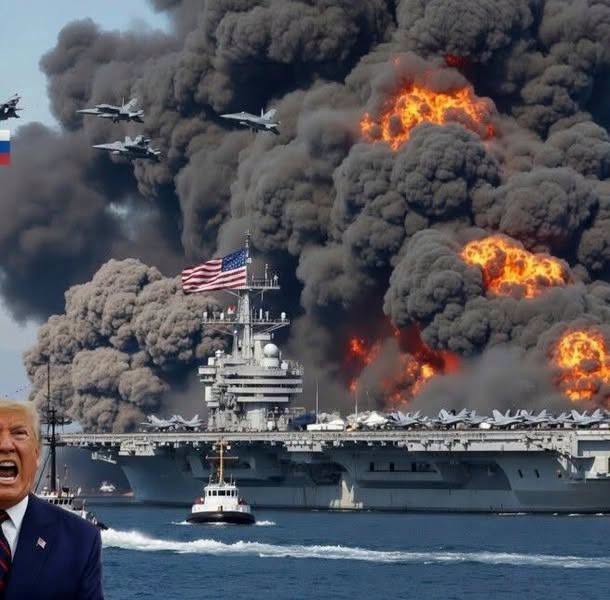
13 MINUTES AGO: RUSSIAN SU-57 PILOT DESTROYS U.S. AIRCRAFT CARRIER CARRYING 700 TANKS — WHAT WE KNOW
A dramatic headline claiming that a Russian Su-57 pilot destroyed a U.S. aircraft carrier carrying 700 tanks is spreading rapidly across social media.
The story sounds like the opening scene of a major international military crisis: a Russian stealth fighter, an American aircraft carrier, hundreds of tanks and a devastating strike supposedly occurring only minutes ago.
But there is a crucial problem.
There is currently no credible evidence confirming that this attack actually happened. Searches for the exact claim lead primarily to social-media posts and sensational websites rather than independent confirmation from major news organizations or official military authorities.
That distinction matters enormously.
THE HEADLINE SOUNDS REAL — BUT THE EVIDENCE IS MISSING
The phrase “13 minutes ago” is designed to create urgency.
It suggests that readers are witnessing a major event while it is still unfolding. People are naturally more likely to click, watch a video and share a post when they believe they are among the first to see breaking news.
But a timestamp attached to a social-media headline is not proof that an event occurred.
If a Russian fighter had actually destroyed a U.S. aircraft carrier, the consequences would be enormous.
It would not be an ordinary military incident.
It would potentially represent one of the most serious confrontations between Russia and the United States in modern history.
Such an event would almost certainly generate immediate attention from governments, defense officials, international news organizations and military analysts around the world.
At the time of writing, that confirmation is absent.
WHAT ABOUT THE “700 TANKS”?
There is another major warning sign in the headline.
It claims that the U.S. aircraft carrier was carrying 700 tanks.
That description does not fit the normal role of an aircraft carrier.
Aircraft carriers are enormous warships, but their primary purpose is to operate and support aircraft. Their internal spaces are designed around aviation operations, fuel, weapons, maintenance facilities, crew accommodation and other systems required to sustain an air wing.
Military tanks are generally moved using specialized cargo and logistics vessels, including roll-on/roll-off ships and other transport platforms.
That makes the “700 tanks aboard an aircraft carrier” detail particularly questionable.
The more extraordinary a claim becomes, the more evidence it requires.
THE SU-57 IS REAL
The aircraft mentioned in the headline is not fictional.
The Sukhoi Su-57 is a real Russian fifth-generation fighter aircraft.
It is designed for advanced combat missions and can carry air-to-air and air-to-surface weapons. The aircraft has become one of the most recognizable symbols of Russia’s modern military aviation program.
But the existence of the Su-57 does not establish that a particular pilot carried out the alleged attack.
That is an important distinction.
Real military equipment is frequently used in fictional stories, simulations and hypothetical scenarios.
A photograph of a real fighter can be paired with a completely false headline.
A video game can depict an aircraft destroying a warship.
A training exercise can be presented as combat footage.
And old footage can be reposted as if it happened today.
THE VIDEO CLAIM
One of the videos circulating alongside the exact headline has been identified in search results as a virtual game simulation, rather than authentic footage of a real Russian attack.
That is especially important.
Modern military simulations can look remarkably realistic.
They can include aircraft, missile launches, explosions, warships, smoke and battlefield environments that appear convincing when viewed for only a few seconds.
When a short clip is removed from its original context and combined with a dramatic breaking-news caption, viewers may reasonably—but incorrectly—assume they are watching genuine combat.
WHY STORIES LIKE THIS SPREAD SO QUICKLY
Military stories generate strong emotions.
A headline about a fighter destroying an aircraft carrier can trigger fear, excitement, anger or disbelief.
Those emotions encourage people to share content before checking it.
The wording also makes the story feel immediate.
“13 minutes ago.”
“Destroyed.”
“700 tanks.”
“Russian Su-57.”
Each phrase increases the drama.
But journalism works differently.
A legitimate breaking-news report needs evidence.
Where did the attack occur?
What carrier was involved?
Where was the carrier located?
Who confirmed the incident?
Are there satellite images?
Are there independent eyewitnesses?
Has the U.S. Navy issued a statement?
Has Russia acknowledged the operation?
Have established international news organizations independently verified the event?
Those questions currently have no convincing answers in the material circulating with this claim.
IF A U.S. CARRIER HAD REALLY BEEN DESTROYED
Imagine for a moment that the headline were true.
The event would have enormous international consequences.
A U.S. aircraft carrier is not simply another military vessel. It is the centerpiece of a carrier strike group and operates alongside other ships, aircraft and support assets.
Destroying one in combat would be an extraordinary military event.
It would trigger intense scrutiny over how the attack happened, what weapons were used, what defenses were involved and what happened to the crew.
Governments would immediately be assessing whether the incident was accidental, deliberate or part of a broader military confrontation.
Markets could react.
Diplomatic communications would intensify.
Military forces could be placed on higher alert.
The possibility of further escalation would become a major international concern.
That is precisely why such an event could not realistically remain confined to a handful of social-media posts.
THE IMPORTANCE OF WAITING FOR CONFIRMATION
None of this means genuine breaking news should be ignored.
Real military incidents do happen.
Sometimes the first reports are incomplete.
Sometimes official confirmation takes time.
But there is an enormous difference between “details are still being verified” and “a social-media post says it happened.”
The responsible approach is to wait for multiple credible sources.
Readers should be particularly careful with videos that do not show a verifiable location or date.
They should also be cautious when a story provides dramatic claims but no identifiable military unit, ship name, coordinates or official statement.
A REAL AIRCRAFT DOES NOT MAKE A FALSE STORY TRUE
This may be the most important lesson from the viral claim.
The Su-57 is real.
U.S. aircraft carriers are real.
Military conflicts are real.
Tanks are real.
Missiles are real.
But combining real objects does not automatically create a real event.
A fictional story can use nothing but real military equipment and still be completely false.
That is why verification matters.
WHAT READERS SHOULD WATCH FOR
If this story develops into a genuine incident, credible confirmation should eventually provide specific details.
Readers should look for information identifying:
- The name of the alleged U.S. carrier.
- The location of the incident.
- The date and time of the attack.
- The source of the original footage.
- Official statements from relevant military authorities.
- Independent reporting from multiple reputable news organizations.
- Evidence that the footage is authentic and not a simulation or recycled material.
Until those details appear, the safest conclusion is that the viral claim remains unverified.
THE BIGGER LESSON
The internet has made it possible for a sensational military story to reach millions of people within minutes.
That can be useful when genuine emergencies occur.
But it also creates opportunities for misinformation to spread at extraordinary speed.
A dramatic headline can travel around the world before anyone checks whether the event actually happened.
The best defense is simple:
Pause before sharing.
Look for independent confirmation.
Check the original source.
Question extraordinary details.
And remember that realistic-looking video is not automatically real.
THE BOTTOM LINE
The claim that a Russian Su-57 pilot has just destroyed a U.S. aircraft carrier carrying 700 tanks is not supported by credible evidence at this time.
The exact headline is circulating widely online, but available results point to social-media posts and sensational content rather than verified reporting. At least one video connected to the claim is explicitly described as a virtual military simulation.
So while the headline may sound like an extraordinary breaking-news event, readers should not treat it as confirmed fact.
The Su-57 is real.
The U.S. Navy’s aircraft carriers are real.
The military capabilities involved are real.
But this particular attack remains an unverified claim.
And until reliable authorities and independent news organizations confirm otherwise, the most responsible thing to say is simple:
The viral story is not confirmed.
See more