MORE THAN 1,000 MISSING AFTER CATASTROPHIC NEPAL-TIBET FLOODS
A devastating disaster has unfolded along the Himalayan border between Nepal and China’s Tibet region, where catastrophic flooding and mudflows have killed hundreds of people and left more than 1,000 missing.
Rescue teams are working through destroyed roads, collapsed bridges and enormous fields of mud and debris as they search for survivors. The disaster struck on August 26 after a glacial collapse triggered a powerful surge of water, mud and rock through communities on both sides of the border.
The scale of the destruction is becoming clearer by the hour.
According to the latest reports, at least 359 people have died in Nepal and three in Tibet, while more than 1,400 people are reported missing across the two regions.
The numbers remain fluid because communications have been disrupted and many affected communities are difficult to reach.
A SUDDEN WALL OF WATER AND MUD
The disaster began when a glacier collapsed high in the Himalayas.
The resulting mass of water, ice, mud and rock surged into river systems, producing an extraordinarily destructive flood.
Communities along the Nepal-China border were suddenly confronted with torrents powerful enough to sweep away buildings, roads, bridges and vehicles.
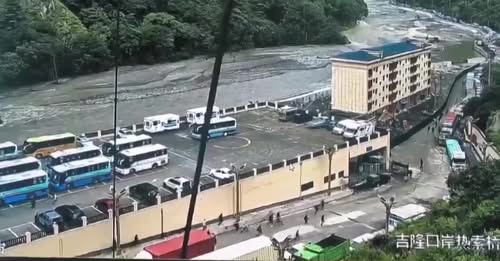
Videos and images emerging from the region show valleys covered in mud and debris.
Entire sections of infrastructure have disappeared.
For people caught in the flood, there was little time to react.
RESCUERS FACE AN ENORMOUS CHALLENGE
Rescue crews have been working through some of the most difficult terrain imaginable.
Military helicopters are being used to reach isolated areas and deliver supplies, while rescuers on the ground search through debris for survivors.
But damaged roads and destroyed bridges have made access extremely difficult.
The Red Cross has warned that entire communities have been cut off.
Hospitals are also facing enormous pressure as casualties are brought in and authorities attempt to identify recovered bodies.
Every hour matters.
People who survived the initial flood may still be trapped, injured or without food, clean water and medical assistance.
THOUSANDS OF FAMILIES WAITING FOR NEWS
Perhaps the most heartbreaking part of the disaster is the uncertainty facing families.
More than 1,000 people remain missing.
For relatives, a missing-person report is not the same as confirmation of death.
It means waiting.
It means checking phones repeatedly.
It means hoping for a message.
It means wondering whether a loved one may have reached higher ground or found shelter somewhere beyond the damaged communications network.
Among those missing are foreign nationals from numerous countries.
Nepalese authorities have reported hundreds of foreign tourists among the missing, including people from India, the United States, Australia, Britain and Canada.
PILGRIMS AND TOURISTS WERE IN THE REGION
The Himalayan border region is not only home to local communities.
It is also an important route for tourists and religious pilgrims.
Many people travel through the area toward Mount Kailash in Tibet, one of Asia’s most sacred pilgrimage destinations.
The flood therefore affected people who were traveling from around the world.
Families in distant countries are now waiting for information about relatives who had traveled to the Himalayas.
The international dimension of the disaster has made the rescue operation even more complicated.
Officials must coordinate information across borders while dealing with damaged infrastructure and difficult terrain.
A SECONDARY FLOOD THREAT
The danger may not be over.
One of the most worrying developments is the formation of a lake created when debris blocked the flow of a river.
As water accumulates behind such a natural barrier, there is a risk that it could suddenly fail.
If that happens, another powerful flood could surge downstream.
Authorities are monitoring the situation closely and warning communities about the possibility of further flooding.
That means rescuers are operating under extremely dangerous conditions.
They are not simply searching through the aftermath of one flood.
They must also consider whether another surge could occur.
WHY THE HIMALAYAS ARE SO VULNERABLE
The disaster has also renewed attention on the growing risks facing Himalayan communities.
The region contains enormous amounts of ice and snow stored in glaciers.
As temperatures rise, glaciers are becoming increasingly unstable in some areas.
Glacial collapses and glacial-lake outburst floods can release huge volumes of water with little warning.
The consequences can be catastrophic in narrow mountain valleys, where communities and infrastructure are concentrated along rivers.
The latest disaster demonstrates how quickly a natural event high in the mountains can become a humanitarian emergency hundreds of miles away.
ENTIRE COMMUNITIES CUT OFF
The destruction of transportation infrastructure is one of the biggest obstacles facing rescue workers.
Roads have been washed away.
Bridges have collapsed.
Communication systems have been damaged.
Some communities are effectively isolated.
Helicopters can reach certain locations, but aircraft cannot replace roads and bridges when thousands of people need assistance.
Food, water, medicine and other supplies must be delivered.
At the same time, injured people may need to be transported to hospitals.
The logistical challenge is enormous.
THE HUMAN COST BEYOND THE NUMBERS
It is easy to become overwhelmed by statistics.
Hundreds dead.
More than 1,000 missing.
Entire communities damaged.
But every number represents a person.
Someone’s parent.
Someone’s child.
Someone’s spouse.
Someone’s friend.
For families waiting for information, the statistics do not capture the emotional reality.
They are waiting for names.
They are waiting for phone calls.
They are waiting for confirmation that their loved ones are alive.
And for many, that uncertainty may continue for days.
INTERNATIONAL ASSISTANCE
The scale of the disaster has prompted international concern.
Governments and organizations are offering support as Nepal and China respond to the catastrophe.
The United States has said it has rescued some Americans and offered assistance, while governments including India and Australia have been monitoring the situation because citizens from their countries are among those missing.
The immediate priority is finding survivors.
The next priority will be providing shelter, medical treatment, food and clean water to people whose homes and communities have been destroyed.
Rebuilding roads and bridges will take much longer.
THE SEARCH CONTINUES
For rescuers, the coming hours are critical.
Teams are searching areas where people may have become trapped.
Helicopters are flying missions when weather and conditions allow.
Ground teams are working through mud and debris.
Officials are collecting information about missing people and attempting to reunite survivors with their families.
But the terrain remains dangerous.
Unstable slopes, blocked rivers and the possibility of additional flooding mean rescuers must constantly balance speed with safety.
A DISASTER STILL UNFOLDING
The true scale of the catastrophe may not be known for some time.
The number of missing people could change as communications are restored and survivors are located.
The death toll could also rise as rescuers reach previously inaccessible areas.
For now, authorities are focused on saving as many people as possible.
The world is watching a disaster that began with a glacial collapse but rapidly became a humanitarian crisis spanning an international border.
THE BOTTOM LINE
More than 1,000 people are missing across Nepal and Tibet after catastrophic floods swept through the Himalayan border region.
The latest reports put the confirmed death toll at more than 360 across Nepal and Tibet, while the number of missing people has climbed above 1,400 in some official and media tallies.
The disaster has destroyed homes, roads and bridges and left communities isolated.
Among the missing are large numbers of foreign tourists and pilgrims, adding an international dimension to an already enormous rescue operation.
For families waiting for news, the search is intensely personal.
Behind every missing-person report is someone desperately hoping that a loved one will be found alive.
And as rescuers continue searching the valleys, the entire region waits for answers.
This is a developing disaster, and the casualty and missing-person figures may continue to change as search teams reach more affected areas.
See more