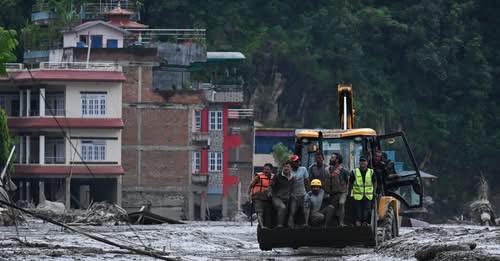
RESCUERS RACE TO REACH SURVIVORS AFTER DEVASTATING HIMALAYAN FLOODS
Rescuers and security forces in Nepal and China are racing against time to locate survivors and deliver urgently needed supplies to communities devastated by catastrophic flooding in the Himalayan border region.
The disaster has left a trail of destruction across remote valleys, with roads and bridges washed away, homes damaged or destroyed and entire communities struggling to reconnect with the outside world.
For rescue teams, every hour is critical.
For families waiting for news, every passing minute brings another moment of uncertainty.
A MASSIVE RESCUE OPERATION
The response has involved military personnel, police, emergency workers and humanitarian organizations working in extremely difficult conditions.
Aircraft have become essential because many roads leading into the affected valleys have been destroyed or blocked by mud and debris.
Helicopters can reach isolated communities that ground teams cannot yet access.
They are being used to transport emergency supplies, evacuate injured people and search areas where survivors may still be trapped.
But flying in the Himalayas presents its own challenges.
Weather can change rapidly, visibility can deteriorate and mountainous terrain makes helicopter operations particularly demanding.
On the ground, rescuers face equally difficult conditions.
ROADS TURNED INTO RIVERS
Some of the region’s transportation networks have been severely damaged.
Roads have been covered by mud.
Bridges have been swept away.
Vehicles have been buried or carried downstream.
In some places, the normal routes into villages simply no longer exist.
That means rescue workers may have to clear debris or establish temporary routes before reaching people who need help.
The problem is especially serious in remote mountain communities, where there may be only one major road connecting residents to larger towns and hospitals.
When that road disappears, the community can effectively become isolated.
FAMILIES STILL WAITING
One of the most painful aspects of the disaster is the large number of people whose whereabouts remain unknown.
Families have been searching for relatives since the floods struck.
Some have received messages from loved ones.
Others have heard nothing.
In disasters involving widespread infrastructure damage, communication failures can make the situation even more frightening.
A person may be safe but unable to contact relatives.
A family may assume the worst simply because a telephone network is unavailable.
That is why rescue officials must gather information from villages, shelters, hospitals and evacuation centers.
Every confirmed survivor can bring relief to a waiting family.
AIRLIFTING ESSENTIAL SUPPLIES
The immediate humanitarian needs are enormous.
Survivors require clean drinking water, food, medicine, blankets and temporary shelter.
People with injuries need medical treatment.
Those who have lost their homes need somewhere safe to stay.
Helicopters and other aircraft can transport smaller quantities of supplies quickly, making them particularly important when roads remain blocked.
But air operations cannot solve everything.
Eventually, ground transportation must be restored so that large quantities of food, construction materials and other necessities can reach affected communities.
RESCUERS FACE DANGEROUS CONDITIONS
The flood itself may have passed through many areas, but danger remains.
Mountain slopes can become unstable after extreme flooding.
Mudslides may occur without warning.
Rivers can change course.
Debris can conceal deep holes and unstable ground.
Rescuers therefore have to move carefully while searching for survivors.
The possibility of additional flooding is another concern.
Natural blockages can temporarily hold back huge quantities of water. If those barriers collapse, another surge could move rapidly downstream.
That possibility makes some areas especially dangerous for both residents and rescue personnel.
THE ROLE OF THE MILITARY
Security forces have become an important part of the emergency response.
Military units often have access to helicopters, engineering equipment and communications systems that civilian emergency services may not possess in sufficient numbers.
They can help clear roads, construct temporary crossings and transport people from isolated areas.
In remote Himalayan terrain, those capabilities can make the difference between reaching a community quickly and waiting days for access.
But even military resources have limits.
The scale of the destruction means that thousands of people may require assistance simultaneously.
INTERNATIONAL CONCERN
The disaster has also attracted international attention because the affected region sits along the border between Nepal and China’s Tibet region.
Foreign tourists and pilgrims were among those caught in the disaster.
That means governments outside the region are also trying to determine whether their citizens are safe.
Families around the world may be waiting for information about relatives who traveled to the Himalayas.
Consular authorities are therefore working alongside local officials to identify missing nationals and assist those who have survived.
THE HUMANITARIAN CHALLENGE
Once the immediate search-and-rescue phase ends, another enormous challenge will begin.
Thousands of displaced people may need temporary accommodation.
Hospitals and clinics will require additional resources.
Water systems may have been contaminated.
Agricultural land could be covered in mud and debris.
Roads and bridges will need to be rebuilt.
Schools and other public buildings may have been damaged.
The recovery could therefore take months or even years in the hardest-hit communities.
WHY EVERY HOUR MATTERS
In any major disaster, the first hours are critical.
People trapped beneath debris can survive if rescuers reach them quickly.
Injured people need medical attention.
Those stranded without water or shelter become increasingly vulnerable as time passes.
That is why rescuers are working despite the dangerous conditions.
Every search area represents a possibility.
Every helicopter flight could locate someone who has been waiting for help.
Every reopened road could allow food and medicine to reach people who have been cut off.
THE STORIES OF SURVIVAL
Even amid enormous destruction, rescue operations often produce remarkable stories of survival.
People find higher ground.
Neighbors help one another.
Strangers carry injured people to safety.
Communities share food and shelter.
Local residents often become the first rescuers because they know the terrain and understand where people are likely to be trapped.
Their efforts can be just as important as those of professional emergency teams.
THE ROAD AHEAD
The immediate goal remains clear: find survivors and provide emergency assistance.
But officials are also beginning to consider what comes afterward.
How will destroyed infrastructure be rebuilt?
How can isolated communities receive permanent access to roads and communications?
What warning systems could provide earlier notice of future glacial or flood-related disasters?
And how can governments reduce the risks faced by people living in vulnerable mountain valleys?
Those questions will become increasingly important once the immediate emergency has passed.
A RACE AGAINST TIME
For now, rescue teams have little time to think about the long-term future.
Their attention is focused on the people who need help today.
Helicopters continue to search.
Ground teams continue clearing debris.
Emergency workers continue treating the injured.
Officials continue compiling lists of missing people.
And families continue waiting.
The Himalayan landscape that normally attracts visitors because of its beauty has become the setting for one of the region’s most difficult rescue operations.
THE BOTTOM LINE
Rescuers and security forces in Nepal and China are working around the clock to reach communities affected by catastrophic flooding in the Himalayan border region.
With roads destroyed and valleys isolated, aircraft have become essential for delivering food, medicine and other emergency supplies while ground crews work to restore access.
The rescue operation remains complicated by difficult terrain, unstable slopes, damaged infrastructure and the possibility of additional flooding.
For the families of missing people, however, the mission is much more personal.
They are not thinking about statistics.
They are waiting for a name.
They are waiting for a phone call.
They are waiting to hear that someone they love has been found alive.
And as rescuers continue moving through the devastated Himalayan valleys, that hope remains at the center of the operation.
See more