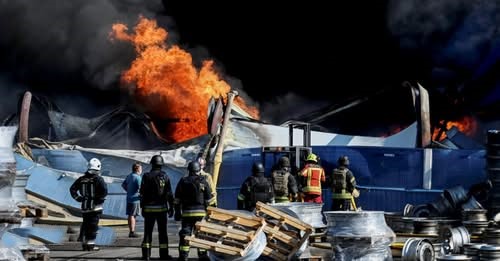
42 Injured, Including Four Children, After Russian Drone Strike in Bucha District
A devastating Russian drone strike in Ukraine’s Kyiv region has left a community facing one of its deadliest tragedies of the year, with at least 37 people reported killed and another 42 injured, including four children.
The attack occurred in the Bucha district, where a drone strike on an ammunition storage facility in the village of Myla triggered enormous secondary explosions and fires. The blasts damaged nearby homes and other civilian infrastructure, turning the area into a dangerous emergency zone.
Children Among the Injured
The fact that four children were among the injured has added another painful dimension to the disaster.
Children and families living near the site were suddenly exposed to powerful explosions, flying debris, fires, and damaged buildings. Emergency crews worked to evacuate residents and provide medical assistance as the full scale of the destruction became clear.
Officials reported that approximately 50 residential buildings sustained damage. More than 380 people were evacuated from the surrounding area, including dozens of children.
A Strike Followed by Massive Explosions
According to Ukrainian officials, the initial Russian drone strike hit a facility where ammunition was stored. The impact was followed by secondary detonations, dramatically increasing the destruction.
President Volodymyr Zelenskyy said the facility contained ammunition and other military materials and questioned why such explosive materials had been stored so close to residential areas.
The Ukrainian government has opened an investigation into whether safety regulations were violated or whether negligence contributed to the scale of the disaster.
Rescue Workers Faced Dangerous Conditions
Emergency responders were confronted with fires, unstable structures, debris, and the possibility of additional explosions.
Rescue operations continued as authorities searched damaged structures and worked to make the area safe.
Among those killed was Taras Didych, head of the neighboring Dmytrivka community. Officials said he had arrived at the scene to help residents following the attack before he was killed.
His death illustrates the danger faced by local officials and emergency personnel who rushed toward the disaster to help others.
Families Left to Cope With Loss
For the families of those killed, the numbers reported by officials represent individual human tragedies.
Every death means a family member, friend, colleague, parent, child, or neighbor is suddenly missing.
Those who survived but were injured now face medical treatment and recovery. For the four injured children, the physical and emotional effects of the attack could last well beyond the immediate emergency.
The hundreds of people evacuated from the area must also confront damaged homes and possessions while trying to understand what happened.
Questions About the Storage Facility
The tragedy has raised difficult questions inside Ukraine.
Ukrainian officials have said ammunition should not have been stored so close to residential neighborhoods. Authorities are investigating whether the facility complied with legal requirements and whether officials or other responsible parties failed to take adequate precautions.
The investigation is separate from the question of the Russian strike itself. Officials are examining whether improper storage contributed to the enormous secondary explosions and the resulting civilian casualties.
A Wider Wave of Attacks
The Bucha district strike occurred amid another intense period of Russian aerial attacks against Ukraine.
Reports indicated that Kyiv and surrounding areas faced repeated drone and missile attacks, while other Ukrainian regions were also targeted.
The continued attacks have placed enormous pressure on emergency services and civilians, many of whom have already spent years living under the threat of aerial bombardment.
A Community in Mourning
For the people of Myla and neighboring communities, the aftermath will not end when the fires are extinguished.
Homes will need to be inspected and repaired. Injured people will require medical attention. Families will have to bury loved ones. Investigators will examine the circumstances surrounding the storage of ammunition, while authorities determine how to prevent another catastrophe.
The attack is a stark reminder that the consequences of war can spread far beyond the immediate point of impact.
The Human Cost
The figures—37 dead, 42 injured, four children among the wounded, and hundreds evacuated—describe the scale of the disaster, but they cannot fully capture what residents experienced.
For those caught in the explosions, the sound of the blast and the sight of fires and damaged buildings may remain with them for years.
For families who lost loved ones, the consequences are permanent.
And for the children who survived, the experience is another reminder of how deeply the war continues to affect ordinary Ukrainian families.
As rescue and investigative operations continue, authorities face the difficult task of caring for the injured, supporting displaced residents, accounting for the dead, and determining how such a devastating chain of events occurred.
For now, the focus remains on the victims and survivors—and on ensuring that those responsible for preventable failures are held accountable.