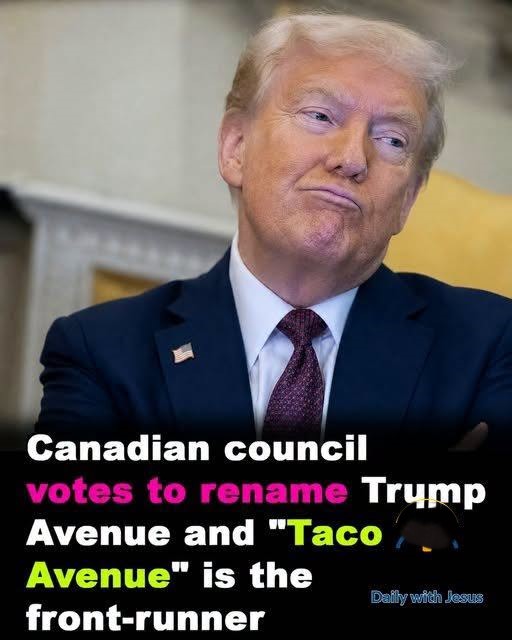
Canadians Don’t Want Anything Honoring Trump on Their Soil — “TACO Avenue” Proposed as a Replacement… See more
A political naming dispute in Canada has suddenly become one of the more unusual stories in the increasingly tense relationship between Canada and the United States.
In Ottawa, a residential street currently carrying the name Trump Avenue could eventually receive a completely different name. And among the suggestions being discussed is one that has attracted enormous attention online: “TACO Avenue.”
The name is a political joke based on the phrase “Trump Always Chickens Out,” an acronym that has been used by critics to describe what they see as President Donald Trump’s tendency to make aggressive tariff threats before later backing away or changing course.
But while the proposal has generated plenty of laughter online, the underlying issue is much more serious.
It reflects growing frustration over relations between the two neighboring countries and raises questions about whether public spaces should continue carrying the names of controversial political figures.
Ottawa Takes the First Step
Ottawa City Council recently voted unanimously to begin the process of considering a new name for Trump Avenue, a residential street in the city’s Central Park neighborhood.
The street has carried the Trump name for roughly 25 years.
Importantly, the council has not officially renamed the street.
Instead, it has opened the door to a process that could eventually result in a new name.
That distinction matters because residents will have a say in what happens next.
According to reporting on the proposal, more than half of the residents would need to support changing the name before the process could move forward. A public consultation would then help determine the replacement name.
So despite the dramatic headlines circulating online, there is no “TACO Avenue” yet.
It is simply one of several suggestions being discussed.
Why Was the Street Named Trump Avenue?
The street wasn’t originally intended as a political statement.
Trump Avenue is located in a neighborhood designed around a New York City theme.
Other nearby names include streets and locations referencing New York, including Staten Way, Madison Park and Gotham Private.
Trump Avenue was therefore part of a broader naming concept rather than an official Canadian tribute to the American president.
That history is important.
The street was named roughly a quarter-century ago, long before the current political tensions between Trump and Canadian leaders.
At the time, the name carried a very different meaning for many people.
Today, however, the name has become politically charged.
A Previous Attempt to Change the Name
This isn’t the first time residents have considered removing Trump’s name from the street.
The issue previously came to a vote in 2021.
At that time, the result was essentially a deadlock.
Of the 62 households on the street, 21 voted in favor of changing the name and 21 voted against it, while 20 households did not vote.
Because the required threshold wasn’t reached, the name remained.
Interestingly, opposition to changing the name didn’t necessarily mean that residents supported Donald Trump.
Some residents were reportedly concerned about the practical inconvenience associated with changing an address.
Changing a street name can mean updating government records, identification documents, mailing information and business records.
For homeowners and residents, those practical concerns can be significant.
Why Is the Issue Back?
The political environment has changed considerably since 2021.
Relations between Canada and the United States have become increasingly tense over trade, tariffs and Trump’s rhetoric toward Canada.
The latest dispute has included Trump’s proposal to refer to Lake Ontario as “Lake America” in the United States.
Canadian Prime Minister Mark Carney has rejected that idea, emphasizing that the lake’s historic name will remain Lake Ontario in Canada.
That controversy has added fuel to the debate surrounding Trump Avenue.
For some Ottawa officials, the street name now feels less like a harmless reference to New York and more like an unwanted political symbol.
Enter “TACO Avenue”
Then came the suggestion that captured the internet’s attention.
“TACO Avenue” is a play on the acronym Trump Always Chickens Out.
The phrase has been used by critics of Trump’s trade policies, particularly in discussions of tariff threats.
The nickname became widely known after Trump was asked about it publicly in 2025.
Trump rejected the characterization and argued that his approach was negotiation rather than backing down.
Regardless of whether someone agrees with the criticism, the phrase has become part of political commentary surrounding Trump’s trade strategy.
Using it as a possible street name therefore turns an ordinary address into a pointed political joke.
Other Names Are Also Being Considered
TACO Avenue is far from the only idea.
Suggestions reported in connection with the Ottawa discussion have included names such as Obama Avenue, Ontario Avenue, Canada Avenue and Beaver Avenue.
Other proposals have included Canada Goose Avenue, Pelosi Avenue, Gulf of Mexico Avenue and even Rosie O’Donnell Avenue.
The variety of suggestions shows just how political and sometimes humorous the debate has become.
Some names would emphasize Canadian identity.
Others would reference American politics.
Some are clearly intended as jokes.
And others would simply provide a neutral alternative.
Ultimately, however, residents and the city will have to decide which direction to take.
It’s About More Than a Street Sign
At first glance, changing a street name may seem trivial.
But symbols can carry enormous political meaning.
A street sign is something people see every day.
It appears on maps.
It appears in addresses.
Visitors see it.
Delivery drivers see it.
Government agencies see it.
For that reason, names can become permanent reminders of the people or ideas they represent.
If Ottawa residents decide that Trump’s name no longer reflects how they want their neighborhood represented, changing the street could become a symbolic statement.
On the other hand, opponents could argue that political disagreements shouldn’t determine street names that were originally chosen for historical or thematic reasons.
A Reflection of Canada-U.S. Tensions
The debate comes at a particularly sensitive moment.
Canada and the United States have historically maintained one of the world’s closest economic and political relationships.
Millions of people live near the border.
Businesses depend on cross-border trade.
Families travel between the two countries.
Communities share cultural and economic connections.
That is why disagreements between Washington and Ottawa can have consequences far beyond politics.
Trade disputes affect businesses.
Tariffs can affect consumers.
Political rhetoric can influence public opinion.
And symbolic disagreements — including arguments over geographic names — can become representations of much larger frustrations.
A Warning From Ottawa
One Ottawa councillor involved in the discussion has cautioned that the street-name debate should not distract from the much more important economic issues facing Canada and the United States.
That is an important point.
A funny street name may attract headlines.
But trade negotiations, tariffs and economic policy affect millions of people.
Changing a street sign won’t solve those problems.
At most, it becomes a symbol of the mood surrounding them.
What Happens Next?
The renaming process is not expected to happen immediately.
The municipal election in Ottawa is scheduled for October, and the broader process is expected to continue afterward.
Residents will have opportunities to participate.
The city will consider the possible names.
And eventually, a decision could be made.
For now, Trump Avenue remains Trump Avenue.
There is no official TACO Avenue.
But the fact that the idea has entered the conversation says something about the current political climate.
The Bigger Meaning
The story may sound humorous, but beneath the jokes is a serious debate about identity, diplomacy and political symbolism.
Should communities honor political figures whose policies they strongly oppose?
Should old street names be preserved simply because they have existed for decades?
Should residents be able to change names when circumstances change?
And how much should international politics influence local decisions?
Those questions don’t have easy answers.
For some Canadians, removing Trump’s name would be a small but meaningful expression of dissatisfaction.
For others, the proposal could be viewed as unnecessary political theater.
And for residents of the street itself, the practical consequences may matter more than the politics.
One Street, One Big Political Argument
What began as a street name has now become part of a much larger conversation.
Trump Avenue may have originally been chosen as part of a New York-themed neighborhood.
Today, however, it has become a symbol caught in the middle of Canada-U.S. tensions.
Whether it eventually becomes Obama Avenue, Canada Avenue, Ontario Avenue, another name — or even the tongue-in-cheek TACO Avenue — remains to be seen.
For now, the story is still developing.
But one thing is certain:
A simple street sign has suddenly become a symbol of a much bigger political relationship.
And with Canadians debating whether they want Trump’s name on their streets at all, the question isn’t just what the avenue will be called.
It’s what that name will represent.
See more 👇