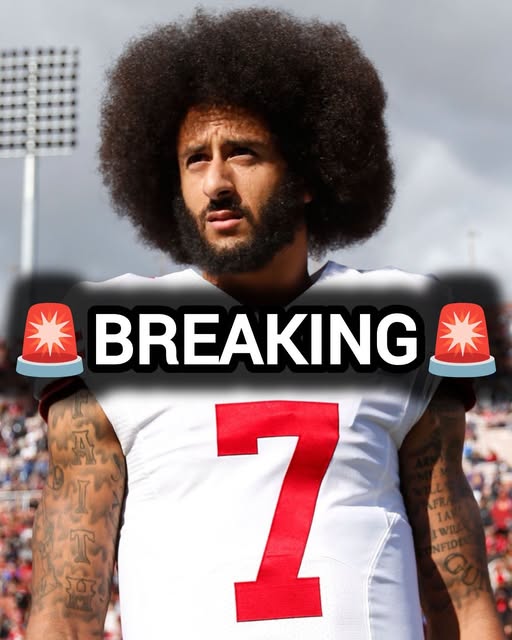
🚨 Colin Kaepernick Says the NFL Is Still “Actively Blackballing” Him 10 Years After His Historic Protest — See More
A decade after Colin Kaepernick first refused to stand during the national anthem, the former San Francisco 49ers quarterback is once again speaking publicly about the decision that changed his life—and transformed the conversation about athletes, race and social justice in America.
Now 38 years old, Kaepernick says he believes the National Football League is still “actively blackballing” him. In a recent interview with NBC News, he explained that he no longer watches NFL games, despite continuing to follow football through the college game. His comments come as he prepares to release his memoir, The Perilous Fight, on September 15.
His words immediately reignited one of the most controversial debates in modern American sports: Was Kaepernick pushed out of professional football because of his political and social activism, or was his departure primarily a consequence of football-related circumstances and the decisions of individual teams?
Kaepernick has maintained his position for years. The NFL, meanwhile, has denied that he was blackballed.
The disagreement remains unresolved in the court of public opinion.
The protest that changed everything
In 2016, Kaepernick was one of the NFL’s most recognizable quarterbacks. He had already reached the Super Bowl with the 49ers following the 2012 season, establishing himself as a talented and unconventional quarterback capable of making plays both through the air and on the ground.
But during the 2016 preseason, his attention shifted beyond football.
Kaepernick initially sat during the national anthem before games, explaining that he was protesting racial injustice and police brutality. After conversations with Nate Boyer, a former NFL player and Army Green Beret, he changed from sitting to kneeling. The gesture was intended to be a peaceful form of protest rather than an act of disrespect toward military members or the country.
The image of an NFL quarterback kneeling during the anthem quickly spread around the world.
Some Americans praised Kaepernick for using his platform to draw attention to issues he believed were being ignored. Others condemned the protest, viewing the national anthem as a symbol that should not be challenged during sporting events.
The argument soon became much larger than football.
Players across the NFL began joining the protest. Eric Reid, Kaepernick’s former 49ers teammate, became one of the most prominent participants. The discussion expanded into questions about patriotism, free expression, racial inequality, police accountability and the responsibilities of professional athletes.
What began as a quiet gesture became one of the defining cultural moments of the decade.
The end of Kaepernick’s NFL career
Kaepernick’s final NFL appearance came during the 2016 season.
After that season, he became a free agent. He was not signed by another NFL team.
Kaepernick and Reid eventually filed a grievance against the league, alleging that NFL owners had colluded to keep them from being employed because of their protests. The NFL denied the allegations, but the case was settled in 2019. The settlement did not establish publicly that the league had blacklisted Kaepernick, leaving both sides to maintain their respective positions.
For Kaepernick, however, the experience has never simply been about whether another team offered him a contract.
He believes the events surrounding his departure represented something larger.
In his latest interview, he said he cannot support an organization that he believes continues to exclude him and has also targeted other players who participated in protests.
“I’m not gonna support an organization that one, is actively blackballing me,” Kaepernick said, according to reports of the NBC News interview.
That statement demonstrates just how deeply the dispute remains embedded in his relationship with professional football.
Ten years later, the argument is still alive
Perhaps the most remarkable part of Kaepernick’s latest comments is not that he continues to believe he was blackballed.
It is that, ten years later, he still views the issue as unfinished business.
The NFL has undergone major changes since Kaepernick’s protest. Following the 2020 killing of George Floyd and the nationwide protests that followed, the league publicly embraced racial justice messaging more strongly than it had during the early years of Kaepernick’s protest.
The NFL has continued displaying social justice messages such as “End Racism” and other initiatives connected with its Inspire Change program.
But Kaepernick has criticized those efforts.
He has described the league’s response to racial injustice as disingenuous and has argued that its public statements do not represent meaningful change.
That creates one of the central contradictions surrounding his story.
The league that once became associated with controversy over players kneeling during the anthem now publicly promotes messages addressing racism and social justice.
Yet Kaepernick, the player whose protest helped force those issues into the center of the sports conversation, remains outside the league.
For Kaepernick, that contradiction is difficult to ignore.
He still watches football—just not the NFL
Despite walking away from the NFL, Kaepernick has not abandoned football itself.
He told NBC News that he watches college football instead.
That distinction is significant.
Football was once central to Kaepernick’s identity. He spent years training, competing and preparing for the possibility of returning to the professional game. Even after his NFL career ended, he continued working out and publicly expressed his desire to play again.
But his relationship with the NFL appears fundamentally different today.
Rather than watching the league he once played in, he has chosen to follow college football.
His explanation is connected directly to his belief that the NFL continues to treat him and other protesting players unfairly.
It is a striking conclusion to a career that once placed him at the center of America’s most powerful sports organization.
More than a football story
Kaepernick’s story has never been exclusively about statistics, contracts or wins and losses.
His protest became part of a much broader movement.
Athletes in basketball, soccer, baseball and other sports began speaking more openly about political and social issues. Major sports leagues were forced to reconsider how they responded to athlete activism.
At the same time, Kaepernick became one of the most recognizable symbols of protest in modern sports.
His supporters see him as someone who sacrificed a lucrative career to stand behind his beliefs.
His critics have argued that professional sports are ultimately businesses and that teams have the right to make personnel decisions based on their assessment of a player’s value.
That disagreement is unlikely to disappear.
And Kaepernick appears comfortable with that reality.
His work continued beyond football
Although Kaepernick’s NFL career ended years ago, his activism did not.
He created Know Your Rights camps aimed at educating young people and continued supporting causes related to racial justice and civil rights.
His foundation has also helped fund independent autopsies in cases involving deaths connected to police encounters, according to reports.
These efforts demonstrate why Kaepernick says he is less concerned about his personal legacy than about the work he believes can create change.
When asked about his legacy, he reportedly emphasized that it is not something he spends much time thinking about.
Instead, he focuses on what he can do now.
That may be one of the clearest signs of how much his priorities have changed since his playing days.
The quarterback who once measured success in touchdowns and victories now appears more interested in measuring it through social impact.
The memoir adds another chapter
Kaepernick’s latest comments arrive shortly before the publication of The Perilous Fight, his upcoming memoir.
The timing makes the interview especially significant.
Ten years have passed since his original protest, giving him an opportunity to look back at the decision with the perspective of age and experience.
Much has changed since 2016.
Kaepernick is no longer simply an NFL quarterback. He has become a symbol, an activist, a controversial public figure and a central character in the history of athlete protest.
His memoir is expected to provide additional insight into his experiences, motivations and the consequences of his decision to kneel.
For many readers, the book may provide a more detailed explanation of how Kaepernick understood the events that followed his protest.
What happens next?
Kaepernick is unlikely to return to the NFL as a player.
The league has moved forward with an entirely new generation of quarterbacks, coaches and stars. Ten years is an extraordinarily long time in professional football.
But his influence remains.
The fact that the NFL continues to discuss racial justice, athlete activism and social responsibility means the questions raised by Kaepernick’s protest have not disappeared.
His latest comments also demonstrate that the disagreement between him and the NFL remains deeply personal.
Kaepernick says the league is still “actively blackballing” him.
The NFL has rejected that characterization.
Between those two positions lies a complicated history that includes a groundbreaking protest, enormous public backlash, a legal dispute, years away from professional football and a transformation in the way sports organizations discuss social justice.
Whether people view Kaepernick as a courageous activist, a divisive figure, or something in between, it is difficult to argue that his protest was insignificant.
Ten years later, people are still debating it.
And perhaps that is precisely why his latest comments have attracted so much attention.
Colin Kaepernick may no longer be taking snaps in an NFL stadium, but his name remains part of the league’s history—and the national conversation he helped create is still very much alive.
As his memoir approaches publication, Kaepernick appears determined to tell his story on his own terms.
The NFL may have moved into a different era.
Kaepernick believes the fundamental questions remain.
And for him, the fight is not over.