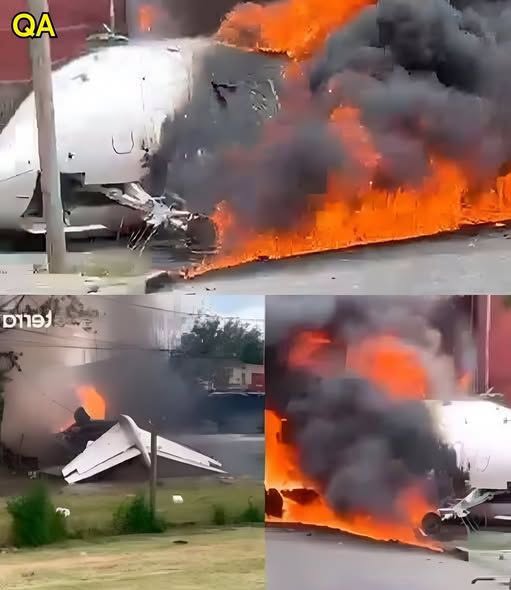
RIGHT NOW, PLANE WITH MORE THAN 244 ONBOARD JUST CRASH… SEE MORE
A frightening headline has been circulating online:
“RIGHT NOW, PLANE WITH MORE THAN 244 ONBOARD JUST CRASH… SEE MORE.”
The wording immediately creates panic. A major passenger aircraft. Hundreds of people onboard. A crash supposedly happening right now.
But there is an important problem with the claim.
At present, there is no credible confirmation of a new aviation disaster matching those details. The headline appears to be part of a recurring viral story that has circulated online in different versions. Similar posts have appeared on websites using almost identical wording, sometimes months apart.
That does not mean aviation disasters are not real or that people should ignore emergency reports.
It means that when a headline claims a catastrophic event is happening “right now,” verification is essential.
The number 244 is particularly notable because it resembles early reporting connected with a real tragedy: Air India Flight AI171, which crashed shortly after takeoff from Ahmedabad, India, on June 12, 2025.
That aircraft was carrying 242 passengers and crew according to Air India. Early reports contained some discrepancies, with one early figure putting the number at 244.
The tragedy was devastating.
The Boeing 787-8 Dreamliner was flying toward London Gatwick when it crashed shortly after takeoff. The aircraft struck an area containing buildings, causing additional deaths on the ground.
The disaster became one of the most serious aviation accidents in recent years.
Investigators began examining the aircraft, flight data, cockpit recordings, maintenance information, and other evidence to understand what happened.
The event also demonstrated why accurate passenger numbers matter.
In the immediate aftermath of an aviation disaster, information can change quickly.
Authorities may not initially know exactly how many people were onboard.
Passenger manifests may need to be checked.
Crew lists may need to be verified.
People on the ground may also be affected.
That is why responsible news organizations avoid treating the first number circulating on social media as the final confirmed figure.
Unfortunately, viral headlines often do the opposite.
A dramatic sentence can be copied from one website to another.
A photograph from an old accident may be attached to a new claim.
A video from a previous incident may suddenly be presented as if it happened today.
And within minutes, thousands of people may believe they are watching a current catastrophe.
For families, that can be terrifying.
Imagine receiving a message saying that a plane has crashed while someone you love is traveling.
Before knowing the airline, flight number, destination, or location, your mind can immediately go to the worst possible conclusion.
That is why breaking aviation news requires particular care.
If a major passenger aircraft really crashes, authorities normally begin releasing information through multiple channels.
Airlines may issue statements.
Airport authorities may respond.
Police and emergency services may provide updates.
Aviation regulators may become involved.
Major news organizations begin reporting the event.
As details become available, the aircraft’s flight number, departure location, destination, airline, aircraft type, and passenger count can usually be established.
None of those essential details are provided by the viral headline.
Instead, readers are told only that a plane with “more than 244 onboard” supposedly crashed.
That lack of information should immediately encourage caution.
It is also important to remember that aviation emergencies are not automatically fatal disasters.
Aircraft can experience engine problems, electrical failures, severe weather, technical malfunctions, or other emergencies and still land safely.
Pilots train extensively for abnormal situations.
Cabin crews receive emergency training.
Airports maintain rescue and firefighting services.
Modern aviation includes multiple layers of safety designed to reduce risk.
When something does go wrong, investigators examine the incident carefully to determine what happened and how future accidents can be prevented.
The Air India tragedy demonstrates how complicated that process can become.
After the 2025 crash, investigators worked to establish the sequence of events and examine possible contributing factors. The investigation involved aviation authorities and specialists from several countries.
It is not responsible to decide the cause of an aviation accident from a short video or social-media post.
Aviation investigations rely on evidence.
Flight recorders can provide crucial information.
Maintenance records can reveal the aircraft’s history.
Cockpit communications can establish what the pilots knew and when they knew it.
Weather information can help investigators understand environmental conditions.
Wreckage examination can reveal important technical clues.
All of those pieces must be considered together.
This is why readers should be especially cautious when a viral post immediately announces a cause of a crash.
Claims about pilot error, mechanical failure, sabotage, terrorism, or other explanations may circulate long before investigators have reached conclusions.
The same principle applies to casualty figures.
Early numbers can be incomplete.
Names may not yet be confirmed.
Authorities may need time to identify victims and notify families.
Responsible reporting means allowing that process to happen.
The current viral headline therefore deserves skepticism.
There is no reliable basis for presenting it as a confirmed new crash involving more than 244 people.
Instead, the wording appears connected to a recurring online headline that has been reused in different forms.
That does not make the subject unimportant.
Plane crashes are among the most emotionally powerful news stories because they affect large numbers of people simultaneously.
Every passenger has a family, friends, colleagues, and people waiting for them at their destination.
Behind every passenger number is an individual human life.
That is why sensationalizing an unconfirmed disaster can cause real harm.
A headline may generate clicks, but it can also create unnecessary fear.
Someone might see the post and immediately call a relative.
Another person might panic because a loved one is traveling.
Families may spend hours searching for information that does not actually exist.
The better approach is simple.
Stop.
Check the date.
Check the airline.
Look for the flight number.
Check official aviation and emergency authorities.
Compare reports from reputable news organizations.
And most importantly, determine whether the event is actually confirmed.
In the case of this particular headline, the evidence does not support presenting a new crash as happening right now.
Instead, readers should be aware that the wording has been circulating online and appears to recycle details associated with older aviation stories, including the tragic Air India Flight AI171 disaster of June 2025.
The lesson is bigger than one headline.
In today’s world, breaking news can travel around the planet in seconds.
But speed does not equal accuracy.
A story can be shared thousands of times and still be false.
A photograph can be genuine but used with the wrong story.
A real tragedy can be repackaged as if it happened again.
And a dramatic headline can create the impression that something is happening “right now” when it actually comes from an older event.
When lives may be involved, accuracy matters more than clicks.
So before sharing the claim that a plane carrying more than 244 people has just crashed, wait for confirmation.
If a genuine emergency has occurred, reliable authorities and established news organizations will provide verified information.
Until then, the responsible thing to do is not to turn an alarming headline into a fact.
Because when a story involves hundreds of passengers and potentially hundreds of families, the truth deserves more attention than the headline.

