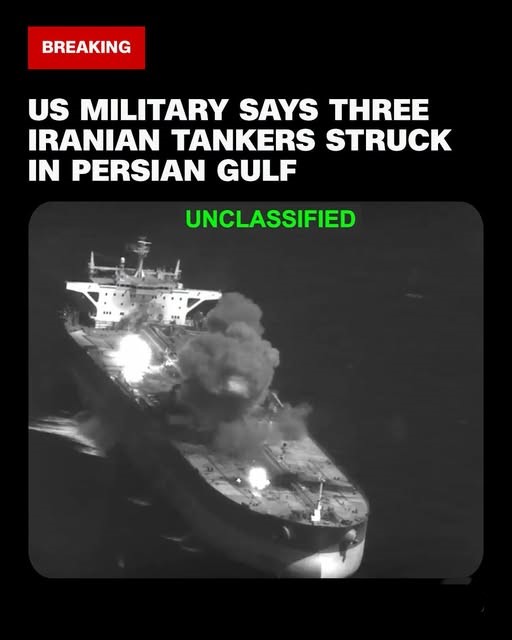
🚨 BREAKING: U.S. Strikes Three Iranian Oil Carriers After Iran Launches Ballistic Missiles at American Warships…See More
The conflict between the United States and Iran has taken another dangerous turn after U.S. Central Command announced that American forces struck three Iranian crude-oil carriers following a ballistic-missile attack directed at two U.S. Navy warships.
According to CENTCOM, the Islamic Revolutionary Guard Corps launched multiple ballistic missiles toward an American aircraft carrier and a guided-missile destroyer operating in regional waters. The U.S. military said both warships successfully evaded the attacks and that no American personnel were injured.
The American response came shortly afterward.
CENTCOM said U.S. forces permanently disabled two Iranian crude-oil carriers and destroyed a third vessel. The military identified the ships as the M/T Downy, the M/T Stark 1 and the M/T Kylo, also known as the Noxen. The reported strikes occurred in waters near Kharg Island, near Jask, and in the Gulf of Oman.
The operation represents a significant escalation because the exchange directly involved both military vessels and Iran’s oil infrastructure.
For Washington, the attacks on U.S. Navy ships represented a direct threat to American forces operating in the region.
For Tehran, the destruction of Iranian oil carriers could represent another major blow to an economy already under enormous pressure from sanctions, military operations and restrictions on oil exports.
CENTCOM Commander Admiral Brad Cooper said the United States was sending a direct message to Iran’s Revolutionary Guard.
The American military maintains that the targeted tankers were connected to a large network used to generate revenue for the IRGC and Iranian-backed regional groups. CENTCOM described the network as a multibillion-dollar “shadow network.”
The operation therefore appears to have been designed not only as a military response but also as an economic one.
The message from Washington was unmistakable: attacks against American military forces could result in attacks against assets considered important to Iran’s military financing.
The confrontation began when Iranian missiles were launched toward two American warships.
According to the U.S. military, the vessels were able to avoid the incoming missiles. That meant the immediate attack did not result in American casualties.
But the absence of casualties does not make the incident insignificant.
An attack involving ballistic missiles against an American aircraft carrier or destroyer carries enormous potential consequences. Had the missiles struck their targets, the situation could have become considerably more dangerous.
Instead, the U.S. military responded by striking Iranian oil carriers.
The decision immediately raised questions about what Iran might do next.
Would Tehran retaliate against American warships?
Would Iranian forces attack additional commercial vessels?
Could the conflict spread to other countries in the region?
And could the fighting eventually threaten one of the world’s most important oil transportation routes?
Those questions are especially significant because the attacks occurred in and around the Persian Gulf and Gulf of Oman, areas that are critical to international energy supplies.
Kharg Island is particularly important to Iran’s oil industry. It has long served as a major export terminal for Iranian crude, making military activity around the island especially sensitive.
Reports from Iranian media also said that an Iranian tanker near Kharg Island had been struck, although details from Tehran and Washington have not always matched. Iranian state media reported that four U.S. missiles hit a tanker near the island and said there were no casualties. The United States had not immediately confirmed that particular account.
That difference illustrates another major feature of the conflict: both sides are providing their own accounts of rapidly developing events.
For the public, determining what happened can therefore be difficult.
Military operations at sea can unfold quickly, while governments may release only selected information for security reasons.
Video footage released by CENTCOM showed the American strikes on the Iranian vessels. The U.S. military said the crew of the M/T Kylo was directed to abandon the ship before American forces struck critical locations to render the vessel inoperable.
The United States described the operation as a response to Iranian aggression.
Iran had not immediately issued a full official response to the American strikes at the time of the latest reports.
That silence could prove temporary.
Iranian leaders have repeatedly warned that attacks on Iranian interests can trigger retaliation. If Tehran decides that the destruction of the tankers requires another military response, the latest exchange could become another step in a cycle of escalation.
The danger extends beyond the United States and Iran.
The region contains important shipping routes used by international commercial vessels. Any major disruption could affect energy markets, shipping companies and consumers around the world.
Oil prices have already been sensitive to developments in the region. Reuters reported that Brent crude recently closed at its highest level since July 24 as concerns about Middle Eastern supply disruptions increased.
That means an attack involving three oil carriers is not simply a military story.
It is also an economic story.
If shipping through the region becomes increasingly dangerous, companies may be forced to reroute vessels, increase insurance costs or delay shipments.
Those effects can eventually reach countries thousands of miles away.
The Strait of Hormuz is particularly important. The narrow waterway connects the Persian Gulf with the Gulf of Oman and is one of the world’s most strategically significant maritime passages.
Any prolonged confrontation around the strait could have consequences for global energy supplies.
That is why governments around the world are watching the latest developments closely.
The United States has also made clear that it intends to continue defending its forces in the region.
Admiral Cooper warned that Washington would impose further costs if American forces were attacked again.
That warning could become extremely important in the coming days.
Iran now faces a choice.
It could retaliate and risk triggering another American response.
It could attempt to use the incident to strengthen its negotiating position.
Or it could seek to reduce tensions before the confrontation expands even further.
The United States faces a similar challenge.
Washington has demonstrated that it is prepared to use military force in response to attacks on American forces. But every additional strike carries the possibility of producing another Iranian response.
That creates a dangerous cycle.
Attack.
Retaliation.
Counter-retaliation.
And eventually, a conflict that becomes much larger than either side originally intended.
For American sailors aboard the warships involved, the immediate danger may have passed.
But the broader threat remains.
The same is true for commercial crews operating throughout the Gulf region.
The latest incident demonstrates that the conflict is no longer limited to distant military bases or isolated targets. Oil tankers, warships and major shipping routes are now directly involved.
The consequences could therefore reach far beyond the battlefield.
For now, the most important confirmed facts are clear.
Iranian forces launched ballistic missiles toward two U.S. Navy warships, according to CENTCOM.
The American vessels successfully avoided the attacks.
No American personnel were reported injured.
The United States then struck three Iranian crude-oil carriers.
Two were reportedly disabled, while a third was destroyed after its crew was ordered to abandon ship.
And Iran has yet to provide a full official response to the latest American strikes.
What happens next could determine whether this becomes another isolated exchange—or the beginning of an even more dangerous phase of the U.S.-Iran conflict.
For millions watching around the world, the question is no longer whether tensions are rising.
They clearly are.
The question is how far both sides are willing to go before the cycle finally stops.