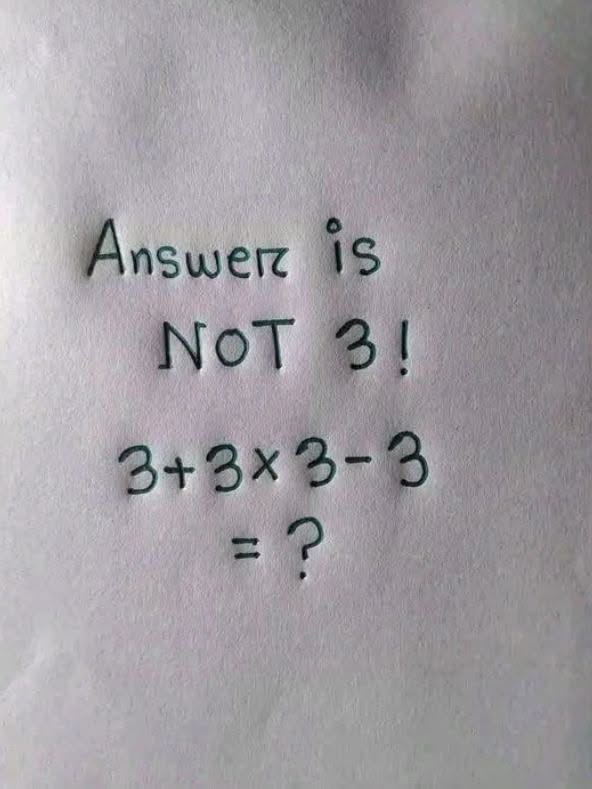
The Answer Is NOT 3! Can You Solve This Simple-Looking Math Puzzle?
At first glance, it looks almost too easy to be worth thinking about.
You see a short mathematical expression, and your brain immediately jumps toward an answer. Maybe you calculate it quickly, feel confident, and move on.
But then comes the warning:
The answer is NOT 3.
Suddenly, everything changes.
What seemed like a simple calculation becomes a test of whether you are actually following the rules—or simply trusting the first answer that comes to mind.
These puzzles have become incredibly popular because they exploit one of the most interesting things about mathematics: sometimes the hardest part isn’t doing the calculation.
It’s knowing which calculation should happen first.
Imagine you’re presented with an expression such as:
6 ÷ 2(1 + 2)
Many people look at it and immediately think the answer is 3.
Their reasoning may be something like this:
First, calculate the parentheses:
1 + 2 = 3
Then the expression becomes:
6 ÷ 2 × 3
From there, some people instinctively multiply 2 × 3 first, producing 6 ÷ 6 = 1.
Others divide first, producing 3 × 3 = 9.
And that’s where the puzzle becomes controversial.
So what is actually happening?
The key is the order of operations.
Mathematics uses conventions to determine which operations should be performed first. Parentheses generally come first. Exponents follow. Multiplication and division come next, and addition and subtraction come afterward.
But there is an important detail that frequently causes confusion.
Multiplication and division have the same priority.
That means you don’t automatically perform multiplication before division simply because multiplication is written first in the traditional phrase “PEMDAS.”
Instead, multiplication and division are generally evaluated from left to right.
So let’s return to the expression:
6 ÷ 2(1 + 2)
First:
1 + 2 = 3
Now we have:
6 ÷ 2 × 3
Working from left to right:
6 ÷ 2 = 3
Then:
3 × 3 = 9
Under that conventional left-to-right interpretation, the answer is:
9.
Not 3.
Not 1.
But there’s an important catch.
The original expression is written in a way that can be considered ambiguous.
Some mathematicians and calculators may interpret the implied multiplication in 2(1 + 2) differently from ordinary multiplication written with a multiplication symbol.
That is why expressions like this create endless arguments online.
One person says the answer is 9.
Another says it’s 1.
Someone else says the question itself is badly written.
And technically, the third person has an important point.
If the intention is to make the expression completely unambiguous, it should be rewritten.
For example, if the intended calculation is:
6 ÷ [2(1 + 2)]
then the answer is clearly:
1.
Because the denominator is the entire quantity:
2 × (1 + 2)
First:
1 + 2 = 3
Then:
2 × 3 = 6
Finally:
6 ÷ 6 = 1
On the other hand, if the intended expression is:
(6 ÷ 2)(1 + 2)
then the answer is clearly:
9.
First:
6 ÷ 2 = 3
Then:
1 + 2 = 3
Finally:
3 × 3 = 9
This is precisely why these puzzles are so effective.
They aren’t necessarily testing whether you know how to multiply and divide.
They’re testing whether you recognize ambiguity.
And that is an important mathematical skill.
In everyday mathematics, notation matters enormously.
A tiny pair of parentheses can completely change the answer.
A fraction bar can change the grouping.
An exponent can change the order of operations.
Even the difference between writing an expression on one line and using a properly structured fraction can eliminate an argument.
Consider these two expressions:
6 ÷ 2(3)
and
6 ÷ [2(3)]
They may look nearly identical, but the brackets explicitly tell you what belongs together.
Good mathematical writing should remove uncertainty whenever possible.
That is why professional mathematicians and scientists are careful with notation.
So why do so many people confidently answer these puzzles incorrectly?
One reason is that humans are very good at recognizing patterns.
When we see something that resembles a familiar problem, our brains often try to solve it automatically.
That’s useful in everyday life.
But puzzles are designed to punish automatic thinking.
They encourage you to slow down.
Read every symbol.
Identify the grouping.
Then apply the appropriate rules.
Another reason is the way order-of-operations mnemonics are taught.
Students often memorize phrases such as PEMDAS:
Parentheses, Exponents, Multiplication, Division, Addition, Subtraction.
But the mnemonic can accidentally create the impression that multiplication must always happen before division.
It doesn’t.
Multiplication and division occupy the same level of precedence.
The same is true for addition and subtraction.
When operations share the same precedence, you generally evaluate them from left to right.
That’s an important distinction.
So if someone tells you, “Multiplication always comes before division,” that’s an oversimplification.
And if someone tells you, “The answer is obviously 1,” they may be relying on a particular interpretation of the notation rather than an universally accepted reading.
The real lesson is therefore more interesting than the number itself.
The puzzle teaches us that how a problem is written matters just as much as how you calculate it.
This is also why viral math puzzles generate so much debate.
People aren’t always disagreeing about arithmetic.
They’re sometimes disagreeing about notation.
One person sees the expression as a fraction.
Another sees it as a sequence of operations.
A third person argues that the problem should have been written more clearly.
All three may understand mathematics perfectly well.
The disagreement comes from the formatting.
So, can you solve the puzzle?
If the intended expression is the commonly circulated:
6 ÷ 2(1 + 2)
then the safest response is to point out the ambiguity rather than pretending there is only one possible interpretation.
Using standard left-to-right multiplication and division gives:
9.
But interpreting the juxtaposed multiplication as part of the divisor gives:
1.
And that means the best mathematical answer may actually be:
The expression is ambiguous as written.
If a puzzle creator insists that the answer is definitely one particular number, the strongest response is to ask them to add parentheses or a fraction bar.
That would settle the debate instantly.
And perhaps that’s the biggest trick of all.
The puzzle isn’t really asking:
“Can you calculate this?”
It’s asking:
“Will you slow down enough to notice that the question itself may be unclear?”
So next time you encounter a viral math puzzle that looks ridiculously easy, don’t rush.
Don’t trust the first number that appears in your head.
Don’t blindly follow a memorized acronym.
Look at the structure.
Check the grouping.
Apply the rules carefully.
And if the notation is ambiguous, say so.
Because sometimes the smartest answer isn’t simply a number.
Sometimes it’s:
“It depends on how the expression is interpreted.”
And that’s exactly what makes these deceptively simple puzzles so much fun.
See More…