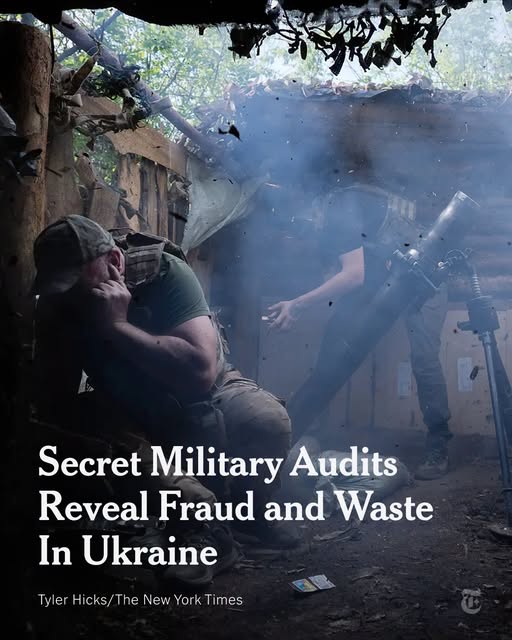
Ukraine’s Military Procurement Under Scrutiny as Contractors Facing Investigations Win New Deals
Ukraine’s military has spent years fighting a war in which every shipment of ammunition, vehicle, drone, and weapon can have consequences on the battlefield. Behind those urgent military needs, however, a growing controversy over defense procurement is raising difficult questions about how government money is being spent.
According to reporting based on Ukrainian government audits and other records, seven of Ukraine’s ten largest military contractors received new business despite having open criminal investigations involving allegations such as fraud, failures to fulfill earlier contracts, or corruption cases involving senior executives.
The findings have created an uncomfortable contradiction.
Ukraine needs weapons quickly. At the same time, officials are expected to make sure that public funds are being awarded to companies capable of delivering what the military actually needs.
The investigation described cases in which companies received additional contracts despite unresolved problems with previous agreements. Auditors also identified companies that allegedly signed new deals even after defaulting on earlier obligations.
In six cases cited in the reporting, companies had failed to fulfill a single contract.
The consequences of such failures can extend far beyond accounting records.
For soldiers on the front line, a delayed shipment isn’t simply an administrative inconvenience.
It can mean missing ammunition.
It can mean equipment arriving too late.
It can mean commanders having fewer options when responding to an attack.
And during a prolonged war, delays can become extremely costly.
A System Under Pressure
Ukraine’s defense procurement system has faced extraordinary pressure since Russia’s full-scale invasion.
The country’s military requirements expanded dramatically, while the government had to purchase enormous quantities of equipment under wartime conditions.
Speed became essential.
But speed can also create opportunities for mistakes, weak oversight, and corruption.
The latest findings suggest that some companies were able to continue receiving government business even when questions had already been raised about their previous performance.
That has prompted concerns about whether procurement decisions are adequately connected to past contract performance.
If a company fails to deliver an earlier agreement, why should it automatically receive another?
That is one of the central questions surrounding the findings.
The answer is not necessarily simple.
A company may be under investigation without having been convicted of a crime. An allegation is not proof of wrongdoing, and wartime procurement can involve circumstances that make replacing a supplier difficult.
Some companies may also provide equipment that the military urgently needs and that few other suppliers can produce.
Those realities make procurement decisions complicated.
But they also make oversight more important.
The Cost of Waste
The reported figures are particularly striking because Ukrainian government audits reportedly estimated that approximately $1.2 billion was lost to fraud, waste, and mismanagement during 2024 alone.
That is a significant amount of money for any government.
For a country fighting a major war, the implications are even greater.
Every dollar lost through waste or failed procurement is money that cannot be spent elsewhere.
It could have funded additional ammunition.
It could have supported soldiers.
It could have repaired vehicles.
It could have purchased drones or protective equipment.
It could have helped maintain critical infrastructure.
This is why defense corruption is not merely a financial issue.
It can become a national-security issue.
The Human Cost
Behind every procurement contract are people who depend on the system functioning properly.
A soldier waiting for ammunition does not see the paperwork behind a contract.
A medic waiting for supplies does not see the negotiations between government officials and suppliers.
A commander facing a shortage does not care which company won the procurement process.
They need the equipment to arrive.
When it doesn’t, someone ultimately pays the price.
That reality explains why allegations of procurement failures can generate such intense anger.
The public expects wartime resources to be handled with exceptional care.
Families whose relatives are serving expect government institutions to do everything possible to support them.
And international partners providing financial and military assistance also need confidence that resources are being managed responsibly.
Criminal Investigations Are Not Convictions
There is another important distinction.
Being the subject of a criminal investigation does not mean that a company or executive has been found guilty.
Investigations exist precisely because authorities are trying to determine what happened.
A contractor accused of fraud may ultimately be convicted, cleared, or never charged.
That distinction is especially important when discussing individual companies and executives.
The reported findings should therefore be understood as evidence of weaknesses and allegations requiring scrutiny, not as proof that every contractor mentioned committed a crime.
Nevertheless, the existence of unresolved investigations alongside new government contracts raises legitimate questions about procurement safeguards.
Why Transparency Matters
Transparency can help answer those questions.
Citizens need to know how large contracts are awarded.
Officials need to explain why certain suppliers are selected.
Auditors need sufficient independence to investigate questionable transactions.
And when wrongdoing is established, consequences need to follow.
At the same time, procurement systems must remain functional.
Ukraine cannot afford a system so slow that urgently needed military supplies become trapped in bureaucracy.
The challenge is finding a balance between speed and accountability.
That balance becomes especially difficult during wartime.
Reform Under Pressure
Ukraine has taken steps over the years to strengthen anti-corruption institutions and improve defense procurement.
But the latest findings suggest that reforms still face serious challenges.
A system can have rules on paper while producing poor results in practice.
The critical question is whether officials consistently enforce those rules.
If companies repeatedly fail to deliver and still receive new contracts, the problem may not simply be individual misconduct.
It could indicate a structural weakness.
Perhaps agencies are operating with incomplete information.
Perhaps procurement officials lack sufficient alternatives.
Perhaps political relationships influence decisions.
Or perhaps wartime urgency creates pressure to overlook problems that would be unacceptable during peacetime.
Determining which explanation is correct requires deeper investigation.
The Bigger Question
The controversy ultimately raises a question larger than any individual contractor.
How can Ukraine maintain the speed of wartime procurement while ensuring that military spending is protected from fraud and waste?
There is no easy answer.
Ukraine is fighting for its survival while simultaneously attempting to maintain public trust.
Its soldiers need weapons immediately.
Its citizens need confidence that their government is protecting national resources.
And its international supporters need assurance that their assistance is reaching legitimate military needs.
Those objectives are not contradictory, but achieving them requires strong institutions.
The reported audit findings are therefore significant not simply because of the companies involved, but because they reveal the enormous challenge facing Ukraine’s defense establishment.
A war can create urgency.
Urgency can create shortcuts.
And shortcuts can create opportunities for abuse.
The answer cannot be to slow down military procurement until every decision becomes impossible.
Nor can it be to ignore warning signs because the country is at war.
Instead, Ukraine faces the difficult task of building a system that can move quickly while still identifying unreliable suppliers, investigating suspected wrongdoing, recovering losses, and preventing repeat failures.
For soldiers on the front line, that may sound like an administrative problem.
It isn’t.
It is part of the war effort itself.
Weapons have to be purchased.
Contracts have to be honored.
Money has to be protected.
And promises have to become actual deliveries.
The latest allegations are a reminder that winning a war requires more than battlefield strength.
It also requires institutions capable of making every resource count.
For Ukraine, the pressure to achieve that balance has never been greater.