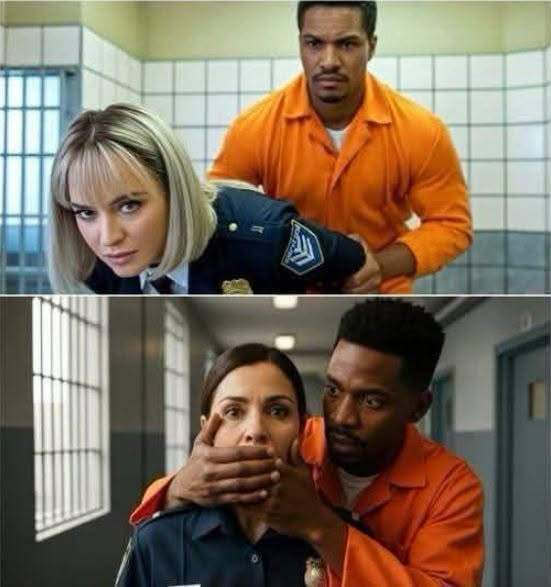
Female Police Officer Fulfilled Prisoner’s Last Wish Before He Died
The request sounded simple.
But when the female police officer heard it, she realized that the prisoner’s final wish had nothing to do with money, freedom, or escaping the consequences of his past.
He simply wanted one last chance to feel like an ordinary human being.
In this fictionalized story, Officer Elena Carter had worked around prisoners for years. She had seen anger, regret, fear, and sadness behind prison walls. She had learned not to judge people only by the worst thing they had ever done.
Still, there was one prisoner whose final days would stay with her forever.
His name was Daniel.
Daniel was an older prisoner who had spent many years behind bars. By the time Elena met him, his health had deteriorated badly. He spent much of his time quietly in his cell, speaking very little and rarely asking for anything.
The other officers knew him as a difficult man from a difficult past.
Elena saw something different.
She noticed that Daniel often stared through the small window near the end of the hallway. He would remain there for several minutes, lost in thought.
One evening, Elena was making her rounds when she stopped outside his cell.
“You okay?” she asked.
Daniel looked up.
For several seconds, he said nothing.
Then he quietly replied, “Can I ask you something?”
Elena nodded.
“I don’t want anything for myself,” he said. “I just want to see my daughter.”
The request immediately changed the atmosphere.
Daniel explained that he had not seen his daughter in many years. She had been a child when their relationship fell apart. Now she was an adult with a family and a life of her own.
He didn’t know whether she wanted to see him.
That uncertainty frightened him more than anything.
“My biggest regret,” Daniel said, “is that she grew up without me.”
Elena listened without interrupting.
She knew there were rules governing visits and that she could not simply make promises. But she also understood that a final wish deserved to be taken seriously.
Daniel was running out of time.
Elena began making inquiries.
She contacted the appropriate people and explained the situation. She carefully followed the required procedures and asked whether a final visit could be arranged.
Days passed.
Then, unexpectedly, an answer came.
Daniel’s daughter had agreed to come.
When Elena told him, he could hardly believe it.
“She said yes?” he asked.
“She did,” Elena replied.
Daniel turned away.
For a moment, he appeared unable to speak.
Then tears began running down his face.
He quickly wiped them away, embarrassed.
Elena pretended not to notice.
The day of the visit arrived.
Daniel spent hours preparing himself. He asked whether his clothes looked acceptable. He repeatedly asked what time his daughter would arrive.
Every few minutes, he looked toward the door.
Finally, footsteps approached.
A woman entered the room.
She stood silently.
Daniel looked at her.
For a few seconds, neither of them moved.
Then he whispered her name.
She walked toward him.
They hugged.
It was not a perfect reunion.
There were years of anger and unanswered questions between them.
There were things that could never be changed.
But there was also something neither of them expected to feel so strongly.
Love.
They talked for a long time.
Daniel apologized.
He did not try to excuse his mistakes.
Instead, he told her that he wished he could go back and make different choices.
His daughter cried as she explained how difficult it had been growing up without him.
For the first time in many years, they spoke honestly.
Elena remained nearby, giving them privacy while ensuring that the visit followed the rules.
At one point, Daniel laughed.
It was a small laugh, but Elena later said it was the first time she had heard him laugh in months.
The conversation eventually turned toward Daniel’s final wish.
He had one more request.
He wanted a photograph with his daughter.
Not a photograph for the internet.
Not something for newspapers.
Just a private photograph that she could keep after he was gone.
Elena helped arrange it.
Daniel sat beside his daughter, wearing the simple clothes he had chosen for the occasion.
They smiled.
The photograph was taken.
For Daniel, it became one of the most important moments of his life.
Later that evening, he told Elena something she would never forget.
“I thought my last days would be about everything I lost,” he said.
He paused.
“Now I think they’ll be about what I got back.”
Elena didn’t know what to say.
She simply stood beside him.
Over the following days, Daniel’s condition became worse.
His daughter returned whenever she could.
Their relationship was still complicated, but they had begun rebuilding something that both had believed was permanently broken.
Eventually, Daniel passed away peacefully.
Elena was working that day.
When she received the news, she stood quietly for several moments.
She thought about the man she had first met—the prisoner who rarely spoke, who stared through the hallway window, and who believed his daughter might never forgive him.
She also remembered the man who had smiled when his daughter walked through the door.
The experience changed Elena.
Before Daniel, she had sometimes viewed prison work as a job defined by rules, schedules, security, and responsibility.
After Daniel, she understood another part of the job.
Sometimes officers become witnesses to the most important moments of people’s lives.
Birthdays.
Goodbyes.
Apologies.
Reunions.
Final conversations.
They may not be able to change someone’s past.
But sometimes they can help make someone’s final chapter a little less painful.
Daniel’s story also reminded Elena that people are more complicated than labels.
A prisoner is still a human being.
A mistake can become part of someone’s history without becoming the entirety of who they are.
And sometimes forgiveness does not erase the past.
It simply allows people to stop carrying it alone.
The photograph of Daniel and his daughter remained private.
His daughter kept it as a reminder of the final opportunity they had been given.
For her, it was not a picture of a prisoner.
It was a picture of her father.
For Elena, it was a reminder that compassion can exist alongside accountability.
She never forgot Daniel’s final words.
He had asked for very little.
He didn’t ask for the past to disappear.
He didn’t ask for his mistakes to be forgotten.
He simply wanted one final chance to tell someone he loved her.
And because one officer took his request seriously, he received that chance.
Sometimes, a person’s final wish isn’t something extraordinary.
Sometimes it is simply a hug.
A conversation.
A photograph.
A hand held for a few minutes.
A chance to say, “I’m sorry.”
Or perhaps the words everyone wishes they had more time to say:
“I love you.”
Daniel received that moment.
And for a man approaching the end of his life, it meant everything.
……… See More