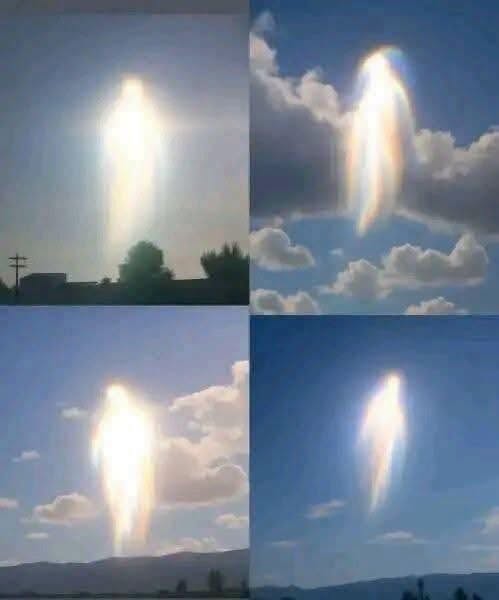
A Dazzling Light Over Ikaria Sparks Wonder — But What Was Really Seen?
Meanwhile, above the Greek island of Ikaria, a dazzling bright-light apparition has captured attention and sparked a wave of questions online. Images and descriptions of an unusually brilliant glow appearing in the sky can look extraordinary, especially when the surrounding landscape is dark and the light seems to hover above the island. For viewers encountering the scene on social media, the natural reaction may be to wonder whether they are looking at a rare atmospheric event, something connected to the sea, or something far more mysterious.
Ikaria, located in the eastern Aegean Sea, is already a place associated with striking natural scenery. Its mountains, coastline, villages, and open views across the water create dramatic conditions for watching the sky. Sunrise, sunset, clouds, reflections, and distant weather can all produce appearances that seem almost unreal when captured by a camera at exactly the right moment.
Several ordinary explanations could potentially account for a bright apparition over or near Ikaria. One possibility is sunlight interacting with high-altitude clouds. Thin clouds made of ice crystals can reflect or scatter sunlight, producing glowing patches, columns, halos, and other unusual effects. Depending on the observer’s position, these features can appear to be concentrated around a particular point in the sky.
Another possibility is a distant light source being distorted by atmospheric conditions. When light travels through layers of air with different temperatures and densities, it can bend slightly. This phenomenon, known as atmospheric refraction, can affect how distant objects appear near the horizon. In some circumstances, it can contribute to mirages or make a light appear displaced from its actual location.
The sea can add another layer to the visual effect. Ikaria is surrounded by water, and the surface of the Aegean can reflect sunlight or artificial illumination. From a particular viewpoint, a bright reflection may appear connected to a cloud or positioned beneath a light source, creating an impression that something is glowing in the sky itself.
Cameras can also create effects that are difficult to recognize from a single image. Bright sources may produce lens flare, internal reflections, starburst patterns, halos, or overexposed areas. If the original photograph has been compressed, cropped, filtered, or reposted, those effects can become even more pronounced. A picture that looks mysterious on a phone screen may therefore have a straightforward optical explanation.
None of this means that every unusual photograph should simply be dismissed. It means that extraordinary-looking observations need context before a reliable explanation can be reached. Useful details would include the exact time and location, the direction the camera was facing, the weather conditions, whether the light moved, how long it remained visible, and whether other people independently observed the same phenomenon.
The distinction between an observation and an interpretation is particularly important online. “A bright light was photographed above Ikaria” is an observation if the image can be verified. Saying that the light was a supernatural apparition, an unidentified craft, or another extraordinary object is an interpretation that requires additional evidence.
Social media can blur that distinction very quickly. A striking photograph may be reposted thousands of times, and each repost can add a more dramatic caption. Within hours, a simple image of an unusual sky effect can become the centerpiece of a story suggesting that something unprecedented has occurred. The original photographer’s description may eventually become separated from the image, making it difficult for viewers to determine what was actually witnessed.
Timing is also crucial. Around sunrise and sunset, sunlight travels through a longer path in Earth’s atmosphere. Shorter wavelengths of light are scattered more strongly, while red and orange tones become more prominent. Clouds can catch this changing illumination and suddenly become bright against an otherwise dark sky. To an observer, the result can look like a glowing object rather than an ordinary cloud illuminated from below or behind.
Another familiar phenomenon is a sun pillar. When sunlight reflects from flat, falling ice crystals in cold, high clouds, it can create a vertical column of light extending above or below the Sun. Related halo phenomena can form rings or bright spots around the Sun or Moon. Although these events are natural, their geometry can be surprisingly dramatic.
For now, the most responsible way to discuss the dazzling image is to treat it as an intriguing observation rather than proof of a particular extraordinary event. Without independently verified information about the photograph or sighting, there is not enough evidence to establish exactly what produced the glow.
That uncertainty does not make the image less fascinating. In fact, it highlights why unusual natural phenomena continue to capture human imagination. The sky can produce colors, shapes, reflections, and optical illusions that seem almost impossible until the science behind them is understood.
The best questions are therefore simple ones: Where exactly was the light? When was the photograph taken? What were the weather conditions? Did the light move independently of the clouds? Were there multiple witnesses? Are there additional photographs or videos from different locations? And can the original file be examined for signs of editing or ordinary optical effects?
Those questions can transform a viral mystery into a genuine investigation. Sometimes the answer is extraordinary. More often, the explanation reveals something equally interesting about light, weather, geography, or human perception.
For residents and visitors to Ikaria, the event is another reminder to look upward. Whether the bright apparition eventually proves to be an atmospheric effect, a reflection, an artificial light, or something that remains unidentified, careful observation matters more than sensational captions.
Until reliable evidence establishes what appeared above the island, the dazzling light remains an intriguing visual mystery. Its beauty is undeniable, but its meaning should be left open until the facts can catch up with the photograph. That is why careful observation remains more valuable than speculation when mysterious images spread online.