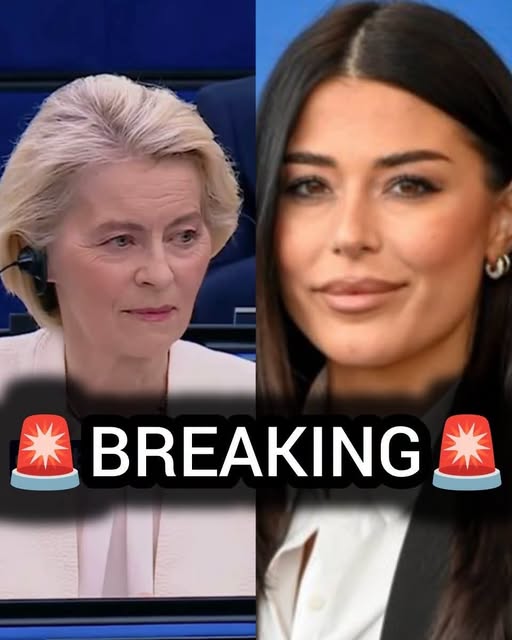
Greek MEP Confronts Ursula von der Leyen in Heated European Parliament Speech
A Greek member of the European Parliament has gone viral after delivering a fierce criticism of European Commission President Ursula von der Leyen during a high-profile debate in Strasbourg, accusing the Commission leadership of damaging Europe through its approach to migration, taxation, environmental regulation and other policies.
The politician was Afroditi Latinopoulou, leader of Greece’s Voice of Reason party. During the European Parliament’s State of the Union debate, Latinopoulou directly addressed von der Leyen and delivered a highly confrontational speech that quickly attracted attention online. Reporting by To Vima described the remarks as a sharp attack on the Commission president.
Latinopoulou accused von der Leyen of pursuing policies that, in her view, have placed excessive burdens on European citizens. Among the issues she highlighted were irregular migration, taxes, bureaucracy, agriculture, industrial production, environmental rules and what she described as a “woke agenda.”
Her strongest criticisms concerned migration.
Latinopoulou argued that Europe has admitted or allowed too many irregular migrants and claimed that this has contributed to problems for European citizens. She also criticized policies that she believes have contributed to what she described as the “Islamization” of Europe.
Those statements represent Latinopoulou’s political position and should not be confused with established findings that von der Leyen personally “destroyed Europe.” That characterization is a political judgment rather than an independently established fact.
The confrontation came only days after von der Leyen delivered her annual State of the European Union address on September 16, 2026. Migration and border security were among the central subjects of that speech.
Von der Leyen presented a significantly different account of the situation.
She argued that Europe’s external borders are shared European borders and said the EU needed a coordinated response to irregular migration. She pointed to the role of smugglers and traffickers and called for stronger cooperation between member states and neighboring countries.
She also announced plans for a new European Emergency Response Framework intended to address exceptional situations involving sudden, large-scale movements of migrants. According to the European Commission, the framework would operate under strictly defined criteria and provide limited flexibility in standard procedures during extraordinary circumstances.
The Commission also highlighted plans to strengthen Frontex, improve early-warning systems and speed up returns.
That means the debate over migration is more complicated than the viral headline suggests. Von der Leyen’s administration is not simply advocating unrestricted migration. Her September speech included proposals for stronger border controls, faster returns and measures against trafficking networks, while also emphasizing asylum rights and legal migration pathways.
The disagreement is instead largely about how far those policies should go and whether they are sufficient.
Latinopoulou and other critics on the right argue that the EU has not done enough to protect national borders and preserve national sovereignty. Von der Leyen and her supporters argue that migration requires a coordinated European response because individual countries cannot effectively manage the EU’s external borders alone.
The debate has become particularly intense following events in Ceuta.
According to Euronews, around 80,000 people crossed irregularly into the Spanish exclave of Ceuta during the July 30–31 crisis, while more than 150 people died. The incident intensified political disagreements inside the European Parliament over how Europe should respond to large-scale migration.
Those numbers and circumstances have become an important part of Europe’s wider migration debate.
Critics argue that the scale of the crisis demonstrates weaknesses in Europe’s border policies. Supporters of the Commission’s approach emphasize the need to protect vulnerable people while combating criminal networks that exploit migrants.
The dispute is not limited to migration.
Latinopoulou also attacked the EU’s economic and environmental policies. She argued that European businesses face excessive regulation and that factories and agricultural producers are struggling under the weight of bureaucracy and competition.
Other critics have made similar arguments, particularly concerning the EU’s climate policies. They contend that ambitious environmental rules can increase costs for European industries while companies outside Europe may operate under different regulatory requirements.
Von der Leyen’s supporters argue that climate and industrial policies are intended to modernize Europe’s economy and reduce dependence on foreign energy and technology.
These disagreements reflect a broader political divide across Europe.
Some political parties are calling for stronger national control over immigration, energy, agriculture and economic policy. Other parties support deeper European integration and common EU-wide solutions.
The European Parliament has become one of the most visible arenas for that dispute.
The tone of Latinopoulou’s speech made the confrontation particularly noticeable. According to To Vima, she used exceptionally strong language when addressing von der Leyen, including accusing the Commission president of being hostile toward Europeans and saying, in substance, that Europe had been ruined under her leadership.
Such language is clearly political rhetoric.
It reflects Latinopoulou’s assessment of von der Leyen’s record rather than a finding established by an independent institution. Readers should therefore distinguish between the actual words spoken by the MEP and the broader claims made about their meaning on social media.
The viral nature of the incident demonstrates how quickly parliamentary speeches can become international social-media stories.
A speech delivered in Strasbourg to other lawmakers can now reach millions of people through short video clips. Those clips are frequently accompanied by dramatic headlines that may emphasize the most controversial portion of a speech while leaving out the surrounding context.
That can make it difficult for viewers to understand what was actually said and what has been added by commentators.
The European Commission’s official record provides additional context. Von der Leyen’s September 16 speech addressed not only migration but also European security, energy, climate resilience, competitiveness, Ukraine, artificial intelligence and relations with Canada.
She argued that Europe needs greater cooperation because the continent faces multiple challenges simultaneously.
Her critics, meanwhile, argue that increased EU coordination can come at the expense of national decision-making.
This disagreement over sovereignty is one of the most important themes behind the confrontation.
Should immigration policy primarily be determined by individual European nations, or should the EU establish stronger common rules? Should environmental policy prioritize ambitious climate targets even when businesses face higher costs? Should Brussels have greater authority over security and economic policy, or should more power remain with national governments?
Different political groups answer those questions differently.
Latinopoulou’s speech represents one of the more strongly critical positions within the European Parliament. Her supporters may see her remarks as an attempt to challenge what they consider an established political consensus. Her opponents may view the rhetoric as unnecessarily divisive.
The important point is that her comments are part of a larger European political debate that is unlikely to disappear.
Migration remains politically significant across the continent, while questions about energy costs, industrial competitiveness, agricultural policy and European sovereignty continue to generate disagreement.
Von der Leyen’s proposed emergency migration framework is now part of that debate. The proposal still requires further institutional and political development, meaning its eventual form could change as European governments and lawmakers consider it.
Meanwhile, opposition politicians will continue pressing the Commission for stronger border controls and different economic policies.
The viral confrontation between Latinopoulou and von der Leyen therefore represents more than one heated parliamentary exchange.
It reflects a much larger argument about what Europe should look like, how much authority should rest in Brussels, how migration should be managed and how European governments should balance economic growth, environmental goals and security.
Latinopoulou has made her position clear.
Von der Leyen has also outlined her position.
For the public, the most useful approach is to examine both the rhetoric and the underlying policies. The viral accusation that one leader has “destroyed Europe” is a political claim, not an objective measurement. The actual record includes specific migration policies, economic regulations, security initiatives and proposals that can be examined individually.
As Europe continues debating its future, those policy differences will remain at the center of political life.
And the fiery exchange in Strasbourg shows just how deep those disagreements have become.