BREAKING: Viral Claim of Russian Su-57 Destroying U.S. Aircraft Carrier Is Not Confirmed
……… See More
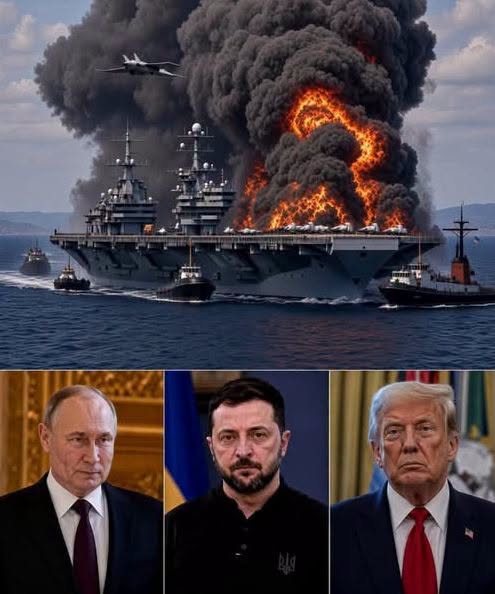
A dramatic claim spreading across social media says that a Russian Su-57 pilot has destroyed a U.S. aircraft carrier carrying hundreds of tanks. The headline has attracted attention because it describes an extraordinary military confrontation between Russia and the United States.
However, there is currently no credible evidence confirming that such an attack occurred.
The specific headline circulating online has been traced to online content associated with a military video-game simulation. A YouTube video carrying essentially the same headline identifies its footage as a virtual combat simulation created using Bohemia Interactive’s ARMA content. The video’s description explicitly states that it is a game simulation and not an actual military event.
That distinction is extremely important.
The Russian Su-57 is a real fifth-generation fighter aircraft, and U.S. aircraft carriers are real military platforms. But combining real military equipment with fictional or simulated footage does not make a reported attack real.
The viral story claims that a Russian pilot destroyed an American aircraft carrier carrying approximately 700 tanks. Such an event would be extraordinarily significant. A successful attack destroying a U.S. carrier would represent a major international military incident and would be expected to generate widespread reporting from governments, defense ministries, and major international news organizations.
The searches available for this claim do not provide that confirmation.
There is also a major question surrounding the claim that the aircraft carrier was carrying 700 tanks. Aircraft carriers are primarily designed to operate and support aircraft. Their internal spaces accommodate aviation fuel, weapons, maintenance equipment, crew facilities, aircraft-support systems, and other military necessities.
Large quantities of armored vehicles are generally transported using specialized military cargo ships, including roll-on/roll-off vessels and other logistics platforms.
That makes the “700 tanks” detail another reason to treat the headline with caution.
The Su-57 itself is a genuine Russian combat aircraft. It was developed as a multirole fighter capable of performing missions involving air combat and attacks against ground targets. Its existence and capabilities, however, provide no evidence that it carried out the specific attack described in the viral post.
This distinction is increasingly important in the age of social media.
Real military equipment is frequently shown in fictional scenarios, training exercises, computer simulations, documentaries, video games, and digitally edited material. Once a video is separated from its original description, viewers may have difficulty determining whether they are watching a genuine event.
The video associated with this particular claim illustrates the problem.
Rather than showing a real Russian attack on an American carrier, the material is identified as ARMA gameplay. The creators themselves describe it as a simulation of an imagined news scenario.
That means viewers should not interpret explosions, aircraft movements, missiles, or ship damage shown in the footage as evidence of an actual battle.
There is another reason the claim deserves careful examination: the timing language.
Posts claiming that something happened “30 minutes ago” or “13 minutes ago” are designed to create urgency. Such wording can encourage people to share information before checking whether it has been confirmed.
A genuine breaking military event should be evaluated using multiple independent sources.
Readers can look for official statements from the U.S. Department of Defense, the U.S. Navy, Russian authorities, and established international news organizations. They can also examine whether reputable journalists have independently verified photographs, videos, locations, or satellite imagery.
If those forms of evidence are absent, caution is appropriate.
This does not mean that military incidents involving Russian and Western forces never occur. In July 2026, for example, Reuters reported that Britain said a Russian maritime patrol aircraft repeatedly approached the aircraft carrier HMS Prince of Wales in the Norwegian Sea. British fighter jets were dispatched to intercept the Russian aircraft.
That was a real reported military encounter, but it was very different from the viral claim about a Russian Su-57 destroying a U.S. aircraft carrier.
Real events can therefore become mixed with fictional stories online.
The U.S. Navy continues to operate aircraft carriers around the world. Reuters recently reported on the USS Abraham Lincoln arriving in Thailand after an extended deployment, providing independently documented evidence of the carrier’s movements.
That kind of independently reported information is much more reliable than an anonymous social-media headline accompanied by simulated footage.
The viral claim also demonstrates why military misinformation can be particularly dangerous.
A fabricated report about an American aircraft carrier being destroyed by Russia could cause unnecessary fear or anger. People may interpret the story as evidence that a major war has begun or that one country has launched an attack against another.
Those conclusions should not be drawn from unverified social-media content.
The most responsible approach is to separate the different pieces of information.
The Su-57 is real.
U.S. aircraft carriers are real.
Military simulations are real.
But there is no credible confirmation in the sources reviewed that a Russian Su-57 pilot destroyed a U.S. aircraft carrier carrying 700 tanks.
The video circulating with the claim is specifically identified as simulated gameplay rather than authentic battlefield footage.
This is also a reminder that impressive visual quality does not prove authenticity. Modern video games and simulations can produce highly realistic aircraft, ships, explosions, landscapes, and combat sequences. Short clips can look convincing when viewed without context.
Before sharing a dramatic military story, readers should ask several basic questions: Who published the original report? Is the source identifiable? Are government officials confirming the event? Are multiple independent news organizations reporting it? Has the location and date of the footage been verified? Could the video be from a game or military exercise?
Those questions can prevent misinformation from spreading.
The extraordinary nature of the claim makes verification even more important. If a U.S. aircraft carrier had genuinely been destroyed by a Russian fighter, the geopolitical consequences would be enormous. Such an event would not normally remain confined to obscure websites and viral social-media posts.
For now, the evidence points in a different direction.
The sensational headline appears to be connected to simulated military content rather than a confirmed attack. The accompanying video should therefore not be presented as evidence that Russia has destroyed an American aircraft carrier.
In a rapidly moving information environment, the difference between a simulation and a real event can become blurred within minutes. That is why checking the original source, identifying the footage, and looking for independent confirmation are essential.
The headline may be designed to sound like an unprecedented military emergency.
But the available evidence does not establish that the event actually happened.
For readers encountering the claim online, the safest conclusion is straightforward: treat the story as unverified and do not mistake the ARMA simulation for real footage of a Russian attack.