Pilot Flies ‘The Rainbow Is God’s, Not Yours’ Banner Over Boise Pride Parade, Renewing Debate Over Faith and LGBTQ+ Rights
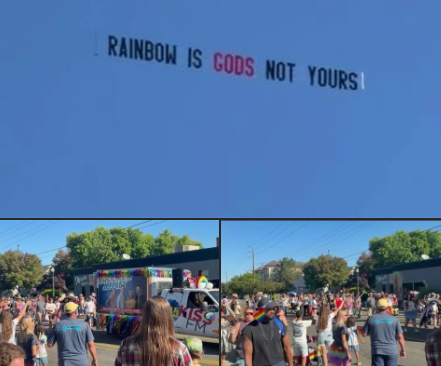
A banner reading “The rainbow is God’s, not yours” has drawn attention during Boise’s Pride celebrations, bringing renewed discussion about Christianity, freedom of expression, and the meaning of the rainbow symbol. The message was reported over Boise, Idaho, during Pride weekend, where thousands of people gathered to celebrate LGBTQ+ identity, community, and inclusion.
The incident is not entirely new. Reports and online discussions document the same message being flown over Boise in September 2023. More recent social media posts have circulated the image again, connecting it to the Boise Pride Parade held on September 20, 2026. The recurring banner has become part of a wider conversation about how religious beliefs and LGBTQ+ visibility intersect in public spaces.
What happened over Boise?
The banner’s wording presents a religious claim about the rainbow, asserting that it belongs to God rather than to the LGBTQ+ community. The phrase is brief, but its meaning is open to interpretation: some may understand it as an expression of Christian belief, while others may see it as a direct challenge to Pride celebrations and the community’s use of rainbow imagery.
A 2023 account from a Boise resident described seeing a small plane pulling the banner during Pride weekend. Other local online discussions from that year also referred to the same message being flown over the city. Those accounts suggest that the banner has appeared before, rather than representing an entirely unprecedented event.
The identity and religious affiliation of the pilot should be treated carefully. Although social media descriptions characterize the person as a Christian pilot, that label should not automatically be taken as independently verified biographical information. The banner itself expresses a religious viewpoint, but that alone does not establish everything about the pilot’s personal beliefs or motivations.
The distinction matters because a news report should separate what can be observed—the wording of the banner and its appearance—from assumptions about the person responsible.
Boise Pride and the meaning of the rainbow
Boise Pride is an annual celebration of lesbian, gay, bisexual, transgender, non-binary, and queer communities. The festival describes its purpose as celebrating social and self-acceptance, achievements, legal rights, and pride. The 2026 parade took place on Sunday, September 20, with the theme “Louder Than Fear.” Organizers said thousands attended, with floats, music, and participants moving along the parade route.
For many LGBTQ+ people, the rainbow flag is a symbol of visibility, solidarity, diversity, and the right to live openly. It has become recognizable around the world at Pride events and is frequently displayed by individuals, community organizations, and businesses.
The banner challenges that meaning by presenting the rainbow primarily through a Christian religious framework. This creates a clash between different interpretations of a symbol that is also a natural phenomenon.
The rainbow existed long before it became associated with either modern Pride celebrations or contemporary debates over public displays. It can carry religious, cultural, scientific, artistic, and personal meanings simultaneously. The existence of one interpretation does not, by itself, erase the others.
The biblical connection
The banner’s reference to God appears to draw on the biblical story of Noah in the Book of Genesis. In that account, following the flood, God places a rainbow in the clouds as a sign of a covenant with Noah and living creatures.
For many Christians, the rainbow therefore carries spiritual significance associated with God’s promise. People who hold this belief may regard the symbol as a reminder of divine faithfulness and the relationship between God and humanity.
However, Christians do not all approach the relationship between the biblical rainbow and LGBTQ+ Pride in the same way. Some emphasize traditional interpretations of scripture and object to the use of the rainbow as a symbol of LGBTQ+ identity. Others support LGBTQ+ inclusion and understand the rainbow’s religious significance as compatible with welcoming and affirming LGBTQ+ people.
Christianity encompasses many denominations, theological traditions, and individual perspectives. A banner flown by one person should not be presented as representing every Christian or the entirety of Christian teaching.
The same principle applies to the LGBTQ+ community, which includes people with a wide range of religious beliefs, including Christians.
Freedom of expression and public disagreement
The incident also raises questions about freedom of expression. In the United States, the First Amendment protects a broad range of speech, including religious expression and messages that others may find offensive or disagreeable.
A person expressing a religious viewpoint in public does not automatically mean that everyone present agrees with that viewpoint. Similarly, people attending a Pride event retain their own rights to assemble, celebrate, display symbols, and express their identities.
The legal circumstances surrounding an aircraft banner can depend on factors beyond its message, including aviation regulations, airspace restrictions, and the location of the flight. The available reports do not establish that the pilot violated any particular aviation rule or that authorities took enforcement action over the banner.
It is therefore important to distinguish public criticism from legal findings. People can disagree strongly with a message without that disagreement establishing that the message was unlawful.
The banner’s wording has attracted criticism in online discussions, with some commenters interpreting it as dismissive of LGBTQ+ people. Others have defended the underlying religious idea that the rainbow has spiritual significance. These reactions illustrate the disagreement surrounding the message, but online comments should not be treated as a representative survey of Boise residents or Christians generally.
A broader debate in Idaho
The banner appeared against a backdrop of continuing discussion about LGBTQ+ visibility in Idaho.
In March 2026, Idaho Governor Brad Little signed House Bill 561, a law restricting which flags government entities may display. Boise removed its Pride flag from City Hall after the legislation took effect. The law provides penalties for government entities that violate its restrictions.
The issue has continued to generate debate about the relationship between state authority, local government, and the expression of community values.
In April, Boise City Hall displayed rainbow-colored artwork and a banner reading “Creating a city for everyone.” City officials said the installation was intended to demonstrate the city’s commitment to being safe and welcoming while complying with the law governing flags.
These developments are separate from the airplane banner incident. The flag legislation concerns government displays, whereas the banner was reportedly flown by a private individual. Treating the two as identical would overlook the different legal and practical questions involved.
Nevertheless, both episodes demonstrate how rainbow imagery has become a subject of public disagreement in Idaho.
Why the incident continues to attract attention
The banner’s short statement is likely to attract attention precisely because it addresses a symbol with multiple meanings.
For some observers, it represents a declaration of religious belief. For others, particularly people who associate the rainbow with LGBTQ+ acceptance, the wording may feel like a rejection of their community’s visibility.
Pride celebrations are often intended to create a space where LGBTQ+ people can gather without hiding their identities. A message challenging the use of the rainbow during such an event can therefore be interpreted in the context of the community’s continuing discussions about acceptance and belonging.
At the same time, religious expression is an important part of American public life. People with religious convictions may wish to communicate their understanding of scripture and symbols, even when their views are unpopular with some members of the public.
Recognizing these competing perspectives does not require assuming that every interpretation has the same consequences for every person. It simply means examining the event accurately and allowing readers to understand the different viewpoints involved.
The importance of accurate reporting
Viral posts frequently use emotionally charged descriptions to encourage engagement. Words such as “breaking” and “just in” can make an older incident appear entirely new, while labels attached to individuals can encourage readers to reach conclusions before examining the underlying evidence.
In this case, the banner’s appearance in Boise has historical context: similar reports date to September 2023. The 2026 Pride Parade is a separate event, and claims about the banner’s appearance during that parade should be distinguished from earlier documented sightings.
Likewise, describing the pilot as Christian should not be confused with establishing that the message represents Christianity as a whole. The banner communicates a particular religious claim, but it does not speak for every believer.
A careful account should also avoid assuming that everyone attending Pride shares the same political or religious views. LGBTQ+ communities are diverse, and individuals may interpret religious symbols in different ways.
A continuing conversation about faith and identity
The airplane banner over Boise has become another example of the public disagreements that can emerge when religious expression meets LGBTQ+ visibility.
Its wording raises questions about who can claim a symbol, how religious traditions are interpreted, and how people with differing beliefs can share public spaces. Those questions are not resolved simply by identifying the banner’s message or the event over which it appeared.
The rainbow has a long history of religious and cultural significance, while its association with LGBTQ+ Pride has become an important expression of identity and community for many people. These meanings can overlap, conflict, or be understood differently depending on an individual’s beliefs and experiences.
Ultimately, the incident illustrates a continuing challenge in a diverse society: protecting freedom of expression while recognizing that public messages can affect people differently.
The available accounts establish that the banner has been reported over Boise before and that it has become a point of disagreement. They do not establish that all Christians support its message, that all Pride participants interpret it identically, or that the flight itself was unlawful.
As Boise continues its annual Pride celebrations, discussions about faith, identity, and public expression are likely to remain part of the broader conversation. Understanding those disagreements requires accurate information, careful distinctions, and respect for the fact that people may hold deeply different beliefs about the same symbol.
The central question is not simply who owns the rainbow, but how