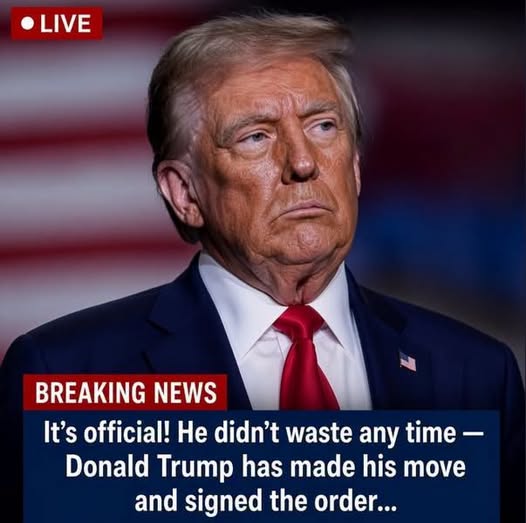
BREAKING NEWS: Trump Signs Executive Order on H-1B Visa Program — What Happens Next?
WASHINGTON — President Donald Trump has signed an executive order addressing the H-1B nonimmigrant visa program, renewing attention on a system used by employers to hire certain skilled foreign workers. The order, signed September 18 and published September 23, is titled “Enhancing Program Integrity and Interagency Coordination in the Administration of the H-1B Nonimmigrant Visa Program.” Its appearance in the public record confirms that a formal action was taken, although the headline alone does not explain every requirement or how it will affect individual workers and employers.
The H-1B program allows qualifying U.S. employers to temporarily employ foreign nationals in specialty occupations that generally require specialized knowledge and at least a bachelor’s degree or equivalent in a related field. Employers in technology, engineering, research, health care and other sectors use the category, though eligibility depends on the job and the worker’s qualifications. It is a temporary immigration classification, not a direct grant of permanent residence.
The order’s stated focus is program integrity and coordination among government agencies. Those terms point to administration and oversight, but readers should avoid assuming that the measure automatically ends the program, cancels every existing visa, or changes every worker’s status. The practical result depends on the order’s operative provisions, agency implementation, and any related regulations or guidance.
A presidential executive order is a formal directive to the executive branch. It can instruct federal agencies to take specified actions within the authority available to the president and those agencies. It does not, by itself, replace every statute governing immigration. When an order directs agencies to develop procedures, issue guidance, or coordinate enforcement, those later steps can be important in determining what employers and applicants must actually do.
That distinction matters for workers already in the United States. Visa classification, permission to remain, and authorization to work are related but separate legal questions. A change in administrative policy may affect future filings or reviews without automatically terminating every previously approved petition. Anyone with an individual immigration concern should examine official instructions and seek qualified legal advice rather than relying on a social-media summary.
Employers also need to distinguish an announcement from an implemented rule. A company may need to review its recruitment, documentation, compliance, and petition procedures if agencies introduce new requirements. However, the existence of an executive order does not establish that a particular new fee, wage threshold, eligibility test, or filing deadline is already in effect. Those details must be confirmed in the order itself and in subsequent agency materials.
The debate around H-1B visas has long involved competing considerations. Supporters argue that the program gives employers access to specialized skills, helps some businesses fill difficult vacancies, and enables companies and research institutions to recruit internationally. They also point to the role of skilled immigration in fields where expertise is in demand. These are arguments made in favor of the program, not a guarantee that every hiring decision benefits every worker or community.
Critics raise concerns about the effect of temporary foreign-worker programs on wages, job opportunities, and bargaining power for U.S. employees. Some argue that employers can become overly dependent on workers whose immigration status is tied to a sponsoring job, while others question whether oversight reliably prevents abuse. These concerns are often debated alongside the program’s contribution to recruitment and innovation. The effects can differ across occupations, employers, regions, and time periods.
The phrase “program integrity” is therefore central to the policy discussion. In general, integrity measures can involve checking whether employers and positions meet eligibility rules, ensuring that filings contain accurate information, and coordinating the responsibilities of agencies. But a broad label does not tell the public which checks will change, how they will be carried out, or what consequences may follow. Those answers require examination of the signed text and official implementation.
Interagency coordination can also shape how an immigration program is administered. Several federal bodies may have distinct responsibilities involving petitions, visa issuance, workplace compliance, or enforcement. Better coordination could be intended to reduce inconsistent decisions or improve detection of violations; depending on its design, it could also increase paperwork or review time. These are possible administrative effects, not established outcomes for every applicant.
The White House’s public materials identify the September 18 measure as an executive order concerning the H-1B program. The published title and date provide a concrete basis for reporting that the president signed an order. They do not justify adding dramatic claims about mass deportations, a complete visa shutdown, or immediate cancellation of work authorization unless the text or reliable reporting supports those claims.
For prospective applicants, the sensible next step is to follow announcements from the federal agencies responsible for the program and confirm which rules apply to the relevant filing date. People considering a job offer should ask the prospective employer how it handles sponsorship and compliance, while recognizing that individual circumstances vary. Existing visa holders should not assume their status has changed merely because a headline announces a new order.
For employers, immigration counsel and human-resources teams may need to monitor any implementing guidance, evaluate current processes, and communicate verified changes to affected staff. Employers should avoid acting on rumors or unofficial summaries, especially where a decision could affect a worker’s employment or ability to remain in the country. The details and effective dates of any new obligations are essential.
The political implications will also be debated. Immigration policy has been a recurring subject of disagreement in the United States, including disputes over labor-market protections, business needs, border and visa enforcement, and the country’s approach to attracting international talent. Different stakeholders may judge the same administrative change according to different priorities. A factual account should describe the measure and its implementation without declaring one side the winner.
What happens next will depend on the order’s specific directives and the actions federal agencies take in response. The public record establishes the signature and the measure’s stated subject. Additional guidance, procedural changes, legal challenges, or clarifications could affect how the policy operates over time. Until those developments are documented, sweeping predictions about its impact would be premature.
The central verified point is straightforward: Trump signed an executive order on September 18 focused on program integrity and interagency coordination in the H-1B visa system. That is a significant administrative development worth following, but the phrase “signed the order” should not be treated as proof of every claim circulating online. Readers seeking to understand the consequences should consult the order and subsequent official guidance, and distinguish confirmed requirements from political interpretation.
As the agencies respond, workers, employers, universities, and other organizations that rely on skilled international recruitment will be watching for clarity about procedures and timing. The questions that matter most are practical: what provisions take effect, who is covered, whether existing cases are affected, what documentation may be required, and how decisions can be reviewed. Those answers—not an incomplete viral headline—will determine what the order means in everyday situations.
Agency instructions and court filings may clarify the scope, deadlines, and review procedures for affected parties as implementation proceeds nationally.