Netanyahu and Abbas Address the UN as Israel-Palestinian Conflict Dominates Debate
NEW YORK — The Israeli-Palestinian conflict is again at the center of international attention as Israeli Prime Minister Benjamin Netanyahu and Palestinian President Mahmoud Abbas address the United Nations General Assembly on Thursday, September 24, 2026.
The two leaders are delivering separate messages at a moment of intense diplomatic and political tension surrounding Gaza, the West Bank, Israel’s military operations, and efforts to advance a political settlement. Their appearances at the 81st session of the General Assembly are being closely watched by governments, diplomats and observers around the world.
The United Nations’ 81st General Assembly general debate is taking place during high-level week in New York from September 22 through September 28. The UN says the general debate brings heads of state, government leaders and other senior representatives to the General Assembly.
Abbas addressed the Assembly earlier Thursday through a prerecorded video rather than appearing in person. According to multiple reports, the United States again denied visas to Abbas and other senior Palestinian officials, preventing them from traveling to New York for the gathering.
In his recorded remarks, Abbas described the situation facing Palestinians as one of the most dangerous periods in their history. He focused heavily on Gaza and the West Bank, criticizing Israel’s military actions and calling on the international community to take stronger action.
Abbas also urged faster implementation of a U.S.-led peace plan for Gaza and renewed his call for a two-state solution to the Israeli-Palestinian conflict. He warned against what he described as another “Nakba,” referring to the mass displacement of Palestinians associated with the 1948 war.
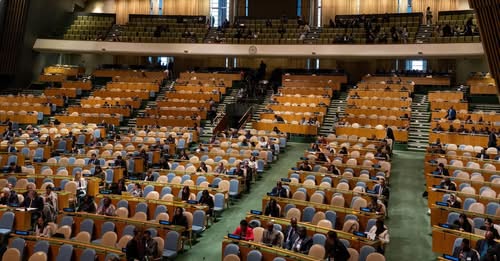
His prerecorded appearance created an unusual scene inside the General Assembly. While Abbas spoke from Ramallah, the Palestinian delegation’s message was transmitted to diplomats and representatives gathered in New York. Reports noted that Israeli delegation seats were vacant during the Palestinian leader’s address, ahead of Netanyahu’s scheduled appearance.
Netanyahu, meanwhile, traveled to New York for his address and was scheduled to speak later Thursday. His appearance comes amid widespread international criticism of Israel’s actions in Gaza and the West Bank.
Before the speech, Netanyahu said he intended to defend Israel’s actions and challenge what his government considers inaccurate or misleading portrayals of the country and its military campaign. Reuters reported that Netanyahu said he would use his UN appearance to defend Israel’s military actions against Hamas and respond to criticism directed at Israel.
The Israeli prime minister has also indicated that he plans to discuss the conflict involving Iran and the wider security environment facing Israel. The Times of Israel reported that Netanyahu’s speech was expected to address the continuing conflict with Iran as well as criticism of Israel at the United Nations.
The speeches are taking place against a broader regional backdrop that extends beyond Gaza. The 2026 General Assembly has been dominated by discussions about conflicts in the Middle East, Ukraine, humanitarian crises and international security.
The United Nations has also placed renewed emphasis on diplomacy and efforts to address global challenges. Secretary-General António Guterres, delivering what has been described as his final General Assembly address before leaving office at the end of 2026, called for an end to wars and emphasized the importance of international cooperation. He also renewed support for a two-state solution between Israelis and Palestinians.
The timing of Netanyahu’s speech has added another layer of political attention. Israel is approaching a national election scheduled for October 27, and his appearance at the United Nations comes only weeks before voters are due to cast ballots. Reporting has noted that his international appearance is occurring during a closely watched period in Israeli politics.
Outside the United Nations, demonstrations have also taken place in New York as Netanyahu arrived for his speech. Protesters have gathered near the UN headquarters to express opposition to Israel’s conduct of the war in Gaza. Reports also described disagreements involving New York City Mayor Zohran Mamdani, who has publicly criticized Netanyahu.
Netanyahu has rejected accusations made against him and Israel by critics. His government maintains that Israel’s military campaign is directed against Hamas and emphasizes Israel’s security concerns following the Hamas-led attack of October 7, 2023.
The conflict has produced enormous human and political consequences. Israeli authorities have continued to emphasize the deaths and kidnappings caused by the October 7 attack, while Palestinian officials and international organizations have focused on the extensive destruction, civilian deaths and humanitarian suffering in Gaza.
The competing narratives are likely to remain a major feature of the diplomatic debate at the United Nations.
For diplomats attending the General Assembly, Thursday’s speeches provide two sharply different perspectives on the same conflict. Abbas is emphasizing Palestinian rights, statehood, displacement and humanitarian conditions, while Netanyahu is expected to focus on Israel’s security, military actions, regional threats and criticism directed at his government.
Neither address by itself can resolve the fundamental disagreements separating Israelis and Palestinians.
The central diplomatic questions remain complex: how to establish lasting security, how to address the humanitarian situation in Gaza, what political future Palestinians will have, how Israeli security concerns can be addressed, and whether negotiations can eventually produce an agreement acceptable to both peoples.
The United Nations continues to serve as a major international forum for those disagreements. Its General Assembly does not itself provide a simple mechanism for resolving the conflict, but the speeches allow national leaders to present their positions before a global audience and seek diplomatic support.
Thursday’s events therefore represent more than two speeches.
They provide a snapshot of the international debate surrounding one of the world’s longest-running and most consequential conflicts. Abbas’s prerecorded address and Netanyahu’s appearance in person also highlight the sharply different diplomatic circumstances facing the two leaders.
As the General Assembly continues through the end of high-level week, attention will remain focused on whether the speeches produce any movement toward diplomacy, whether international pressure changes, and how governments respond to the competing calls for security, humanitarian protection and Palestinian self-determination.
For now, the messages from New York underline how far apart the two sides remain on many of the central questions surrounding the conflict.
The coming days will show whether the diplomatic exchanges at the United Nations lead to concrete initiatives or remain primarily statements of national positions before the international community.
Word count: 1,000 words.