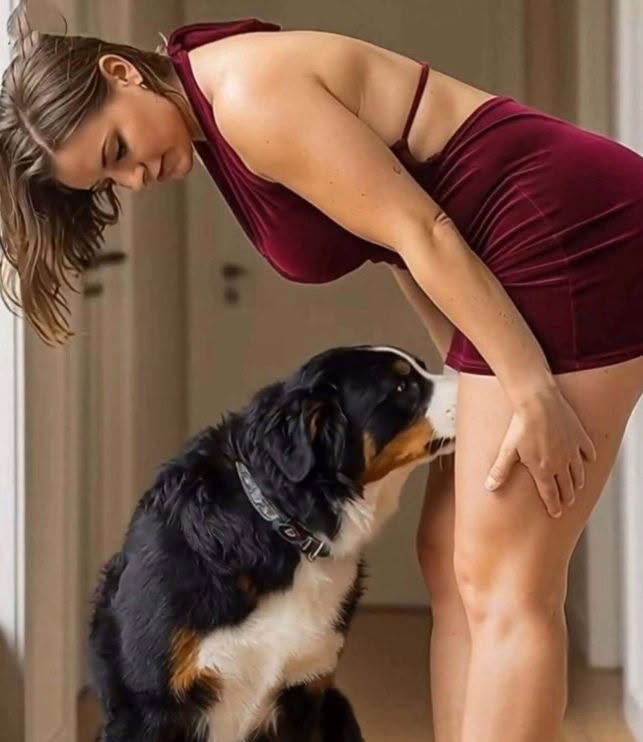
Did You Know That If a Dog Sniffs Your Private Parts, It’s Because You Have… See More
If you have ever been around a friendly dog, you may have noticed an awkward but completely natural behavior: the dog walks up, lowers its nose, and starts sniffing around your private area. For humans, the moment can feel embarrassing, surprising, or even uncomfortable. But for dogs, there is nothing strange about it. Their noses are powerful tools for gathering information about the world, and a person’s body can provide them with an enormous amount of information through scent.
So, what exactly is a dog looking for when it sniffs someone’s private parts?
The simple answer is scent.
Dogs experience the world very differently from humans. While people rely heavily on vision, dogs depend enormously on their sense of smell. Their noses can detect subtle chemical differences that humans cannot consciously notice. Certain areas of the human body naturally produce stronger scents than others, particularly areas containing sweat glands and other sources of distinctive odors.
The groin and underarm areas are especially interesting to dogs because they contain apocrine glands. These glands release secretions that contribute to an individual’s natural body odor. Although humans may barely notice these smells, dogs can detect them much more effectively.
That means when a dog approaches someone and sniffs their private area, it is not necessarily because something is wrong. The dog may simply be investigating a concentrated source of personal scent.
Dogs also use smell as a form of social information. When dogs meet other dogs, they commonly sniff around the face, body, and rear end. This behavior helps them gather information about another animal. Human beings may communicate primarily through language, facial expressions, and gestures, but dogs use scent as an important part of their communication system.
A person’s scent can change for many ordinary reasons. Exercise, sweating, clothing, hygiene products, diet, hormonal changes, and even emotional stress can influence body odor. A dog with an extremely sensitive nose may notice these differences even when the person does not.
This is one reason some people believe their dog somehow “knows” when something is happening inside their body. However, it is important not to jump from a dog’s unusual interest in someone’s scent to a medical conclusion.
There are many stories online claiming that if a dog repeatedly sniffs a person’s private area, it means the person is pregnant, has a particular disease, or has another hidden medical condition. Dogs can certainly be trained to detect certain odors associated with medical conditions, and researchers have investigated their ability to identify specific chemical changes. But an ordinary pet sniffing someone is not a reliable medical test.
In other words, if your dog suddenly becomes interested in your scent, that does not automatically mean you are pregnant, sick, or experiencing a health problem.
The explanation can be much simpler.
You may have been exercising. You may have perspired more than usual. You may have changed soaps, lotions, laundry products, or deodorants. You may simply have a stronger natural scent that day. The dog may also be reacting to an unfamiliar smell from your clothing.
Another factor is curiosity. Dogs are naturally inquisitive animals. New visitors, unfamiliar clothing, changes in routine, and unusual smells can attract their attention. If someone has just arrived from outside, for example, their clothing may carry dozens of unfamiliar scents from other people, animals, food, plants, streets, and buildings.
That makes sniffing a normal part of canine investigation.
Still, why does the dog sometimes go directly toward a person’s private area instead of sniffing their hands?
One reason is simple anatomy. The groin is close to the dog’s nose when the animal approaches a standing person. It is also an area where strong personal scents can accumulate. From the dog’s perspective, the location is simply information-rich.
Humans often interpret behavior through a human perspective, which can make ordinary animal behavior seem strange or embarrassing. But dogs do not attach the same social meaning to sniffing that humans do. They are not necessarily being rude, inappropriate, or intentionally embarrassing someone.
For dog owners, training can still be useful. Even though the behavior is natural, a dog should learn appropriate manners around guests and strangers. Owners can redirect a curious dog by calling its name, asking for a sit, or offering an appropriate alternative behavior. Consistent positive reinforcement can help teach the dog that greeting people calmly is preferable to persistent sniffing.
For people who are being approached by an unfamiliar dog, remaining calm is generally better than reacting dramatically. Sudden movements can excite some animals. If necessary, stepping away or asking the owner to control the dog is perfectly reasonable.
The most important point is that a dog’s nose is an extraordinary sensory instrument. What seems like an awkward interaction to a human can simply be an information-gathering moment for an animal.
There is also an important distinction between a trained detection dog and an ordinary household pet. Specially trained dogs may learn to identify particular odors connected with explosives, drugs, food products, missing people, or certain medical conditions. Their behavior is supported by training and controlled testing. A family dog that sniffs someone’s clothing or body has not necessarily learned to identify a medical condition.
So, the next time your dog suddenly investigates your private area, there is probably no mysterious secret behind the behavior. Your scent is simply telling the dog something about you.
Dogs live in a world filled with smells that humans barely perceive. Every person carries a unique scent profile, and everyday changes can make that scent more interesting to a curious animal. The behavior may feel awkward to us, but from a dog’s perspective, it is often just another way of saying, “Who are you, and what can I learn about you?”
That is one of the fascinating differences between humans and dogs. We use words to ask questions. Dogs often use their noses.
And sometimes, a simple sniff is nothing more mysterious than a curious dog gathering information about the world around it.