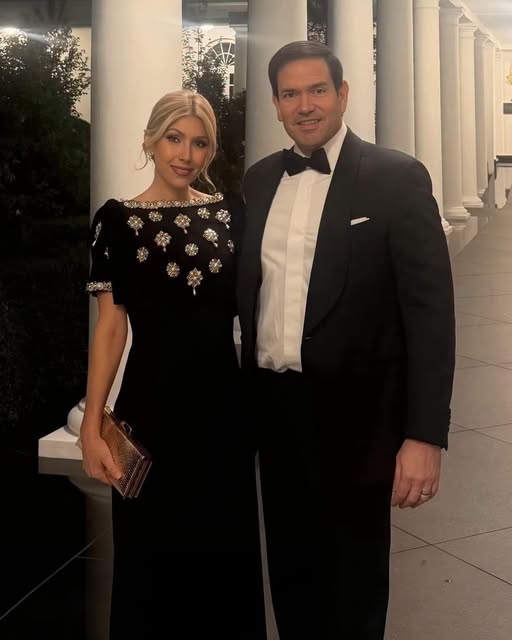
A White House Moment Captures Attention Across America 🇺🇸❤️
A photograph described online as showing a “future president and first lady” at the White House has attracted attention from social-media users, with supporters sharing the image alongside patriotic messages and expressions of admiration.
The caption is short, emotional and designed for a social-media audience: “FUTURE PRESIDENT and FIRST LADY last night at the White House.” The accompanying American flag and heart emojis add to the celebratory tone.
While the caption expresses the poster’s hopes for the future, the phrase “future president” should be understood as an opinion or prediction rather than an established fact. Presidential elections determine who will serve as president, and future outcomes cannot be established from a photograph or social-media post.
Nevertheless, photographs involving political figures and the White House often attract significant attention because of the symbolism associated with the building.
The White House is more than the official residence and workplace of the president. It has become one of the most recognizable symbols of American government. For generations, photographs taken there have documented presidential meetings, celebrations, ceremonies, family moments and major political events.
Being photographed inside or around the White House can therefore carry considerable symbolic meaning.
For supporters of a particular political figure, such a photograph may represent ambition, continuity or the possibility of a future political era. For other viewers, it may simply be an interesting image involving people connected to American politics.
Social media allows those interpretations to spread rapidly.
A photograph that might once have appeared in a newspaper or magazine can now reach thousands or millions of people through Facebook, Instagram, X and other platforms. Captions can also influence how viewers interpret an image before they even know the circumstances in which it was taken.
Words such as “future president” are particularly powerful because they transform an ordinary photograph into a statement about the future.
Political campaigns have long understood the importance of imagery.
Candidates are photographed beside American flags, historic buildings, military personnel, families and other symbols that communicate ideas without requiring a lengthy speech. A carefully composed photograph can suggest leadership, patriotism, confidence or connection with ordinary citizens.
In the social-media era, this visual communication has become even more immediate.
People can share a photograph with a single tap, add their own caption and encourage friends and followers to respond. Comments can then create a second layer of conversation around the original image.
Some people may interpret the photograph as evidence of political momentum. Others may see it simply as a personal or ceremonial moment. Still others may disagree with the political message entirely.
That range of reactions is normal in a politically divided country.
The White House itself has witnessed countless moments that were initially described as ordinary but later became part of the historical record.
Presidents have welcomed foreign leaders, signed legislation, addressed national emergencies and celebrated major achievements from the building. First ladies have also used the White House as a platform for causes involving education, health, children, veterans, culture and other public issues.
The role of the first lady, however, is not an elected constitutional office.
Historically, first ladies have had different priorities and responsibilities depending on their interests, their administration and the expectations of the period. Some have focused heavily on public policy initiatives, while others have concentrated on ceremonial duties or charitable causes.
The political partnership between a president and spouse can nevertheless become an important part of a public image.
Photographs of couples together can communicate unity and familiarity. Supporters may see them as symbols of family and leadership, while critics may interpret the same images differently.
The meaning of political photographs is therefore rarely universal.
One reason the caption “future president and first lady” may resonate with supporters is that political movements often think in terms of generations.
People who strongly support a political leader may imagine a continuing political legacy. They may hope that another member of the same political family, movement or ideological tradition will eventually occupy the White House.
But American politics is unpredictable.
Political careers can change quickly. Candidates can enter or leave races. Voters can change their preferences. Elections can produce unexpected results.
A photograph cannot determine any of those outcomes.
That does not make political photographs unimportant.
Images can reveal how supporters want their movement to be perceived. They can show which symbols are being emphasized and how political personalities are presented to the public.
The American flag in the caption is particularly significant.
The flag is one of the country’s most recognizable national symbols and is frequently used in political photography. It can represent patriotism, national identity, military service, constitutional ideals or simply pride in the United States.
Different Americans attach different meanings to it, but its visual impact is difficult to miss.
Adding a heart emoji gives the caption an even more personal quality.
Instead of presenting the photograph as a formal political announcement, the post presents it as something emotional and personal. The message is essentially asking viewers to see the people in the photograph not merely as political figures but as individuals representing hopes for the future.
That is a common feature of social-media politics.
Modern political communication increasingly combines traditional campaign imagery with personal storytelling. Family photographs, behind-the-scenes moments and informal interactions can receive as much attention as official speeches.
The approach can make politicians appear more relatable, but it can also make it harder for viewers to distinguish between political branding and documented political developments.
A photograph is still only a photograph.
To understand a politician’s actual plans, qualifications or positions, viewers need additional information, including public statements, voting records where applicable, official documents and reliable reporting.
The image may create an emotional impression, but it cannot answer questions about future policy.
That distinction is especially important when captions make predictions.
Calling someone a “future president” expresses confidence that the person will eventually occupy the office. But until an election occurs and the constitutional process is completed, that remains a prediction.
The same applies to the phrase “future first lady.”
American elections are decided by voters and the constitutional process, not by social-media captions.
Still, the popularity of such captions tells us something about political culture.
Millions of people use social media not only to receive information but also to express identity, hope and loyalty. A photograph can become a way of telling others what a person believes or hopes will happen.
In that sense, the caption may be less about documenting a confirmed political event and more about expressing a vision of the future.
The White House provides a particularly powerful backdrop for that vision.
Few buildings in America carry the same political symbolism. Images taken there immediately connect viewers with the presidency, American history and national government.
For someone who dreams of occupying the Oval Office someday, appearing at the White House can be an especially meaningful moment.
But the path from appearing at the White House to becoming president is extraordinarily demanding.
It requires political organization, public support, fundraising, campaigning, policy development and ultimately success through the electoral process.
Many people who have been photographed at the White House have never sought the presidency. Others have pursued political careers without ever reaching the office.
History therefore provides plenty of examples of how uncertain political futures can be.
The photograph circulating online should consequently be appreciated for what it actually shows while treating the accompanying prediction as a prediction.
The image may capture a memorable evening. It may represent a personal milestone. It may inspire supporters. It may even become more significant in retrospect if one of the people pictured eventually holds national office.
But history has not yet written that chapter.
For now, the photograph is a snapshot of a moment and the caption is an expression of hope.
That combination explains why it works so well on social media.
It is short enough to read instantly, emotional enough to encourage reactions and visually connected to one of America’s most recognizable institutions.
Whether viewers agree with the political message or not, the post demonstrates the continuing power of political imagery.
A single photograph can invite people to imagine what comes next.
And sometimes that is precisely why people share it.
The White House has witnessed generations of American history. Presidents have come and gone, political movements have risen and declined, and voters have repeatedly reshaped the direction of the country.
The people pictured in today’s photographs may or may not play a larger role in tomorrow’s history.
Only time, voters and the constitutional process will determine that.
For now, the image remains what it is: a White House moment that has inspired a hopeful political caption and generated conversation among those who see it.
The future, as always, remains unwritten. 🇺🇸❤️