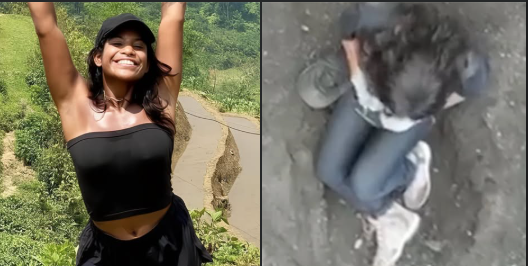
Tragic Final Images of Juliana Marins on Mount Rinjani
The final known images of Brazilian traveler Juliana Marins on Mount Rinjani have become part of a heartbreaking story that captured international attention. Juliana, a 26-year-old Brazilian tourist, was hiking on Indonesia’s Mount Rinjani on June 21, 2025, when she fell from a steep section of the trail. Her accident triggered a difficult, days-long rescue operation involving Indonesian authorities and rescuers.
Mount Rinjani, located on the Indonesian island of Lombok, is a spectacular but challenging destination. Its steep volcanic terrain, exposed ridges, changing weather, loose rocks, and difficult access can make rescue operations extremely complicated. In Juliana’s case, rescuers located her far below the trail, and poor weather and dangerous terrain repeatedly complicated efforts to reach her.
According to Indonesian authorities, Juliana fell into a deep ravine while hiking toward the summit. Initial reports placed her roughly 400 meters below the trail, while later reports described the fall and recovery location as being approximately 600 meters below the trail area. Rescue teams used drones and other equipment to locate her.
The images from the mountain became especially painful for people following the story because they showed just how isolated and dangerous the location was. Juliana was separated from the main trail and surrounded by rugged terrain that was extremely difficult for rescuers to cross. The operation was not simply a matter of reaching a person on an ordinary hiking path. Teams had to work around steep slopes, unstable ground, fog, wind, and limited visibility.
As news of the accident spread, people in Brazil and around the world followed updates closely. Social media users shared photographs and videos while hoping that Juliana could be brought to safety. The rescue operation became a major international story, with her family and supporters waiting for information.
Indonesian officials said rescue teams worked to locate and evacuate her, including the use of thermal-drone technology. A government statement issued on June 24 said a thermal drone had located the victim at significant depth and that preparations were underway for evacuation.
Unfortunately, the rescue ended in tragedy. Juliana was found dead on June 24, several days after her fall. Her body was eventually recovered during a difficult operation involving rescuers working in the hazardous mountain environment. The Associated Press reported that the recovery operation was complicated by steep, rocky terrain and dense fog.
Questions surrounding the circumstances of the accident and the response also emerged. Some reports and social-media discussions focused on whether Juliana had been left alone and whether the guide had acted appropriately. Indonesian police questioned the guide and other people connected with the trek as part of an investigation into what happened. Officials emphasized at the time that allegations of negligence were still being examined and should not be treated as established facts.
That distinction is important because a tragedy can quickly become surrounded by conflicting accounts. Online posts may describe events with certainty before investigators have established what happened. In Juliana’s case, authorities interviewed the trekking organizer, guide, porter, and forestry personnel while examining the circumstances of her fall and the subsequent response.
The medical findings added another important part to the story. Indonesian forensic doctors reported that Juliana suffered severe blunt-force injuries, including multiple fractures and extensive internal bleeding. The Indonesian National Police said the injuries were consistent with impacts from a fall and that the trauma was fatal.
There was also public discussion about how long Juliana survived after the fall. Indonesian forensic authorities initially estimated that she died approximately 20 minutes after suffering the major injuries. Later reporting about a second examination in Brazil presented a different estimate, with Brazilian experts suggesting she may have survived substantially longer. These differing forensic assessments are an important reason to avoid presenting one timeline as unquestionable without explaining the source behind it.
Beyond the investigation, Juliana’s story has remained a deeply human one. She was traveling and exploring another part of the world when a routine adventure suddenly became a life-threatening emergency. Her story reminds travelers that beautiful destinations can also contain serious risks, particularly when hiking at high elevations or in remote volcanic terrain.
Mount Rinjani attracts visitors because of its extraordinary scenery. The mountain offers dramatic views, challenging trails, and an experience that many travelers consider unforgettable. But its beauty can conceal hazards. Weather can change quickly, visibility can disappear, and a seemingly manageable trail can become extremely dangerous.
For hikers, the tragedy also highlights the importance of preparation, experienced guidance, weather awareness, communication, and established safety procedures. A beautiful photograph from a mountain may show only a moment of a much larger journey. Behind every image are conditions that may not be visible in the frame.
The final images associated with Juliana’s journey therefore carry a meaning far beyond their appearance. They are not simply photographs from a vacation. They represent the last documented moments of a young traveler whose life ended unexpectedly while exploring a remote and difficult landscape.
Her death also prompted discussions in Indonesia about safety standards and guide oversight. The Indonesian National Police reported that authorities were investigating possible negligence, while officials from Rinjani National Park evaluated safety procedures.
In July 2025, Rinjani National Park officials said the guide involved in Juliana’s trek had been temporarily prohibited from climbing in the park while the investigation continued, and officials said the guide’s certification would be reviewed.
For Juliana’s family, however, the most important part of the story was never the controversy. It was the loss of a loved one.
Her death generated an outpouring of grief in Brazil, while Indonesian officials expressed condolences. Authorities in Indonesia also worked with Brazilian representatives during the rescue and subsequent procedures. Her remains were eventually returned to Brazil.
Today, photographs from that journey can be difficult to view because viewers know what happened afterward. A normal-looking image can take on an entirely different emotional meaning once the story behind it is known.
That is why the final images of Juliana Marins continue to attract attention. They capture a moment before the tragedy became known, before the rescue operation dominated headlines, and before the world learned how her journey would end.
The photographs cannot tell the entire story. They cannot show every decision, every weather change, every rescue attempt, or every conversation on the mountain. Only a full investigation can establish those details. But they can preserve a fragment of Juliana’s journey and remind people that behind every headline is a real person, a real family, and a life that meant much more than the circumstances of its final days.
Juliana’s story remains a tragic reminder to respect nature, understand the risks of extreme environments, and never underestimate how quickly conditions can change in remote places. Her final known images are painful not because they reveal everything, but because they capture a young traveler shortly before an unexpected tragedy changed everything.