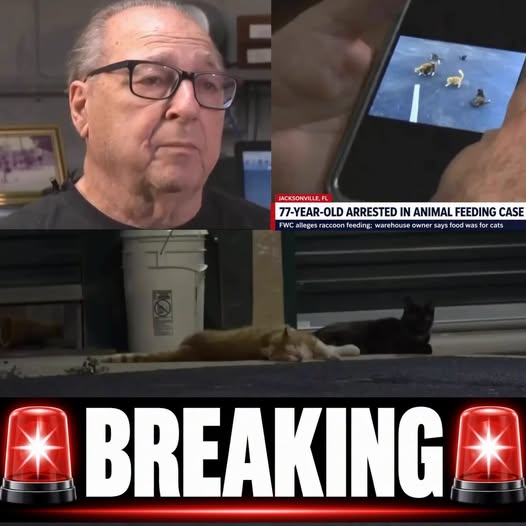
BREAKING: 77-Year-Old Jacksonville Man’s Arrest Over Cat Food Sparks Questions
A story circulating online about a 77-year-old Jacksonville-area man, a bowl of cat food, and a pair of handcuffs has drawn attention and raised questions about how disputes involving stray animals can escalate into criminal enforcement.
According to social-media posts circulating on September 30, the man is identified as Louis Abbruzze. The posts claim that Abbruzze was dealing with a broken ankle and using a cane when officers arrived at a property associated with him. They further allege that he was handcuffed and taken into custody after authorities accused him of feeding raccoons.
The details circulating online are claims, but they remain allegations. Available material does not independently confirm every detail of the arrest, precise charge, or final legal outcome.
The social-media account describes a much larger personal story behind the dispute. It says Abbruzze and his wife lost their only son in 2010. Afterward, several stray cats reportedly began appearing around their warehouse. According to the post, the couple cared for the animals over many years, arranging vaccinations, sterilization, and homes for some of them. Seven cats allegedly remained connected to the property.
The account says Abbruzze continued feeding those cats and allowing them shelter. The post attributes to him the sentiment that the animals became deeply important to him and his wife during a painful period of grief. That emotional background is central to the story now being shared online, because what might otherwise appear to be a simple property or animal-control dispute is presented as something tied to years of companionship and loss.
According to the circulating account, the situation changed after new property management became involved. The post claims that management wanted the warehouse door kept closed and that concerns were raised about animals being attracted to food left outside.
The online account says someone contacted the Florida Fish and Wildlife Conservation Commission, commonly known as FWC, alleging that Abbruzze was feeding raccoons. It further claims that officers initially warned or cited him and that he says he followed instructions to feed the cats while removing food if raccoons appeared.
The most dramatic allegation concerns an encounter described as occurring on September 15. According to the social-media account, officers returned and placed Abbruzze in handcuffs. The post says he told them he could not walk normally because of his broken ankle and needed a cane.
That account has prompted strong reactions online, particularly because the alleged conduct involved food intended for cats rather than an allegation of violence or theft. Images and descriptions of an elderly man with a physical injury being taken away in handcuffs have made the story especially emotional for people who believe the enforcement response was excessive.
At the same time, animal-control disputes can involve legitimate concerns. Feeding outdoor animals can attract wildlife, create sanitation problems, affect neighboring properties, and conflict with rules established by property owners or local authorities. Even when a person intends to help cats, officials may have separate responsibilities involving wildlife management, nuisance complaints, or property regulations.
That distinction matters because the phrase “arrested over cat food” can simplify a potentially more complicated legal situation. If the reported misdemeanor charge involved feeding wildlife or violating an animal-related rule, the legal issue would not necessarily be whether feeding cats is itself illegal. The specific allegation, applicable regulation, location, warnings previously issued, and conduct observed by officers would all be relevant.
The story also illustrates how quickly a local dispute can become a national social-media controversy. A short post can combine personal grief, an elderly person, an injured body, animals, handcuffs, and a seemingly ordinary bowl of food into a narrative that invites an immediate emotional reaction. Those elements are powerful, but they can also make it difficult to distinguish documented facts from commentary.
There is at least some public-record evidence connecting the name Louis Abbruzze with Jacksonville-area business activity. Florida corporate records list a Louis S. Abbruzze as an officer and director of LSA International Inc., a company with a Jacksonville address. Those records establish the identity of a person with that name and a Jacksonville business connection, but they do not independently establish the details of the reported arrest or the animal dispute.
The online account also says that the cats had been part of Abbruzze’s life for many years. If accurate, that history helps explain why the confrontation has resonated with animal lovers and people who have experienced grief. Caring for stray animals can become an important routine, especially for people who develop long-term relationships with animals that depend on them.
For now, the most responsible way to describe the incident is as a developing and disputed account. The social-media posts make specific allegations about Abbruzze, the cats, FWC officers, the property, and the reported misdemeanor. Those claims deserve verification through police or court records, statements from the relevant agency, and reporting from established local news organizations.
What is already clear is that the story has touched a sensitive question: how should communities balance compassion for people caring for stray animals with rules designed to control wildlife, protect property, and address neighborhood concerns?
For Abbruzze, if the account is accurate, the dispute is about much more than a bowl of food. It is connected to years of caring for animals and, according to the circulating story, to a family tragedy that changed his life.
For everyone following the case, the next important details will be the official charge, the circumstances surrounding the reported handcuffing, whether any citation or arrest record is available, and what authorities say happened. Until those details are independently established, the strongest claims should be treated as allegations rather than settled facts.
The story may continue to develop, but its central image—a 77-year-old man with a broken ankle, a cane, stray cats, and handcuffs—has already captured widespread attention. It is a reminder that seemingly small disputes can become complicated when personal grief, animal welfare, property rules, and law enforcement meet in the same place.