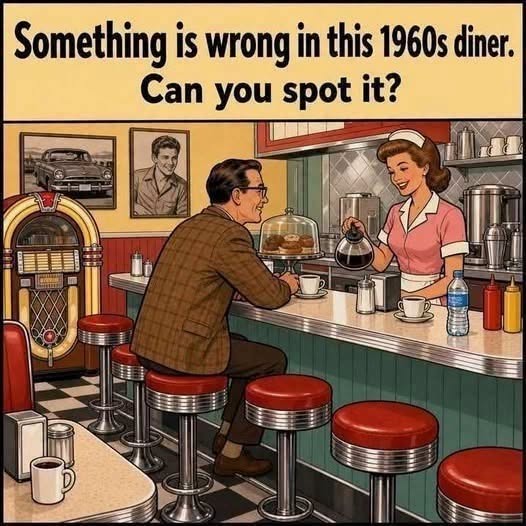
Something Is Wrong in This 1960s Diner. Can You Spot It?
At first glance, the scene looks like a snapshot of American life in the 1960s. There is a diner, shiny tables, familiar counter stools, bright lighting, and the unmistakable atmosphere of an era when roadside restaurants were social gathering places as much as they were places to grab a meal. The clothing, furniture, colors, and design all seem to fit the period.
That is what makes vintage-image puzzles so entertaining. The photograph may look completely authentic when you first see it, yet one small detail can reveal that something has been added, moved, redesigned, or simply does not fit the historical period. The challenge is training your eyes to notice the tiny detail that everyone else overlooks.
The first thing to remember is that the 1960s were a very specific time in American design. Diners commonly featured chrome trim, vinyl booths, Formica tables, stainless-steel counters, patterned floors, neon signs, glass display cases, and brightly colored interiors. Men and women often dressed more formally than people do in many restaurants today, particularly during the earlier part of the decade. Waitresses could wear uniforms, customers might sit at a counter, and jukeboxes were often an important part of the atmosphere.
Look closely at the objects rather than simply looking at the overall scene. Ask yourself whether every item could realistically have existed in a diner during the 1960s. Does the technology make sense? Does the packaging look period-correct? Are the signs using a style that existed at the time? Is there an appliance, electronic device, or piece of furniture that seems suspiciously modern?
One of the easiest ways for a modern object to hide in a vintage scene is through technology. Telephones, televisions, cameras, clocks, payment machines, and other electronic devices changed dramatically over the decades. A modern-looking screen, digital display, wireless device, or contemporary control panel can immediately break the illusion.
Another clue is advertising.
Diners were filled with signs promoting drinks, cigarettes, hamburgers, desserts, and other products. Many familiar brands existed decades ago, but their logos, packaging, slogans, and typography changed over time. A package that looks almost right may still reveal the mystery if its design was introduced years later.
Modern restaurant furniture can resemble older furniture surprisingly well, especially when a photograph is designed to imitate a historical setting. Small details can give it away. The shape of a chair, the materials used, the style of a light fixture, or even the construction of a countertop may belong to a later period.
Fashion changed rapidly during the 1960s. Early-1960s clothing looked different from late-1960s clothing, and the decade contained major shifts in hairstyles, suits, dresses, skirts, shoes, and accessories. If someone appears to be wearing something associated with a much later decade, that could be the clue.
However, there is an important complication with puzzles like this: not every unusual object is automatically wrong.
Vintage diners sometimes remained in operation for decades. A restaurant that opened in the 1950s could still contain an appliance or decoration installed much later. A photograph taken in a diner with retro decoration does not necessarily prove that every object visible in it dates from the original period.
The wording of the puzzle itself is also important. If the scene is presented specifically as a 1960s diner, viewers are expected to examine the image for an anachronism. The mistake may be obvious once someone points it out, but nearly invisible before then. Your brain tends to accept the overall story of an image before checking every individual detail.
This is why the best visual puzzles are rarely about one enormous mistake. They are often about something small enough to disappear into the background. It might be an object on a table, a sign behind the counter, a piece of equipment, a logo, or an item someone is holding.
Start at one side of the scene and slowly move toward the other. Examine every table. Look behind the counter. Check the walls. Inspect the signs. Look at what customers are holding. Then examine the appliances and decorations.
A telephone could certainly be there. But what kind of telephone?
A television could certainly be there. But what kind?
A menu could certainly be there. But does its design match the period?
A vending machine could certainly be there. But does its branding belong to the decade?
Those questions turn a casual glance into historical detective work.
And sometimes the answer is not an object at all. The problem may be a detail in the architecture, a word on a sign, a road marking visible through a window, or another background feature. Even the calendar or clock can become evidence. Historical puzzles reward patience because the clue may be hiding in the least important-looking part of the picture.
There is another reason these images remain popular. They encourage people to compare their memories of the past with the reality of the past. Older generations may recognize certain diner features immediately, while younger viewers may rely on movies, television shows, and photographs to understand what the era looked like.
One person may insist that an object is perfectly authentic. Another may recognize it as a later invention. Someone else may notice that the object existed at the time but was not commonly used in diners. The discussion becomes part of the puzzle.
Without the actual image in front of us, there is no reliable way to identify the specific hidden object. The puzzle depends on visual evidence, and naming a particular object without seeing the photograph would simply be a guess.
But the next time you see the image, slow down.
Ignore the obvious retro atmosphere. Ignore the neon. Ignore the chrome. Ignore the hairstyles.
That is what makes a good “spot the mistake” puzzle so satisfying: the answer can be hiding in plain sight, waiting for someone to stop looking at the picture as a whole and start looking at it piece by piece.
The smallest detail may be the biggest clue.