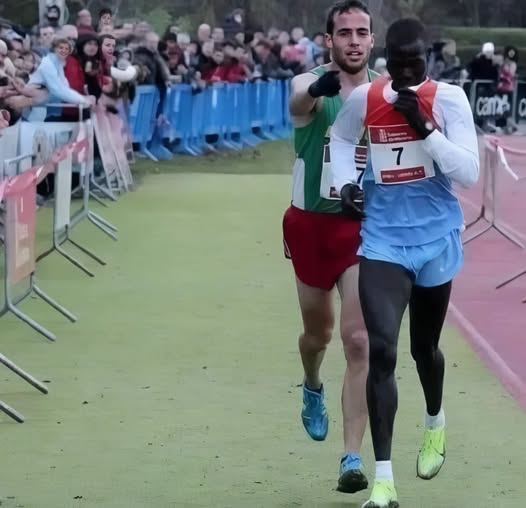
WOW: The Legendary Moment Iván Fernández Anaya Chose Sportsmanship Over Victory
On December 2, 2012, a remarkable scene unfolded during a cross-country race in Burlada, Navarre, Spain. Spanish runner Iván Fernández Anaya had every reason to keep pushing. Yet, in a moment that would later become famous around the world, he made a choice that changed the meaning of winning.
Fernández was running in second place behind Abel Mutai, a Kenyan distance runner who had already established himself as an elite athlete. Only months earlier, Mutai had won a bronze medal in the 3,000-meter steeplechase at the London Olympics. During the Spanish race, he was comfortably ahead and appeared certain to win.
As the runners approached the finishing straight, something unexpected happened. Mutai slowed and stopped roughly ten meters before the actual finish line. He appeared to believe that he had already completed the race. Fernández, who had been chasing him from behind, suddenly found himself with an extraordinary opportunity.
He could have simply continued running.
Had he done so, Fernández would have passed Mutai and crossed the finish line first. No rule required him to stop. No official was telling him to wait. In the intense final seconds of a race, competitors are normally expected to take every legal advantage available.
Instead, Fernández recognized that Mutai had made an honest mistake.
Rather than sprinting past his rival, Fernández used gestures to show Mutai where the real finish line was. He stayed behind him and guided him forward. According to contemporary reports, Fernández even helped direct Mutai toward the line so the Kenyan could finish first.
Mutai crossed the line ahead of Fernández, preserving the victory that appeared to have been his before the mistake. Fernández finished behind him, but the story of the race did not end with the official results.
It became a story about character.
When Fernández was later asked about his decision, he explained the principle behind it simply. He said he did not deserve to win because Mutai had been the rightful winner. The explanation captured the principle behind his choice. A victory created by exploiting an opponent’s genuine misunderstanding would not feel like the victory he wanted.
Sports are built around competition. Athletes train for years to become faster, stronger, and more prepared than their rivals. Finishing first is the goal of a race. But sports also depend on rules, respect, and a shared understanding that competition should be conducted fairly.
Fernández’s decision became a powerful example of that principle.
The incident later attracted international attention, and Fernández was recognized for his sportsmanship. The inaugural Save the Dream Award for sportsmanship was presented to him, highlighting the lasting impact of his decision.
The story also gained enormous popularity online, where it was repeatedly shared as an example of honesty. However, there is an important detail that often gets lost when the story is reposted on social media.
The incident itself is genuine, but some photographs circulated with the story are not.
Fact-checkers have established that a widely shared photograph supposedly showing Fernández and Mutai actually depicts British runner Mo Farah and American runner Galen Rupp after the men’s 10,000-meter final at the 2012 London Olympics. The incorrect photograph does not change what happened in Burlada, but it is a reminder that even inspiring stories can become mixed with inaccurate images as they travel across the internet.
It presents a question that extends far beyond running: What does winning really mean?
For Fernández, the answer was apparently not limited to the name listed first in the results. He had the chance to receive the official victory by passing a confused competitor. Instead, he chose to preserve the result he believed reflected the race before the mistake occurred.
That decision did not make Fernández less competitive. In fact, it demonstrated that competition and sportsmanship can exist together.
Mutai’s Olympic credentials also add context to the story. He was not an unknown recreational runner who accidentally wandered into a major competition. He was an accomplished international athlete and an Olympic bronze medalist. Fernández understood that he was chasing someone who had earned the right to be taken seriously.
The remarkable part was that Fernández did not treat Mutai’s mistake as an opportunity to rewrite the outcome.
In today’s world of constant competition, the lesson remains surprisingly relevant. People compete for jobs, grades, promotions, recognition, customers, followers, and opportunities. Sometimes success can come from noticing another person’s mistake before anyone else does. The temptation is to take advantage and move ahead.
The Fernández story offers a different possibility: sometimes integrity matters more than an immediate reward.
That does not mean every competitor should surrender legitimate opportunities. It means there are moments when circumstances matter, and when fairness can require something beyond simply asking whether an action is allowed.
More than ten years after the race, the image of Fernández guiding Mutai toward the finish remains memorable because it is so simple. One runner was ahead. Another runner had a chance to pass. Instead of doing so, he helped the leader finish what he had started.
There was no complicated strategy and no dramatic speech required.
There was simply a decision.
Fernández could chase the result, or he could respect the race.
He chose respect.
The official record may show who finished first and second, but the enduring story is about something harder to measure. It is about how a person behaves when nobody can force them to do the right thing.
That simple decision made the moment unforgettable for millions.
That is why the Burlada race continues to be remembered. Fernández did not become famous because he crossed the finish line first. He became famous because, when victory suddenly became available through another runner’s mistake, he decided that some victories were not worth taking.
And perhaps that is the most enduring lesson of all: winning can put your name at the top of a results sheet, but integrity can leave a mark long after the race is over.