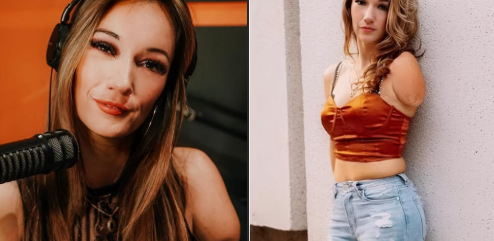
Charlie Rousseau: The Remarkable Story of a Life That Refused to Be Defined by Circumstances
Charlie Rousseau’s story is one of survival, determination, and a life that has unfolded in ways few people could have predicted. Born in Quebec with significant limb differences, Rousseau grew up without initially understanding why her body looked different from those of other children. Years later, she learned from her mother that an attempted abortion during the pregnancy had reportedly failed, and that doctors had advised her parents to continue the pregnancy. Rousseau has since spoken publicly about her experiences, while also making clear that her story does not fit neatly into the political arguments people often attach to abortion.
According to interviews and profiles published about Rousseau, she was born with one arm, no elbows or knees, shortened legs, and fewer digits than most people. The exact descriptions of her anatomy vary somewhat between accounts, but the central facts are consistent: she has lived her entire life with congenital limb differences and has developed ways to navigate daily activities independently.
What makes her story particularly striking is that she did not grow up seeing herself primarily through the lens of disability. In a 2022 interview reported by LADbible, Rousseau said she attended a regular school, had ordinary friendships, and did not fully recognize herself as disabled until she was a teenager. Her perspective changed as she became older and began thinking more about relationships, dating, and how other people might perceive her.
The revelation about her birth came during adolescence. Rousseau said her mother eventually explained that she had attempted to end the pregnancy but that the procedure did not succeed. Her parents had reportedly chosen not to make the circumstances public while she was growing up because they feared the story could follow her and affect how people treated her. Rousseau later shared the story herself, turning a deeply personal family experience into part of a broader conversation about disability, identity, and resilience.
It is important to distinguish Rousseau’s account from independently verified medical records. Public reports largely rely on interviews in which Rousseau describes what her mother told her. They do not provide a complete medical history or documentation that allows outsiders to reconstruct exactly what happened during the pregnancy. Descriptions such as “failed abortion” or “botched abortion” therefore reflect the language used in reporting and commentary, rather than a complete independent medical finding.
Rousseau’s own views also complicate the way her story is sometimes presented online. In a 2024 profile by Quebec publication Urbania, she said that she supports access to abortion and believes there are circumstances in which it can be a valid choice. That position is significant because social-media posts sometimes present her solely as a symbol in arguments against abortion. Her public comments show that she does not describe herself that way.
Instead, Rousseau has emphasized living her life rather than allowing her circumstances to define her. Travel became a major part of that philosophy. In 2019, she moved to Britain to teach French, and during that period she traveled to other countries, including Mexico and Australia. The COVID-19 pandemic interrupted her plans and forced her to return to Canada in 2020, but she later resumed traveling.
She has openly discussed the practical difficulties involved. Airports, luggage, transportation, and everyday tasks can require extra planning when someone has significant limb differences. Yet Rousseau has repeatedly described strangers as willing to help when she needs assistance. Her message has been straightforward: do not postpone living because life is unpredictable.
That attitude has also shaped her professional life. Rousseau has worked as a radio host and performer and has developed an audience through social media. In 2024, Urbania reported that she had launched a travel podcast called Les Backpackeuses with Pascale Ruas. She also appeared in the television series Vestiaires, a comedy centered on athletes with disabilities. Radio-Canada and other Canadian media have continued to feature her work, demonstrating that her identity extends far beyond the circumstances of her birth.
Her story can be viewed from several perspectives. For disability advocates, it illustrates how a person can build an active, creative, and independent life while navigating physical limitations. For people involved in abortion debates, it is a powerful personal story that raises questions about medical outcomes, informed consent, and how society understands people born with disabilities. But Rousseau herself has resisted being reduced to a political symbol.
That distinction matters. A person’s life can inspire a discussion without becoming proof of every argument surrounding that discussion. Abortion is a complex medical, ethical, legal, and personal issue, and individual stories cannot by themselves establish broad conclusions about medical practice or public policy. Rousseau’s experience is best understood as her own testimony: deeply personal, unusual, and meaningful, while still limited by what can be independently documented.
Perhaps the most enduring part of Rousseau’s story is what happened after the circumstances of her birth. She grew up, went to school, built relationships, worked, traveled internationally, entered entertainment, and shared her experiences with a growing audience. Rather than spending her life trying to hide the differences that once made her feel separate, she has used them as part of a much larger story about independence.
Her journey also challenges a common assumption that disability automatically means a smaller life. Rousseau has demonstrated through her choices that physical limitations can create real obstacles without determining every possibility. Her travels, media work, and public appearances show someone who has deliberately pursued experiences that might once have seemed difficult or inaccessible.
There is also a deeply human element to the story. Learning that the circumstances surrounding your birth were different from what you believed for much of your childhood could raise complicated emotions. Rousseau has chosen to speak about that revelation publicly while continuing to focus on the life she has built. Her approach is not about pretending difficulties do not exist. It is about refusing to let those difficulties become the only story people see.
What makes Rousseau’s story memorable is what she did with the life that followed. She grew up, worked, traveled internationally, entered media, and became comfortable sharing her experiences publicly. She has described practical challenges involving airports, luggage, and everyday tasks, but she has also emphasized that people will help.
Her journey has appeared in media. She has worked as a radio host and performer, created the travel podcast Les Backpackeuses with Pascale Ruas, and appeared in Vestiaires. These accomplishments show that her identity extends beyond her birth.
Rousseau’s story deserves careful presentation. Her account is personal, and public reporting does not provide a complete medical record establishing every detail. Her determination and achievements, however, are documented through interviews and media profiles.
Ultimately, Rousseau has focused on living rather than being defined by a headline. Her story is deeply personal. Whatever people believe about abortion or disability, her life shows that a difficult beginning does not define the entire future today.