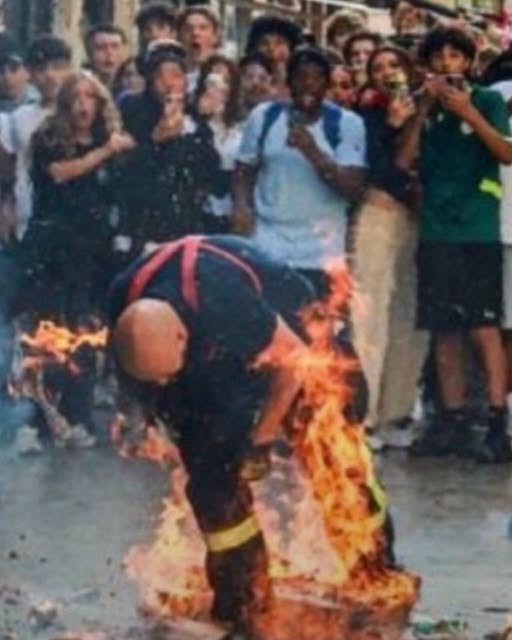
This Image From France Alone Has Just RADICALISED the Entire Western World…
Sometimes, a single photograph can capture a mood that thousands of words struggle to explain. One image emerging from France has sparked an enormous wave of discussion online, with people across the Western world stopping to ask what they are actually looking at, what it represents, and why it has generated such an intense emotional reaction.
The claim that the photograph has “radicalised the entire Western world” is, of course, a dramatic description rather than something that can literally be measured. The Western world is made up of hundreds of millions of people with completely different political beliefs, cultural backgrounds, experiences, and opinions. Yet the phrase reflects something real about the power of viral images: photographs can become symbols almost overnight.
In an era when people encounter enormous amounts of information every day, an image can sometimes communicate more quickly than an article, speech, or television interview. Viewers see a particular moment, interpret it through their own experiences, and then share it with friends, family members, and strangers. Within hours, an image that was originally seen by a relatively small audience can become part of a much larger cultural conversation.
That appears to be what has happened with the photograph from France.
The reaction has not been uniform. Some viewers have described the image as shocking, disturbing, or revealing. Others have questioned the context surrounding it and warned against drawing sweeping conclusions from a single photograph. Still others have used the image as evidence for arguments they already held about immigration, national identity, public safety, political leadership, cultural change, or the future direction of European societies.
That difference in interpretation is important.
A photograph does not automatically explain everything happening outside the frame. It captures one moment, from one angle, at one location, at one point in time. Without reliable information about when the photograph was taken, where it was taken, who appears in it, and what happened immediately before and afterward, viewers can easily reach conclusions that the photograph itself cannot establish.
Nevertheless, images can have enormous political and cultural influence.
France has long occupied an important place in debates about identity, secularism, immigration, national unity, religion, and the relationship between citizens and the state. These subjects can be highly emotional because they touch questions that are deeply personal. People may look at the same event and see completely different things depending on their background and beliefs.
For some, the photograph may represent a warning about changes they believe are happening too quickly. For others, it may represent a society struggling with problems that require greater understanding rather than confrontation. Others may simply see an extraordinary moment that has been removed from its original context and transformed into a political symbol online.
Social media intensifies this process.
Algorithms reward content that generates strong reactions. A calm explanation of a complicated event may receive relatively little attention, while a dramatic photograph accompanied by an emotionally charged headline can spread rapidly. People click, comment, argue, repost, and react. Each interaction gives the content another opportunity to reach someone new.
Eventually, the original photograph can become almost secondary to the discussion surrounding it.
The words placed above an image can influence how millions of people interpret what they see. Calling something “proof,” “a warning,” “a disaster,” or a “turning point” encourages viewers to approach the photograph from a particular perspective. Once an interpretation becomes widespread, people may begin sharing the image not because they know its full context, but because it appears to confirm something they already believe.
That phenomenon is not unique to France.
Throughout modern history, powerful photographs have influenced public opinion, journalism, activism, and political debate. Images of wars, protests, natural disasters, historic speeches, and humanitarian crises have sometimes become defining symbols of entire eras.
The internet has simply accelerated the process.
A photograph can now travel across continents before journalists have finished verifying its origins. A screenshot can be reposted thousands of times. A caption can be changed. Context can disappear. Old photographs can be presented as new ones, while genuine recent photographs can be interpreted without sufficient background information.
That is why emotional reactions should be separated from factual conclusions.
It is perfectly reasonable for an image to make people angry, frightened, saddened, surprised, or curious. What matters is what happens next. Do viewers look for the original source? Do they check when and where the photograph was taken? Do they search for reporting from multiple reputable organizations? Do they distinguish what the image actually shows from what someone claims it proves?
Those questions become especially important when an image is being used to make sweeping claims about an entire country, religion, political movement, ethnic group, or population.
France is not a single photograph.
Neither is Europe.
And neither is the Western world.
Millions of people can experience the same society in completely different ways. A viral image may highlight a genuine problem, but it cannot by itself explain an entire country’s circumstances or predict where society is heading.
What makes this particular photograph so fascinating is therefore not simply the picture itself, but the reaction surrounding it. The intensity of the online response demonstrates how deeply people are thinking about questions of identity, security, culture, political accountability, and social change.
Whether someone views the photograph as a warning, a misunderstanding, a powerful symbol, or simply an unusual moment depends heavily on the information they bring to it.
That is precisely why the conversation deserves more than an angry headline.
If the image represents something genuinely important, understanding the full story makes the argument stronger, not weaker. Facts, dates, locations, firsthand accounts, and credible reporting can reveal whether the dramatic claims circulating online are justified or whether the photograph has been transformed into something far larger than the original event.
The phrase “radicalised the entire Western world” may be designed to provoke attention, but the real story is more complicated.
A single image can certainly change conversations.
It can expose emotions that were already present beneath the surface. It can bring forgotten issues back into public discussion. It can cause people to question institutions, challenge assumptions, or reconsider beliefs they previously took for granted.
But perhaps the most important lesson is that powerful images should encourage people to investigate, not simply react.
The photograph from France may continue circulating for days, weeks, or even years. Its meaning will likely change depending on who shares it and why.
And that may ultimately be the most remarkable thing about viral images: they do not merely show us a moment.
They show us how people choose to interpret that moment.