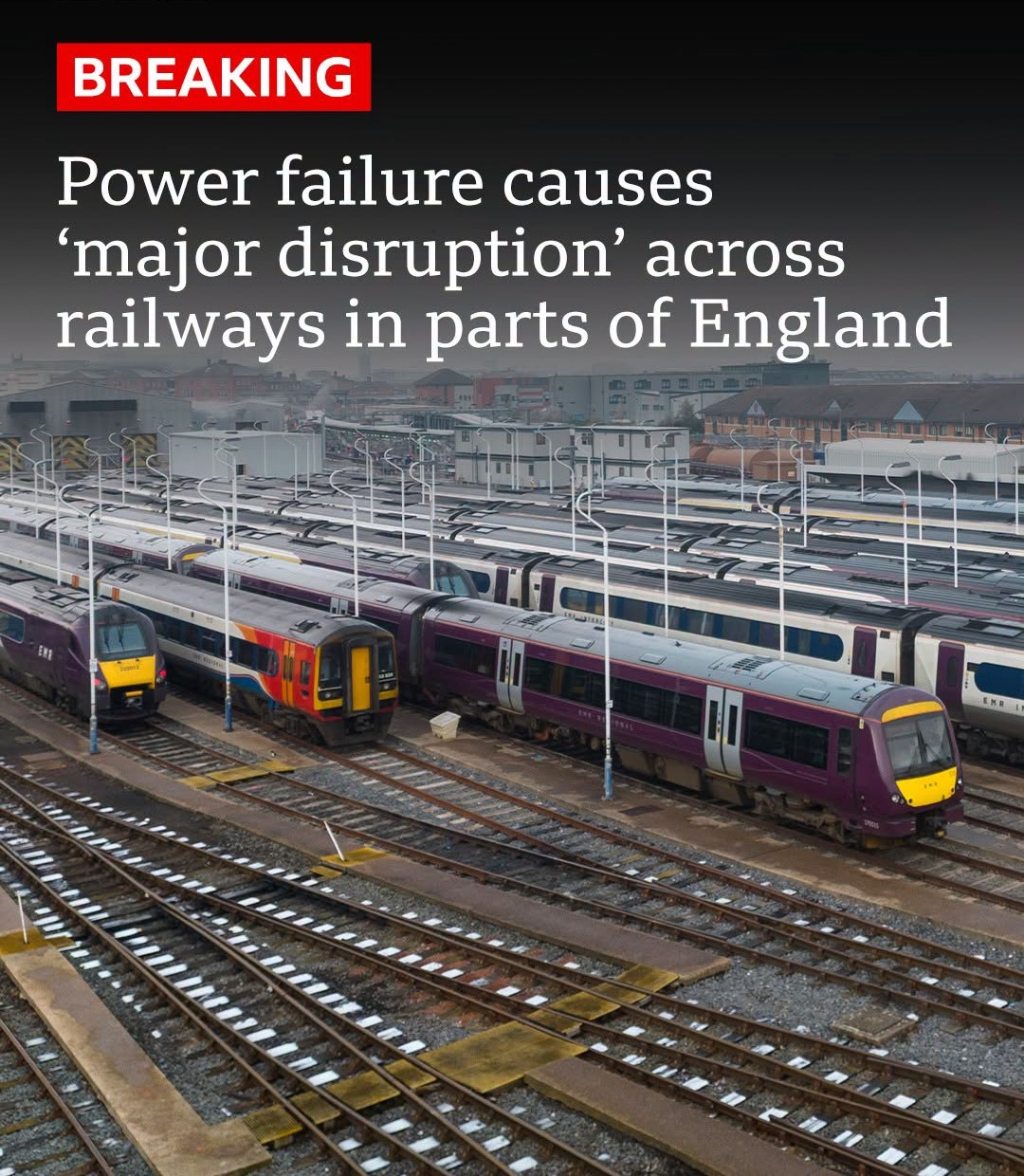
Major Rail Disruption Across the Midlands and Northern England After Electrical Failure
Thousands of rail passengers across the Midlands and the north of England experienced significant travel disruption after an unexpected electrical failure affected large sections of the railway network. The incident, which occurred during one of the busiest travel periods of the day, led to widespread delays, cancellations, and reduced services, leaving commuters, tourists, and business travelers searching for alternative ways to reach their destinations.
National Rail confirmed that the disruption was caused by an electrical fault affecting infrastructure used to power railway operations. Although engineers were immediately dispatched to investigate and repair the problem, officials warned that services could remain disrupted for several hours while technicians worked to safely restore the network.
For many passengers, the morning began like any other. Commuters arrived at stations expecting routine journeys to work, students prepared to travel to universities, and families boarded trains for holidays and day trips. However, electronic departure boards soon began displaying delayed and canceled services, while station announcements informed travelers that trains were unable to operate normally.
Within minutes, platforms became crowded as passengers waited for further information. Customer service desks experienced long queues as travelers sought advice on refunds, replacement buses, and alternative rail routes.
Across major stations in Birmingham, Manchester, Leeds, Sheffield, Nottingham, Liverpool, and surrounding areas, railway staff worked continuously to assist passengers. Loudspeaker announcements were updated frequently as engineers assessed the extent of the electrical failure.
The disruption quickly spread throughout the railway network.
Because Britain’s rail system is highly interconnected, delays affecting one major route often have consequences hundreds of miles away. Trains that could not complete scheduled journeys were unavailable for later services, while train crews found themselves stranded at locations different from where they were expected to begin their next shifts.
Transportation experts often describe this as a “domino effect.”
A single infrastructure problem can gradually affect dozens of routes as trains, staff, and equipment fall out of position.
Passengers expressed a mixture of frustration and understanding.
“I’ve been waiting for over an hour,” one commuter said while standing at Birmingham New Street Station. “It’s disappointing, but I appreciate that safety has to come first.”
Another traveler heading to Manchester explained that she missed an important business meeting after multiple services were canceled.
“I understand technical problems happen,” she said. “I just wish there had been more information earlier.”
Rail operators emphasized that passenger safety remained their highest priority.
Electrical systems powering modern railways are highly sophisticated, supplying energy to overhead lines, signaling equipment, communications systems, and various operational technologies. Before services can resume following any major fault, engineers must carefully inspect damaged infrastructure to ensure it is safe.
Network Rail teams were dispatched across affected areas carrying specialized diagnostic equipment.
Engineers examined substations responsible for distributing electricity to railway lines, inspected overhead cables for visible damage, and tested signaling systems to identify any related faults.
Some specialists focused on restoring electrical supply, while others coordinated train movements to prevent further disruption elsewhere on the network.
Control centers remained active throughout the day.
Large digital displays monitored train locations in real time while operations managers communicated with station staff, emergency planners, and train companies to coordinate responses.
Passengers were encouraged to delay non-essential travel whenever possible.
For those who still needed to travel, train operators advised checking live journey information before leaving home, as departure times changed frequently while repairs continued.
Several train companies honored tickets on alternative services or arranged replacement bus transportation where practical.
Taxi companies near major railway stations also reported unusually high demand.
Hotels close to transport hubs received numerous inquiries from travelers who decided to postpone their journeys until normal services resumed.
Businesses across affected regions experienced knock-on effects.
Employees arrived late for work.
Meetings were postponed.
Deliveries scheduled to travel by rail faced delays.
Some companies advised staff to work remotely after realizing transportation problems were unlikely to improve quickly.
Universities also reported attendance issues.
Students traveling between cities struggled to reach campuses, prompting some institutions to offer additional flexibility regarding lectures and examinations.
Tourists found themselves adapting sightseeing plans as popular destinations became temporarily more difficult to reach.
Travel agencies encouraged visitors to remain flexible while monitoring official updates throughout the day.
Experts noted that although Britain’s railway infrastructure includes multiple backup systems, certain electrical failures can still significantly reduce operational capacity.
Modern railways depend upon reliable power supplies not only for train movement but also for signaling, communications, passenger information systems, and safety monitoring equipment.
Even after electricity is restored, extensive testing must be completed before trains can safely resume normal speeds.
Throughout the afternoon, railway employees worked tirelessly despite difficult conditions.
Customer service representatives answered thousands of questions.
Station managers coordinated crowd control.
Platform staff assisted elderly passengers and families with young children.
Maintenance crews continued inspecting equipment under challenging circumstances.
Many passengers praised frontline staff for remaining calm despite the pressure.
“They’ve been incredibly helpful,” one traveler commented.
“They’re dealing with frustrated passengers all day, but they’re still trying their best.”
Meanwhile, transportation analysts discussed the broader importance of investing in resilient railway infrastructure.
As passenger demand continues growing, experts say maintaining electrical systems, replacing aging equipment, and modernizing control technology remain essential priorities.
Unexpected failures cannot always be prevented.
However, continuous investment reduces their likelihood and improves recovery times when incidents occur.
Late in the afternoon, engineers successfully restored power to several affected sections.
Train operators cautiously resumed limited services while continuing safety inspections across remaining areas.
Officials warned passengers that even though some trains had restarted, delays would likely continue into the evening because rolling stock and train crews remained out of their normal operating positions.
Recovery after a major disruption often takes many hours.
A train delayed early in the day may affect multiple later journeys because each scheduled service depends upon equipment arriving at precise times.
Similarly, train drivers and onboard staff must remain within regulated working hours, meaning replacement crews sometimes need to be arranged before operations can fully normalize.
As evening approached, passenger numbers gradually decreased.
Many commuters had already made alternative arrangements or postponed travel until the following day.
Nevertheless, engineers continued working overnight to complete repairs and verify that all systems operated correctly.
Officials thanked passengers for their patience throughout the disruption.
They also praised maintenance teams, control room operators, emergency planners, station employees, and train crews whose coordinated efforts helped restore services as safely and efficiently as possible.
National Rail encouraged passengers whose journeys had been delayed or canceled to retain their tickets and consult their train operator regarding compensation under applicable delay repayment schemes.
Investigations into the precise cause of the electrical failure were expected to continue after services returned to normal.
Technical specialists would review equipment performance, inspect damaged components, and analyze operational data to determine exactly what had occurred.
Such investigations help engineers identify improvements that may reduce the likelihood of similar incidents in the future.
Transportation experts say every major disruption provides valuable lessons.
Whether the cause involves aging equipment, unexpected technical faults, weather conditions, or external factors, detailed analysis helps strengthen the reliability of the railway network over time.
By the following morning, most routes were expected to return to their regular timetables, although some minor delays could continue while equipment and train schedules returned to normal.
For thousands of passengers, the day served as a reminder of how essential Britain’s railways are to everyday life.
Millions of people depend upon trains for work, education, healthcare, tourism, and family visits. Even a temporary interruption demonstrates the complexity of keeping one of Europe’s busiest railway systems operating safely and efficiently.
Although the electrical failure caused considerable inconvenience, the coordinated response by engineers, railway staff, emergency planners, and train operators highlighted the resilience of the network. Their priority remained clear throughout the incident: restore services as quickly as possible while ensuring that every train could operate safely.
As investigations continue and repairs are completed, passengers hope that lessons learned from this disruption will contribute to an even more reliable railway system in the years ahead, ensuring that future journeys across the Midlands and northern England are smoother, safer, and more dependable for everyone who relies on the rail network every day.