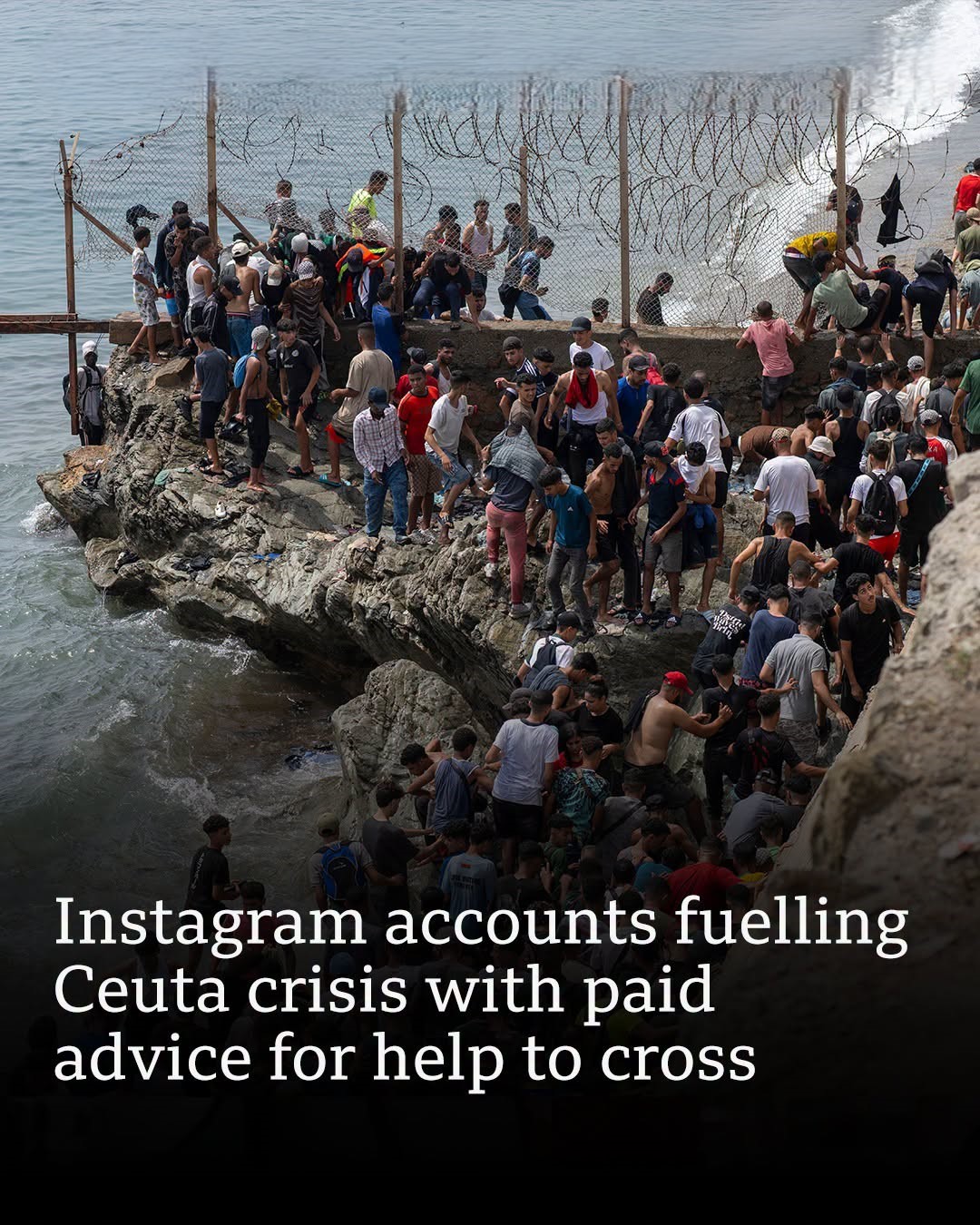
Inside the Ceuta Crisis: How Instagram Advice Is Fueling a Migration Debate
A growing controversy surrounding the migration situation in Ceuta has drawn attention to an unexpected part of the crisis: social media.
According to the claim, an investigation by the BBC’s Top Comment podcast identified dozens of Instagram profiles allegedly offering paid advice connected to attempts to reach Ceuta. The accounts reportedly provide information to people considering dangerous journeys, turning social media into a potential marketplace for migration-related information.
The allegation raises difficult questions.
When does information become exploitation? Can social-media platforms unintentionally encourage dangerous journeys? And who should be held responsible when people pay strangers online for advice about crossing borders?
Ceuta is a Spanish city located on the North African coast, surrounded by Morocco. Because of its location, it has long occupied a unique position in European migration debates. People seeking entry into Europe may view the territory as a possible gateway, while Spanish and Moroccan authorities face enormous pressure to control the border.
For migrants, however, the journey can be extremely dangerous.
People may spend significant amounts of money on transportation, accommodation, intermediaries, or information. Some may leave their homes after hearing stories online about successful journeys. Others may be influenced by photographs and videos showing people who appear to have reached Europe.
This is where Instagram and other social platforms can become especially powerful.
A photograph of someone arriving safely can communicate a message more strongly than a newspaper article. A short video can make a difficult journey appear simple. A confident social-media personality can create the impression that they understand exactly how the border works.
For someone desperate to find a route to safety or a better life, such content can be enormously persuasive.
The alleged paid-advice accounts take that phenomenon one step further.
Instead of simply sharing information, some profiles are accused of charging users for guidance. The exact nature of the services can vary. Some may claim to provide general travel information, while others may allegedly offer more specific advice about routes, timing, border conditions, or methods of reaching Europe.
That creates an ethical problem.
Information itself is not inherently illegal or harmful. People have a legitimate need for accurate information about immigration procedures, asylum rights, transportation, and legal pathways.
But misinformation can be deadly.
If someone pays for advice that is inaccurate, outdated, exaggerated, or deliberately misleading, the consequences can be much more serious than losing money. A person could make a dangerous decision based on information that was never properly verified.
Social media makes this problem harder to control because anyone can present themselves as an expert.
A polished Instagram profile can create credibility without providing evidence of expertise. Followers may see thousands of views, comments, and likes and assume that popularity equals reliability.
It does not.
An account with a large audience may still provide misleading information.
At the same time, not every account discussing migration should automatically be considered part of an organized trafficking or smuggling operation. This distinction is crucial.
People may share their personal experiences, explain legal procedures, discuss news events, or document journeys for many different reasons. Some may genuinely want to help others.
The challenge is identifying where legitimate information ends and exploitation begins.
The reported investigation has therefore placed attention on the economic incentives surrounding migration content.
Social-media platforms operate on attention. The more people watch, share, comment, and follow, the more valuable an account can become. In some circumstances, migration stories may attract enormous engagement because they involve danger, hope, fear, and dramatic personal experiences.
That attention can create opportunities for monetization.
A person who has successfully reached Europe may gain thousands of followers. Others may begin asking questions through private messages. Some may be willing to pay for information.
The cycle can then become self-reinforcing.
More followers create more visibility.
More visibility creates more potential customers.
More customers create financial incentives to produce additional content.
And additional content can attract even more viewers.
For vulnerable migrants, however, the stakes are far higher than for ordinary social-media consumers.
Someone watching a cooking video can try a recipe and discover that it failed.
Someone acting on dangerous migration advice may not get a second chance.
This is why experts and authorities have repeatedly emphasized the importance of reliable information and legal migration pathways.
The controversy also highlights the limitations of content moderation.
Instagram and other platforms can remove posts that violate their rules, but identifying harmful migration-related content is complicated. A post discussing migration may be completely legitimate. Another may subtly encourage dangerous behavior without explicitly stating what users should do.
Some content may also be disguised as ordinary lifestyle material.
A photograph beside a European landmark.
A video describing a successful journey.
A caption promising that “everything is possible.”
A private message offering more information for a fee.
Individually, each element may appear harmless. Together, they can create a powerful narrative.
That narrative can make migration appear easier, safer, or more predictable than it really is.
The human consequences are often hidden behind the screen.
A person scrolling through Instagram may see a smiling individual standing somewhere in Europe. They may not see the fear, exhaustion, financial debt, injuries, separation from family, detention, or uncertainty that may have preceded that photograph.
Social media naturally favors the final image.
It rarely shows the entire journey.
This is one reason migration researchers are increasingly interested in digital platforms. The internet is not simply a place where people communicate after migration decisions have been made. It can also influence those decisions in the first place.
People compare routes.
They exchange experiences.
They ask questions.
They look for opportunities.
They evaluate risks.
And sometimes they spend money.
The Ceuta controversy therefore represents something larger than one group of Instagram accounts. It illustrates how traditional migration networks are adapting to the digital age.
In previous decades, information might have been passed through relatives, friends, community networks, or intermediaries.
Today, a stranger with a smartphone can potentially reach thousands of people.
That changes the scale of the information network dramatically.
It also makes accountability more difficult.
If someone receives harmful advice through a private Instagram message, proving who provided it and what was promised can be difficult. Payments may take place through different platforms. Accounts can disappear and reappear under new names. Content can be copied before it is removed.
For investigators, following those digital trails can be challenging.
For migrants, the consequences can be immediate.
The situation also raises questions for governments.
Authorities understandably want to prevent dangerous crossings and disrupt criminal networks. But simply removing social-media content cannot solve the underlying reasons people migrate.
Wars, poverty, political instability, family circumstances, economic inequality, and the hope of a safer future can all influence migration decisions.
Removing one Instagram account does not remove those pressures.
At the same time, migrants need accurate information about their rights and available legal options. Without reliable sources, they may become more vulnerable to people who claim to possess secret knowledge.
That may be the most important lesson from the controversy.
When people are desperate for information, somebody will usually offer to provide it.
The question is whether that information is accurate, legal, ethical, and genuinely intended to help.
The reported BBC investigation has brought renewed attention to this hidden side of the Ceuta migration story. But the allegations surrounding individual profiles should be carefully verified before specific people or accounts are accused of wrongdoing.
Ultimately, the story is about much more than Instagram.
It is about how technology intersects with human desperation.
It is about how hope can become a commodity.
And it is about how information can be both a lifeline and a danger.
For migrants considering an extremely difficult journey, a social-media post may appear to offer certainty in an uncertain world. But a confident caption cannot eliminate the physical dangers of crossing borders, and an online stranger cannot guarantee a successful journey.
As authorities, journalists, technology companies, and researchers continue examining the role of social media in migration, one principle remains essential: people making life-changing decisions deserve reliable information, not promises designed primarily to generate money or attention.
The Ceuta crisis is therefore a reminder of the enormous responsibility that comes with digital influence.
Behind every account is a potential audience.
Behind every follower may be a real person.
And behind every decision made from information found online may be a human life.