The Palisades Fire Retrial: Prosecutors Try Again After Jury Deadlock — See More
The devastating 2025 Palisades Fire remains at the center of one of California’s most closely watched arson cases. After a federal jury failed to reach a unanimous verdict in June, prosecutors are preparing for a second attempt to convict Jonathan Rinderknecht, the man accused of starting the blaze that eventually became one of the most destructive wildfires in Los Angeles history. The first trial ended in a mistrial, leaving the case unresolved and setting the stage for another courtroom battle later this year.
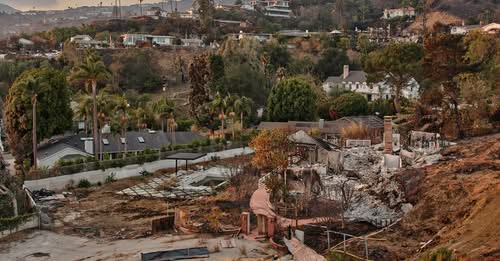
The stakes are enormous because the fire caused devastating destruction. The Palisades Fire killed 12 people and destroyed more than 6,800 buildings across Pacific Palisades and parts of Malibu. Entire neighborhoods were transformed as flames moved rapidly through communities, destroying homes, businesses and other structures.
For prosecutors, the retrial represents another opportunity to persuade a jury that Rinderknecht deliberately caused the initial fire. For the defense, however, the first trial demonstrated what they describe as a major weakness in the government’s case: the absence of direct evidence proving that Rinderknecht actually ignited the fire.
Rinderknecht has pleaded not guilty and maintains his innocence.
During the first trial, prosecutors argued that Rinderknecht used a barbecue lighter to start a fire on January 1, 2025. According to the government’s theory, the initial blaze was not completely extinguished. Instead, fire continued burning underground in root systems before eventually resurfacing days later. Prosecutors say that the January 1 fire ultimately became connected to the devastating Palisades Fire that erupted on January 7.
That theory was a central part of the government’s case.
Prosecutors presented evidence they said placed Rinderknecht in the area when the initial fire began. They also presented digital evidence and recordings of interviews in which they argued that his statements about his movements were inconsistent. Prosecutors attempted to use those inconsistencies to raise questions about what he was doing that night.
The government also presented an alleged motive. Prosecutors argued that Rinderknecht had grievances toward society and that his views about economic inequality provided a possible reason for deliberately starting a fire. But the defense strongly disputed that interpretation.
Defense attorneys argued that prosecutors were attempting to build a case from circumstantial evidence rather than demonstrating directly that Rinderknecht had started the fire.
They also pointed to another possible explanation: fireworks.
That issue became particularly important because investigators did not have a simple piece of evidence showing Rinderknecht physically igniting the blaze. The defense argued that alternative causes were not adequately investigated and that the government’s focus on Rinderknecht came too quickly.
After the evidence was presented, jurors deliberated for more than a day. Eventually, they told the judge they were unable to reach a unanimous verdict.
The division was striking.
Ten of the 12 jurors favored acquitting Rinderknecht, while two favored conviction. Because a unanimous verdict was required, the disagreement meant the jury could not resolve the case. On June 26, 2026, Judge Anne Hwang declared a mistrial because of the deadlock.
A mistrial does not mean that the defendant was found guilty or not guilty. Instead, it means that the trial ended without a final verdict. Prosecutors subsequently announced that they intended to try the case again.
The new trial is expected in the fall, with October 19 previously set as the retrial date.
But prosecutors have now changed their strategy.
In a new indictment filed in August, the government reduced the number of charges from three to two. The dropped charge involved timber being set afire. Prosecutors are now pursuing charges involving destruction of property by fire and arson affecting property used in interstate commerce.
The revised case also narrows the government’s focus. One charge continues to connect the January 1 incident with the larger Palisades Fire, while another concentrates on the destruction caused by the earlier fire.
That change could be significant.
Rather than simply repeating everything presented during the first trial, prosecutors appear to be refining their argument and concentrating on evidence they believe will be strongest before a second jury.
The defense, meanwhile, has reason to feel encouraged by what happened the first time.
Attorney Steve Haney has argued that the government failed to prove its case beyond a reasonable doubt and that the jury’s vote demonstrated how unpersuasive prosecutors’ evidence was to most jurors. The defense continues to maintain that Rinderknecht was wrongly accused and that investigators failed to sufficiently consider other possible causes of the initial fire.
The upcoming trial will therefore revolve around a fundamental question: Did prosecutors prove that Rinderknecht intentionally started the fire, or did investigators simply find a person who happened to be in the area and build a case around circumstantial evidence?
That question matters enormously because the consequences of the Palisades Fire were so severe.
The destruction went far beyond individual homes. Communities were displaced, businesses disappeared, roads and infrastructure were damaged, and thousands of residents faced the difficult process of rebuilding their lives. The emotional consequences have continued long after the flames disappeared.
For families who lost loved ones, the criminal case represents another part of the search for accountability.
But criminal courts require more than public anger or devastating consequences. Prosecutors must establish guilt beyond a reasonable doubt. The fact that an event caused enormous destruction does not, by itself, prove who caused it.
That is likely to remain one of the most important issues during the retrial.
The case also highlights how difficult wildfire investigations can become. Fire destroys physical evidence, and investigators may have to reconstruct what happened from photographs, digital records, witness accounts, weather conditions, fire patterns and other information.
In a rapidly spreading wildfire, determining the exact point and method of ignition can be extraordinarily challenging.
That is why the January 1 fire is so important. Prosecutors argue that it was the beginning of a chain of events that eventually led to the January 7 disaster. The defense disputes that connection and argues that the government has not established the necessary proof.
The second trial will give both sides another opportunity.
Prosecutors will try to present their revised case more effectively and convince a new jury that the evidence establishes intentional wrongdoing. Defense attorneys will attempt to highlight uncertainty, alternative explanations and what they consider gaps in the government’s investigation.
Unlike the first trial, both sides now know exactly how the evidence affected a jury.
That could make the retrial especially important.
The prosecution knows which arguments failed to produce a unanimous verdict. The defense knows which pieces of evidence prosecutors are likely to emphasize. Both sides have already experienced the first trial, and both will enter the second proceeding with a clearer understanding of the challenges ahead.
For the victims and residents of Pacific Palisades, the retrial is another chapter in a tragedy that began more than a year ago.
The fire may have disappeared from the landscape, but its consequences remain visible. Homes must be rebuilt. Families must recover. Communities must determine how to move forward.
Now, the legal system must determine whether the person accused of igniting the initial fire can be held criminally responsible.
The first jury could not reach that conclusion.
The second jury will have to decide for itself.
Until then, Rinderknecht remains legally presumed innocent, and the allegations against him remain allegations rather than established facts.
The retrial promises to bring renewed attention to one of the most devastating wildfires in Los Angeles history—and to the difficult question of whether prosecutors can prove beyond a reasonable doubt who was responsible for the spark that started it all.
See More