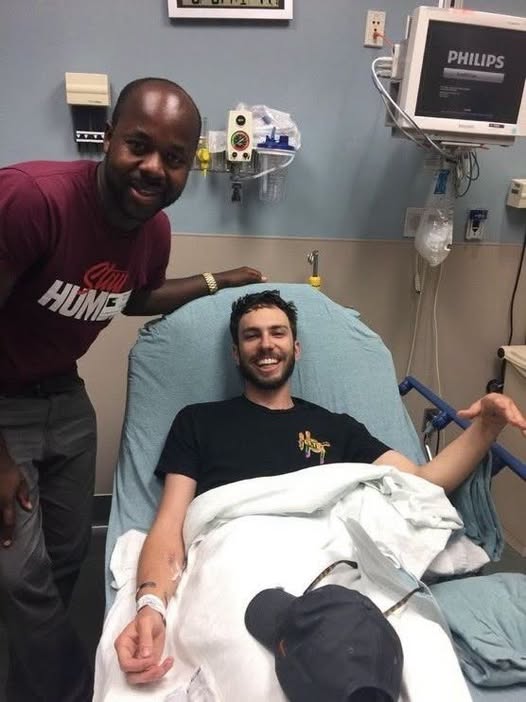
WOW: A College Student in Texas Broke His Wrist and Ordered an Uber Instead of an Ambulance Because of the Cost
A painful injury can be frightening enough on its own. But for many Americans, the first question after an accident is not simply, “How badly am I hurt?” It can also be, “How much is this going to cost me?”
That concern has become a familiar part of conversations about health care in the United States, particularly among young adults and college students who may be living on tight budgets.
One story involving a Texas college student has drawn attention for exactly that reason. After reportedly breaking his wrist, the student chose to order an Uber rather than call an ambulance, with the cost of emergency transportation weighing heavily on his decision.
At first, the decision may sound surprising. When someone suffers an injury, an ambulance is often viewed as the obvious option. Emergency medical technicians can assess the patient, provide basic treatment and monitor their condition while transporting them to a hospital.
But an ambulance ride can also come with a substantial bill.
For a college student who is already worried about tuition, rent, food, textbooks and other everyday expenses, the possibility of receiving a large medical transportation bill can be intimidating.
That is what makes this story resonate beyond one individual experience.
The incident highlights a difficult question: What happens when people who need medical attention hesitate because they are afraid of the financial consequences?
For the student, the injury reportedly involved his wrist. A broken wrist can be extremely painful and may require imaging, a cast or splint, medication, and follow-up care with an orthopedic specialist. In some cases, surgery may even be necessary.
Yet a wrist injury does not automatically mean that an ambulance is medically necessary. If a person is otherwise stable, able to travel safely, and does not have symptoms suggesting a more serious emergency, another form of transportation may sometimes be reasonable.
The important distinction is safety.
Someone experiencing severe bleeding, loss of consciousness, difficulty breathing, chest pain, severe head or neck trauma, signs of stroke, or another potentially life-threatening condition should not simply choose transportation based on price. Emergency medical professionals should be contacted when the situation calls for emergency care.
The Texas student’s experience therefore raises two separate issues.
The first is medical judgment.
The second is financial anxiety.
For many young people, especially those without substantial savings, unexpected medical expenses can feel overwhelming. Even students with insurance may worry about deductibles, copayments, coinsurance or bills they do not fully understand.
An ambulance can feel particularly intimidating because emergency transportation is often billed separately from hospital services.
That means someone might receive one bill for the ambulance, another for emergency-department care, and additional charges for imaging, physicians, medications or follow-up treatment.
The exact amount varies considerably depending on location, insurance coverage, ambulance provider and the services provided. There is no universal price for an ambulance ride.
Still, the fear of receiving an unexpectedly large bill can influence decisions.
That is the part of the story that deserves attention.
Imagine being a college student, sitting in pain after an accident, trying to decide what to do next. You may know that you need medical attention, but you may also be thinking about whether your bank account can survive another unexpected expense.
For some people, that calculation happens almost immediately.
The situation can become even more complicated when students are away from home. A young person attending college in another city or state may not have family nearby to help with transportation or medical decisions.
Instead, they may rely on friends, rideshare services or public transportation.
An Uber may seem like the simplest option if the person is stable enough to travel without medical assistance.
But rideshare services are not substitutes for ambulances.
An Uber driver is not an emergency medical professional. The driver generally cannot provide medical monitoring, administer emergency treatment or respond appropriately if a patient’s condition suddenly deteriorates.
That difference is crucial.
The decision to use a rideshare service should therefore never be based solely on avoiding a bill when someone may actually need emergency medical care.
The broader discussion surrounding this story is about the emotional impact of medical costs.
Health emergencies are already stressful. Adding financial uncertainty can make the situation even more difficult.
People may delay seeing a doctor.
They may avoid emergency departments.
They may choose less appropriate transportation.
Or they may attempt to treat an injury themselves because they fear the price of professional care.
Those decisions can sometimes make a medical problem worse.
A relatively straightforward injury may become more complicated if treatment is delayed. A person with a fracture may continue using the injured limb, potentially increasing pain or causing additional damage. A serious medical condition may also become harder to treat when someone waits too long.
That does not mean every injury requires an ambulance.
It means people need reliable information about when emergency transportation is necessary and when other safe options may be available.
The Texas student’s story is particularly striking because it illustrates how financial concerns can become part of an emergency decision.
For college students, the issue can be especially relevant. Many are experiencing financial independence for the first time. They may have limited income and little savings. Even a modest unexpected expense can disrupt their monthly budget.
At the same time, students often have access to campus health services, student insurance plans, urgent-care clinics and other resources. Understanding those options before an emergency happens can make decision-making easier.
Knowing where the nearest emergency department is, having insurance information available, and understanding campus medical resources can all help.
It is also worth remembering that not every medical problem is an emergency-department problem. For certain stable injuries, urgent care or a primary-care provider may be appropriate. However, the safest choice depends on the circumstances, and people should seek professional medical advice when they are uncertain.
Ultimately, the story of the Texas college student is bigger than one broken wrist.
It is about the difficult decisions people sometimes make when health care and personal finances collide.
Nobody expects to be injured while attending college. A normal day can suddenly turn into a hospital visit, a medical bill and weeks of recovery.
The hope is that people never have to choose between receiving appropriate medical care and protecting themselves financially.
Until that becomes a reality for everyone, stories like this serve as reminders to understand both sides of an emergency: the medical side and the financial side.
A rideshare may be appropriate for a stable person who simply needs transportation to receive care. But when symptoms indicate a genuine emergency, the priority should always be getting appropriate emergency help.
A broken wrist can heal.
A financial problem can often be addressed through insurance, payment plans or assistance programs.
But when a potentially life-threatening emergency occurs, waiting because of cost can carry consequences far more serious than a medical bill.
The most important lesson is therefore simple: know the difference between needing transportation and needing emergency medical care.
And if someone is seriously ill or injured, the safest decision should come before the cheapest one.