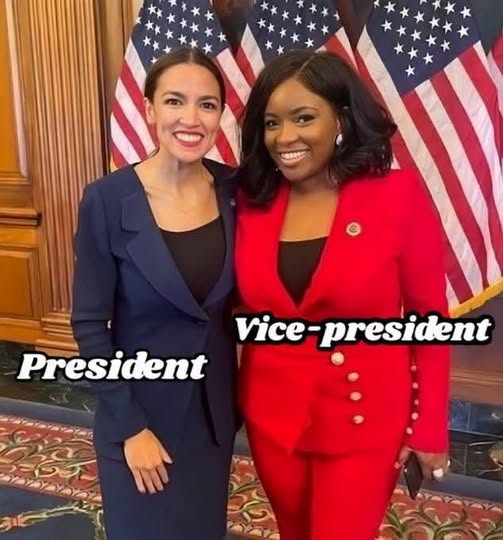
🚨 BREAKING: AOC / Jasmine Crockett 2028 Presidential Ticket Is Being Pushed by Democrats…See More
A political idea that once sounded like internet speculation is now generating serious attention among progressive activists: a potential 2028 presidential ticket featuring Alexandria Ocasio-Cortez and Jasmine Crockett.
The proposed combination would bring together two of the Democratic Party’s most recognizable progressive voices, creating a ticket that would almost certainly transform the 2028 presidential race.
But there is an important distinction.
There is currently no official announcement that Alexandria Ocasio-Cortez and Jasmine Crockett will run together.
Instead, the idea is being discussed and promoted by activists and political supporters as Democrats begin positioning themselves for what could become one of the most competitive presidential contests in years.
Ocasio-Cortez, widely known as AOC, has emerged as one of the Democratic Party’s most influential progressive figures. Recent reporting indicates that she is seriously considering her options for 2028, including a possible presidential campaign or a run for the U.S. Senate.
That alone has made her potential candidacy one of the biggest stories in Democratic politics.
Crockett, meanwhile, has developed her own national profile through outspoken appearances, congressional battles and a political style that appeals strongly to many progressive voters.
Putting the two women on the same ticket would create an unmistakable political message.
It would also represent a generational shift.
For years, Democrats have relied heavily on established national figures to lead the party. But the 2028 field is beginning to look very different, with younger politicians competing for influence and attempting to define what the Democratic Party should become after the Trump era.
AOC’s supporters increasingly view her as a potential successor to Bernie Sanders on the progressive left. Axios reported earlier this year that progressive Democrats have been quietly increasing pressure on her to enter the presidential race.
An early YouGov survey also found that 38% of Democratic and Democratic-leaning respondents said they would consider voting for Ocasio-Cortez in a 2028 Democratic primary. She ranked behind Gavin Newsom, Kamala Harris and Pete Buttigieg in that particular survey, but ahead of several other prominent Democrats.
Those numbers are not a prediction of who will win.
They do, however, demonstrate that AOC has already established a significant national base.
Crockett brings something different.
Her political identity has been built around confrontation, direct communication and an ability to generate enormous attention online. Supporters believe that combination could help Democrats reach voters who feel disconnected from traditional Washington politics.
AOC and Crockett together would therefore offer a ticket built around two highly recognizable personalities rather than traditional establishment politics.
That possibility is precisely why the idea has generated so much excitement among some activists.
But it would also generate enormous opposition.
A presidential campaign involving AOC would immediately face questions about whether her progressive positions could attract enough voters outside the Democratic Party’s liberal base.
Moderate Democrats have already begun organizing around the possibility of a more centrist nominee. Axios reported that center-left activists have been working to prevent the party from nominating another candidate modeled on Sanders-style progressivism.
That means the 2028 Democratic primary could become more than a contest between personalities.
It could become a battle over the future direction of the party.
Should Democrats move further toward progressive economic policies?
Should they emphasize healthcare, housing affordability, wealth inequality and aggressive climate policies?
Or should they move toward the political center in an attempt to win back suburban and independent voters?
AOC’s potential candidacy sits directly in the middle of that debate.
A Crockett partnership would intensify it.
There is another complication: the vice-presidential candidate does not simply get selected because activists want a particular combination.
If AOC eventually decides to run for president, she would first have to win the Democratic nomination. Only after becoming the presumptive nominee would the question of a running mate become realistic.
Crockett would also have her own political ambitions and considerations.
For that reason, describing an AOC-Crockett ticket as already decided would be premature.
Still, political movements often begin this way.
Before a campaign announces its candidates, supporters begin creating slogans.
They launch social-media pages.
They organize volunteers.
They discuss potential running mates.
They test slogans and messages.
And eventually, what began as a grassroots idea can become a serious political campaign.
AOC already has evidence of an organized grassroots movement supporting a presidential run. One independent activist group has created a “Draft AOC” effort specifically aimed at encouraging her to seek the presidency in 2028.
At the same time, political analysts are increasingly placing her among the leading potential Democratic contenders.
Axios’s July 2026 Democratic power rankings placed AOC near the top of the potential field, describing her as the possible progressive heir to Bernie Sanders.
That is a remarkable position for a politician who entered Congress only a few years ago.
But the road to the White House would be extraordinarily difficult.
AOC would have to compete against governors, senators, former national officials and other Democratic politicians with extensive political networks.
Potential candidates such as Gavin Newsom, Kamala Harris, Pete Buttigieg, Josh Shapiro and others could all become major competitors.
The primary could therefore become a crowded battlefield.
And if AOC did become the nominee, the choice of a running mate would become one of the most consequential decisions of her campaign.
That’s where Jasmine Crockett enters the conversation.
Her supporters argue that she could energize younger voters, strengthen the ticket’s appeal among progressives and provide a forceful campaign voice.
Critics would argue that putting two highly progressive politicians together could make it harder to appeal to moderate voters in competitive states.
Both arguments would likely dominate political coverage if the idea ever became an actual campaign proposal.
For now, however, the headline should be understood as a political possibility—not a confirmed ticket.
What is confirmed is that AOC is keeping her 2028 options open, and that Democrats are already fighting over what kind of candidate should lead the party.
That makes the AOC-Crockett conversation worth watching.
The 2028 election is still ahead, and much can change before voters enter the voting booths.
Candidates can rise unexpectedly.
Others can disappear from consideration.
Political movements can gain momentum almost overnight.
And a name that sounds like pure speculation today can become a serious possibility tomorrow.
For now, the proposed AOC-Crockett ticket remains exactly that: a proposed ticket.
But the fact that people are already debating it tells us something important about the Democratic Party.
The next generation of Democratic leadership is already being discussed.
And if Alexandria Ocasio-Cortez eventually decides to run for president, the question of who could stand beside her may become one of the biggest political stories of the 2028 campaign.
The race has not officially begun.
But the conversation already has.