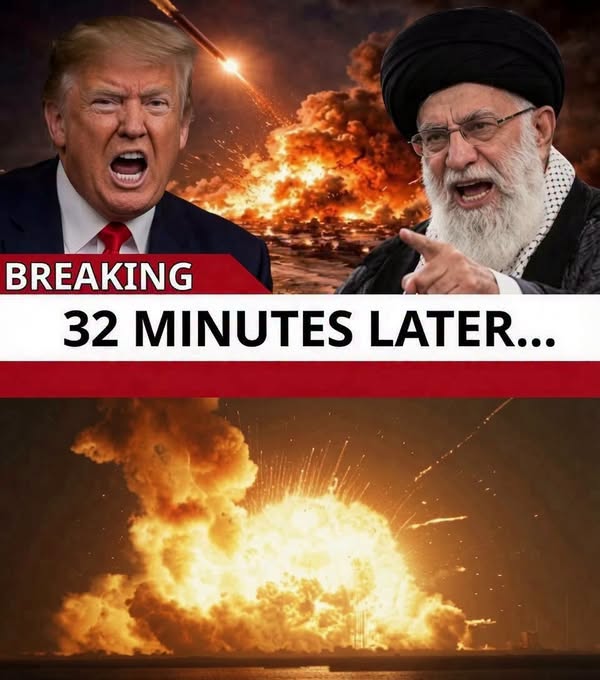
BREAKING NEWS: Iran Tried to Sink a U.S. Aircraft Carrier — 32 Minutes Later…
A dramatic claim circulating online says Iran attempted to sink a U.S. aircraft carrier and that a major American response followed just 32 minutes later. The headline has attracted attention because an aircraft carrier represents one of the most heavily protected and strategically important assets in the U.S. military.
But the details matter. Available fact-checking and credible reporting do not establish the viral “32 minutes later” scenario as a confirmed real-world event. Similar claims that Iranian missiles struck or sank the USS Abraham Lincoln have been denied by U.S. Central Command, while independent fact-checkers found no credible evidence that the carrier was hit.
That distinction is especially important when military stories spread rapidly online.
The claim appears to have been amplified by videos and dramatic military-content channels. One widely circulated video described a fictional scenario involving Iranian warships, missiles and a U.S. carrier, but its own description identified the scenario as fictional rather than an actual historical event. Another video made a similar claim about an attack on the USS Theodore Roosevelt, but the description presented a highly dramatized scenario that does not correspond to verified reporting.
There have also been fabricated or digitally altered videos presented as evidence of Iranian attacks on American carriers. In July 2026, Lead Stories reported on a video purporting to show an Iranian ballistic missile attack on a U.S. aircraft carrier and concluded that the footage was digitally created, with no evidence that Iran had hit a U.S. carrier with ballistic missiles.
Earlier in 2026, another viral video claimed that Iranian missiles had struck or sunk the USS Abraham Lincoln. Fact-checkers found that the footage did not demonstrate such an attack, and U.S. Central Command denied the claim.
So where does the “32 minutes later” story come from?
The precise timeline appears to be part of a dramatic narrative rather than a verified military report. The number is repeated in online videos and websites, but the available evidence does not establish that Iran launched an attack against a U.S. aircraft carrier followed exactly 32 minutes later by the events described in the viral posts.
That does not mean the broader military situation is imaginary.
The United States and Iran have experienced serious military confrontations and dangerous encounters. Iranian forces possess missiles, drones, naval craft and other systems capable of threatening ships and military installations. The Strait of Hormuz remains a particularly sensitive area because of its strategic importance to global energy transportation.
Aircraft carriers are also genuine high-value military targets.
A carrier does not normally travel alone. It operates as part of a carrier strike group, with other warships and aircraft providing layers of protection. These defenses are designed to detect and respond to potential threats from aircraft, missiles, drones, surface vessels and submarines.
Because of those defenses, an online headline claiming that an aircraft carrier was attacked should not automatically be interpreted as evidence that the carrier was actually struck.
There is an important difference between an attempted attack, a detected threat, an intercepted weapon and a successful hit.
Those distinctions can disappear in social-media headlines.
A post might say that a country “attacked” a carrier when a drone merely approached it. Another might describe a military exercise as an actual battle. A third might use footage from a video game or computer simulation and present it as battlefield footage.
This has become an increasingly serious problem during modern conflicts.
In the case of the USS Abraham Lincoln, fact-checkers specifically found that videos circulating online did not show Iranian missiles striking the carrier. One piece of footage had been online previously, while another contained visual characteristics inconsistent with authentic footage.
Another false image claimed to show damage to the carrier’s flight deck. Investigation traced the image to an older photograph of the USS Forrestal from 1967, decades before the current U.S.-Iran conflict.
These examples demonstrate why dramatic military images should be verified before being treated as breaking news.
At the same time, there have been genuine confrontations involving Iranian and American forces. In recent regional fighting, Iranian forces have launched attacks against U.S. and allied targets, while American forces have carried out operations against Iranian military assets. CBS News has reported on attacks involving Iranian forces and U.S. military responses in the region.
The existence of real fighting makes fabricated stories more believable.
Readers already know that missiles and drones are being used. They know American warships are operating in the region. They know Iran has threatened U.S. forces. When a sensational headline appears, it can therefore seem plausible even when its specific details have not been verified.
That is why the wording of the original claim deserves careful attention.
“Iran tried to sink a U.S. aircraft carrier” is a major allegation.
“32 minutes later” implies an exact, documented sequence.
If such an event actually occurred, evidence would normally be expected from multiple sources, including military statements, satellite imagery, credible journalists, maritime tracking information and other independent evidence.
As of the available reporting reviewed here, that evidence does not establish the viral story.
The broader strategic situation, however, remains serious.
The Strait of Hormuz is one of the world’s most important maritime chokepoints. Any major military confrontation there could affect commercial shipping, energy markets and regional security.
That is one reason naval movements in the area receive so much attention.
It is also why aircraft carriers matter beyond their individual crews and aircraft. A carrier can serve as a mobile platform for air operations and represents a significant concentration of military capability.
An attack on such a vessel would therefore be a major event requiring extensive verification.
The most responsible way to understand the current story is to separate the confirmed facts from the viral narrative.
There is no reliable evidence establishing that Iran successfully sank a U.S. aircraft carrier.
There is no verified evidence establishing the dramatic “32 minutes later” sequence promoted by viral posts.
There have, however, been serious military confrontations between Iran and the United States, including attacks, interceptions and operations involving naval and air forces.
That difference matters.
During a war or military crisis, misinformation can spread faster than official statements. Old photographs can become “breaking news.” Computer-generated footage can appear authentic. Fictional military simulations can be mistaken for real battles.
And once a dramatic story receives millions of views, correcting it becomes much harder.
The best approach is therefore to look for the original source, check the date of the footage, determine whether the military involved has confirmed the event, and compare the claim with reporting from multiple established news organizations.
The phrase “32 minutes later” makes the story sound precise.
But precision in a headline is not the same thing as proof.
For now, the available evidence supports a more cautious conclusion: the viral claim about Iran trying to sink a U.S. aircraft carrier and the dramatic events supposedly occurring 32 minutes afterward should not be presented as confirmed news.
The real U.S.-Iran military confrontation is serious enough without adding unverified details.
And in an environment where authentic battlefield events and fabricated videos can appear side by side, knowing the difference may be more important than ever.