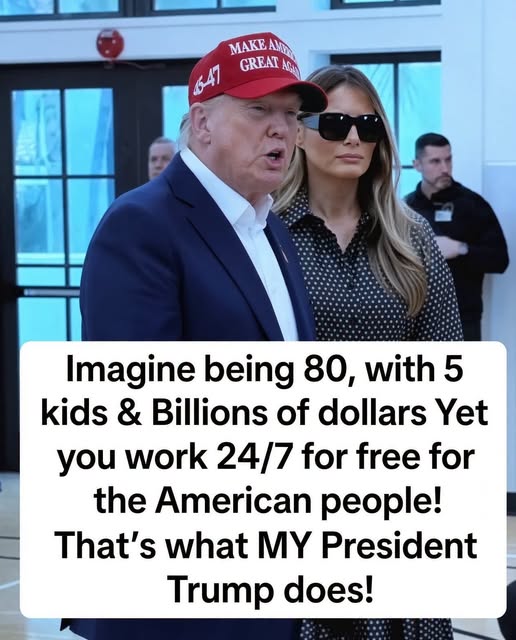
“That’s My President!” 🇺🇸
“That’s my president!” is a short phrase, but when it appears alongside a photograph or video of a U.S. president, it can express a powerful personal reaction. For some Americans, the words communicate pride, loyalty, or admiration. For others, the same image may prompt disagreement over the president’s policies, decisions, or public statements.
The phrase has become especially common on social media, where political moments can spread to millions of people within minutes. A photograph from a speech, a public appearance, a military event, or an interaction with supporters can quickly become the subject of thousands of comments.
For the person posting “That’s my president!” the message may be deeply personal. It can represent a feeling that the elected leader reflects their values or political priorities. But the same photograph can mean something entirely different to another viewer.
That difference is part of democratic life in the United States.
The presidency is one of the most visible political institutions in the country. The president serves as both head of state and head of government and occupies a central role in national politics. Because presidential decisions can affect issues ranging from the economy and foreign policy to immigration, national security, and federal spending, presidents often generate strong reactions.
Supporters frequently highlight moments they believe demonstrate leadership or strength. Critics may focus on the same administration’s decisions from a completely different perspective.
Social media intensifies those reactions.
A traditional political speech might once have been watched primarily through television coverage or reported in newspapers the following day. Today, a single photograph can become a viral post almost immediately. A caption containing only a few words can encourage thousands of people to share their own reactions.
“That’s my president!” is an example of how political identity can be communicated with very little text.
The phrase does not necessarily explain why the person supports the president. It simply communicates an emotional or political connection.
For some people, that connection may come from agreement with economic policies. For others, it may involve immigration, foreign affairs, social issues, government spending, judicial appointments, or the president’s broader political philosophy.
Other Americans may reject the statement entirely.
The United States has a long tradition of political disagreement. Citizens are free to support presidents, criticize them, protest their policies, praise individual decisions, or oppose an administration while still participating in the democratic system.
That is why a photograph or viral caption should not be treated as evidence that the entire country shares one opinion.
Political reactions are diverse.
Even among people who voted for the same candidate, opinions can differ considerably. One supporter may strongly approve of a particular policy while disagreeing with another. Another person may support an administration overall but criticize a specific decision.
Likewise, someone who generally opposes a president may still agree with a particular action.
This complexity is often lost on social media, where posts are designed for quick reactions rather than lengthy political analysis.
A dramatic photograph accompanied by “That’s my president!” can therefore become less about the specific event in the photograph and more about what the president represents to the person sharing it.
The emotional nature of presidential politics is not new.
Throughout American history, presidents have inspired both intense admiration and intense opposition. Supporters have organized rallies, written letters, displayed signs, and celebrated political victories. Opponents have organized demonstrations, published criticism, and challenged presidential policies through political and legal institutions.
Modern technology has simply made those reactions much faster and more visible.
A post can travel from one person’s account to thousands of others in a matter of hours. People who have never met can begin debating the president in the comments.
Sometimes those conversations are thoughtful. Other times, they become confrontational.
Political discussions can easily become personal when people feel that their values or identity are being challenged. A statement as simple as “That’s my president!” can therefore trigger strong reactions from people on both sides.
One useful distinction is between supporting a president and agreeing with every decision that president makes.
Citizens do not have to agree with every action taken by a leader they support. Likewise, opposing a president does not necessarily mean rejecting everything the administration does.
Democratic participation involves evaluating individual policies and decisions.
People can examine what a president promised during a campaign, what actions were actually taken, what laws were passed, what executive actions were issued, and what consequences followed.
Reliable information is especially important when political claims circulate online.
Photographs can be genuine while captions are misleading. Videos can be edited. Old events can be presented as recent. A statement can be removed from its original context. Headlines can emphasize emotion while leaving out important details.
For that reason, people who encounter a political post should consider checking the date, location, original source, and surrounding circumstances before sharing it as news.
The phrase “That’s my president!” does not need to be treated as a factual claim. It is primarily an expression of personal political support.
And people are entitled to express political support.
At the same time, other people are entitled to disagree.
That tension is fundamental to a democratic society.
The presidency belongs to the constitutional system of the United States, but political leaders are ultimately subject to voters, laws, courts, Congress, elections, and other institutions. Citizens can participate by voting, contacting representatives, attending public meetings, joining civic organizations, volunteering, or simply staying informed about issues that matter to them.
A social-media post is only one form of political expression.
The most meaningful part of civic participation often happens beyond the screen.
People discuss policies with neighbors, attend community events, read legislation, follow government announcements, examine competing arguments, and decide which issues deserve their attention.
That is why a simple phrase like “That’s my president!” can open a much larger conversation.
What does the person mean by “my”? Is it pride in the office itself? Support for a particular leader? Agreement with a policy? A reaction to a speech or photograph? Or simply enthusiasm in the moment?
Without additional context, the phrase cannot answer those questions.
What it does show is that presidential politics remains deeply personal for many Americans.
A single image can become a symbol. A few words can represent an entire political viewpoint. And one post can bring together people who share the same enthusiasm as well as people who strongly disagree.
Ultimately, the American political system depends not on everyone having the same opinion, but on people having the freedom to express different opinions while participating in the same democratic institutions.
So when someone writes, “That’s my president!” the statement tells us something about that person’s reaction.
It does not, by itself, tell us what every American thinks.
And in a country as politically diverse as the United States, that distinction matters.