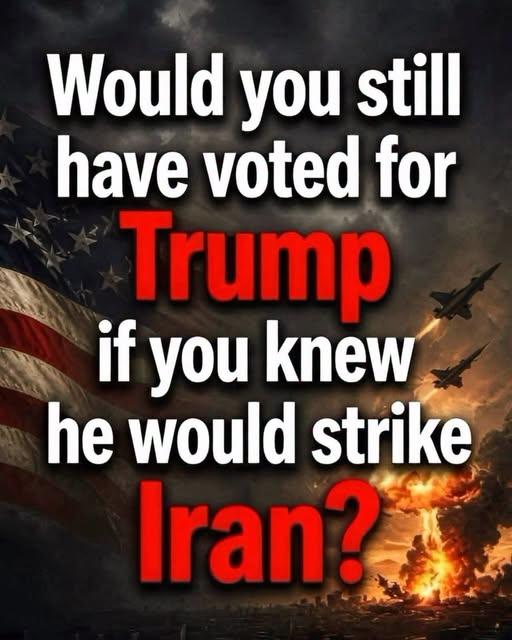
Trump, Iran, and the Ultimate Voter Test: Where Do You Stand?
The growing conflict between the United States and Iran has become one of the most consequential foreign-policy challenges facing President Donald Trump and one of the issues that American voters will have to consider carefully. The confrontation raises questions that extend far beyond the battlefield: How should the United States protect its national security? When should military force be used? How important should diplomacy be? And how much economic cost should Americans accept in pursuit of a major foreign-policy objective?
For Trump’s supporters, the administration’s approach reflects a determination to prevent Iran from obtaining a nuclear weapon and to demonstrate American military strength. Critics have raised concerns about the costs and risks associated with prolonged military involvement. Between those positions are millions of Americans who may agree with some elements of the administration’s policy while disagreeing with others.
The debate is therefore not simply about supporting or opposing one president. It is about competing priorities and the consequences of different choices.
The central issue is Iran’s nuclear program. Trump has repeatedly identified preventing Iran from acquiring a nuclear weapon as a major U.S. objective. His administration has argued that allowing Iran to develop such a capability could create a serious security threat to the United States and its allies.
That argument has been accompanied by military action, economic pressure and continued discussion of negotiations. The conflict has also involved Israel and other countries in the region, making the situation more complicated than a direct dispute between Washington and Tehran.
One of the most immediate consequences for ordinary Americans is the effect on energy markets.
The Strait of Hormuz is a critical route for international oil shipments. Any prolonged disruption in the area can create uncertainty in global energy markets and potentially push gasoline and other energy costs higher. For American families, that means a foreign-policy conflict can quickly become a domestic economic issue.
A driver paying more at the gas station may not think about international diplomacy when looking at the price displayed on the pump. Yet energy markets respond to expectations about supply, transportation and geopolitical risk. Businesses can also face higher costs for shipping and production, which can eventually influence consumer prices.
That creates a difficult political question. How much economic pain should Americans tolerate if policymakers believe military pressure is necessary to address a national-security threat?
Trump has suggested that preventing Iran from obtaining a nuclear weapon is important enough that Americans may have to accept higher gasoline prices in the short term. His position places national security ahead of immediate fuel costs.
Supporters can view that as a necessary sacrifice. Others may ask whether there are diplomatic alternatives that could achieve the same objective without creating comparable economic or military risks.
The financial cost of military operations is another consideration.
Modern warfare requires enormous quantities of aircraft, missiles, ammunition, fuel, intelligence resources and logistical support. Military operations also involve long-term maintenance and replacement costs. Even when American forces are not engaged in a large-scale ground war, sustained operations can require substantial federal spending.
That money ultimately comes from the national budget. Voters therefore have an interest in understanding not only what a military operation is intended to accomplish but also how much it costs and how those resources might otherwise be used.
There is also the human cost.
American service members can be placed in danger whenever the United States conducts military operations overseas. Even limited strikes can create the possibility of retaliation against U.S. troops, diplomatic personnel, bases or American citizens in the region.
That risk makes decisions about military force particularly significant. A president must consider whether military action can accomplish a clearly defined objective, what retaliation could follow, and whether the United States has a realistic strategy for ending the conflict.
Diplomacy remains another major part of the discussion.
Trump has indicated at various points that he remains open to negotiations if an agreement can address American concerns. The possibility of a diplomatic settlement raises its own questions. What restrictions should Iran accept? What sanctions could be removed? What verification system would be necessary? And what would happen if either side believed the other was violating the agreement?
A diplomatic agreement could potentially reduce the risk of continued fighting, but negotiations often require compromises. The challenge for policymakers is determining whether those compromises provide sufficient security guarantees.
The disagreement over Iran also illustrates broader differences in American foreign policy.
One approach emphasizes military strength and deterrence. From this perspective, demonstrating that the United States is willing to use force can discourage adversaries from taking actions that threaten American interests.
Another approach emphasizes diplomacy, alliances and negotiations. Supporters of this approach argue that military action can create unintended consequences and that diplomatic agreements may provide a more sustainable path when they can be verified and enforced.
There are also Americans who favor a combination of both strategies: maintaining military strength while continuing to pursue negotiations.
The political debate becomes especially significant as Americans consider congressional and other elections. Candidates will face questions about whether they support the administration’s objectives, whether they agree with the methods being used, and what alternatives they would pursue.
Voters may therefore want to look beyond campaign slogans.
A useful comparison begins with concrete questions. What does each candidate say about Iran’s nuclear program? Do they support continued military operations? Would they seek negotiations? How would they approach sanctions? What level of defense spending do they support? How would they protect American troops and civilians? And what would their strategy be for ending the conflict?
Those questions can reveal important differences without requiring voters to accept anyone else’s political conclusion.
The economic effects should also be considered separately from the national-security debate. A voter might strongly support preventing Iran from obtaining a nuclear weapon while being concerned about rising gasoline prices. Another voter might prioritize reducing military spending while still supporting diplomatic efforts to prevent nuclear proliferation.
There is no requirement that every position fit neatly into one political category.
The same is true of public opinion. Americans have different experiences and priorities. Someone living in a household heavily affected by fuel prices may view the conflict differently from someone whose primary concern is national security. Military families may focus particularly closely on the risks faced by service members, while business owners may be more concerned about energy prices and supply chains.
Understanding those perspectives is important because foreign policy affects more than Washington.
Ultimately, the Trump-Iran conflict presents voters with a complicated set of choices involving security, economics, diplomacy and military power. The most useful way to approach the issue is to examine documented actions and proposals, distinguish established facts from political claims, and consider the possible consequences of different policies.
The question “Where do you stand?” therefore has several parts.
Do you believe preventing an Iranian nuclear weapon should be the highest priority? How much military force should the United States use? What role should diplomacy play? How much economic disruption is acceptable? How much should taxpayers spend? And what responsibilities does the United States have toward its allies and American personnel overseas?
These are questions that reasonable Americans can answer differently.
As the conflict develops, new information will emerge about military operations, negotiations, energy markets, government spending and Iran’s nuclear activities. Those developments may change the political debate and provide voters with additional evidence to evaluate.
For now, the most important point is that the issue cannot be reduced to a single slogan. The decisions surrounding Iran involve real security risks, financial costs, diplomatic possibilities and human consequences.
American voters ultimately have to decide which priorities matter most to them.
Trump’s Iran policy will remain an important part of the national conversation, but the final judgment belongs to individual citizens. The strongest democratic decisions come from examining the facts, questioning competing claims and understanding the consequences before making a choice.
The question is not simply whether someone supports or opposes Donald Trump.
The deeper question is what role Americans believe their country should play in confronting Iran—and what price they believe the United States should be willing to pay to achieve its objectives.