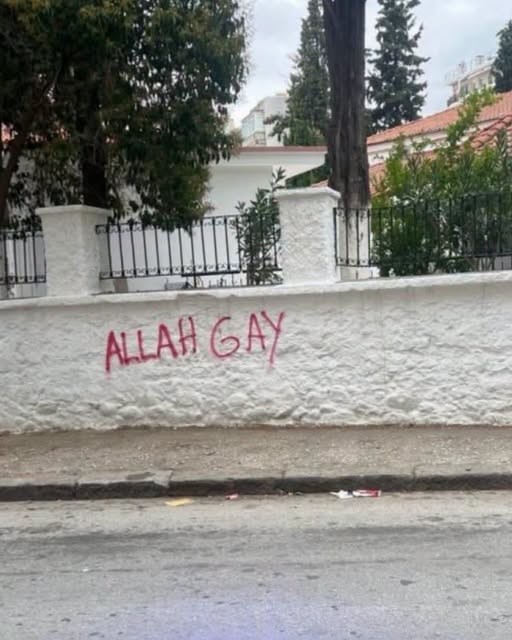
Vandalism at Historic Mosque in Xanthi Sparks Condemnation and Calls for Investigation
A historic mosque in Xanthi, northeastern Greece, became the target of vandalism on September 13, 2026, after offensive writing was discovered on an exterior wall near the entrance to the Platanos Mosque, also known as the Cinar Mosque. The incident prompted condemnation from the Xanthi Muftiate and renewed calls for respect toward places of worship.
The vandalism was discovered Sunday morning, when unknown individuals were found to have written an insulting message on the exterior wall surrounding the mosque. Local reports identified the writing as the phrase “Allah Gay,” painted in red.
The incident immediately attracted attention because the mosque is a religious site serving the Muslim community in Xanthi, a city in Western Thrace where Christian and Muslim communities have lived alongside one another for generations.
The Xanthi Muftiate strongly condemned the act, describing it as vandalism against a place of worship. In a statement, the organization said such incidents could undermine the atmosphere of mutual respect and cooperation between Christians and Muslims in the region.
The Muftiate also appealed directly to members of the public who witness similar incidents. Rather than attempting to clean or repair damage themselves, residents were urged to notify the authorities and cooperate with investigators.
That request was particularly important because preserving evidence can be essential when authorities are attempting to identify those responsible for vandalism. According to local reporting, the offensive writing was removed and the affected wall was repainted after the incident. A preliminary investigation was being conducted to identify the person or people responsible.
At the time of the reports, authorities had not publicly identified a suspect.
The absence of an identified perpetrator has also led to differing interpretations of the incident. Some local commentary treated the vandalism as an act of hostility toward Muslims and religious beliefs. Other commentators raised questions about the circumstances surrounding the incident and how it was subsequently handled. Those claims and interpretations remain distinct from the established fact that offensive writing was discovered on the mosque’s exterior wall.
The most firmly documented information concerns the vandalism itself, the condemnation issued by the Muftiate and the investigation into who was responsible.
The incident also occurred against the backdrop of another reported act of vandalism in the wider Xanthi area. On the same day, an image of Saint George at a small chapel in Manganas was reportedly damaged. Local media reported that unknown individuals caused damage to the religious image, particularly around the face.
The fact that the two incidents occurred on the same day generated discussion in local media. Some commentators questioned whether the events were connected, while others treated them as separate incidents. At present, publicly available reporting does not establish that the two acts were coordinated.
That distinction matters.
When vandalism occurs at religious sites, emotions can rise quickly, particularly in communities where religious identity is closely connected with local history. Claims about who may be responsible can spread rapidly through social media before investigators have established the facts.
The mosque incident therefore provides another example of why authorities typically encourage witnesses to report information directly rather than attempting to determine responsibility themselves.
The Xanthi Muftiate’s statement emphasized the importance of cooperation between the region’s religious communities. It argued that attacks on sacred places can damage the atmosphere of mutual respect that exists between Christians and Muslims in the area.
The Western Thrace Turkish Minority Consultative Council also condemned the incident. According to Anadolu Agency, the council said the offensive expressions were incompatible with the respect that should be shown to places of worship and called for those responsible to be identified and brought before the courts.
The incident has consequently become more than a property-damage case in public discussion. It has touched on broader questions involving religious freedom, social harmony and the protection of historic places of worship.
For residents of Xanthi, however, the immediate issue is straightforward: a religious site was vandalized, and authorities need to determine who was responsible.
The investigation will be important for establishing the facts. Investigators may examine available surveillance footage, witness accounts, physical evidence and other information that could help identify the person or people involved.
Until such evidence is made public, it is difficult to responsibly determine the motive behind the vandalism.
The wording itself was offensive toward Islam, but the precise motivation of the person who painted it has not been established publicly. It could represent religious hostility, an individual act of provocation, or another motive that investigators have yet to determine.
That uncertainty is one reason responsible reporting should distinguish between what is known and what is alleged.
The incident also highlights the vulnerability of historic religious sites. Places of worship are not simply buildings. For communities, they can represent generations of history, tradition, identity and faith. Damage to such a location can therefore have an emotional impact far beyond the physical cost of cleaning a wall.
At the same time, a strong community response does not require retaliation or confrontation.
The Muftiate’s appeal for residents to contact authorities rather than intervene themselves reflects that principle. Allowing law-enforcement authorities to investigate can help prevent further conflict while preserving evidence needed to determine what happened.
For the broader community, the episode is a reminder that religious differences do not have to become sources of division. Christians and Muslims may hold fundamentally different religious beliefs while still sharing neighborhoods, schools, workplaces and civic institutions.
The response to vandalism can therefore matter almost as much as the original act. Condemnation of attacks on religious sites, regardless of which faith is targeted, can reinforce the principle that people should be free to worship without intimidation or harassment.
The Xanthi incident is now part of that larger conversation.
As of the latest reports, the perpetrators had not been publicly identified, and the investigation remained ongoing. The offensive graffiti was removed, and the affected wall was restored.
What happens next will depend on the evidence gathered by authorities.
If suspects are identified, investigators and prosecutors will determine what charges may be appropriate under Greek law. Until then, speculation about responsibility should not be treated as established fact.
For residents of Xanthi and the wider Western Thrace region, the hope is that the incident will be resolved through lawful investigation rather than further confrontation.
The vandalism at the Platanos Mosque has understandably generated anger and concern, but the documented response has centered on condemnation, investigation and calls for cooperation.
Ultimately, the case illustrates a basic principle that extends beyond one mosque or one community: places of worship should be treated with respect, and acts of vandalism should be addressed through evidence, law and due process.
The investigation will determine what happened and who was responsible. Until those facts are established, the most responsible response is to condemn the vandalism, protect the integrity of the investigation and avoid turning an unresolved incident into a source of further division.