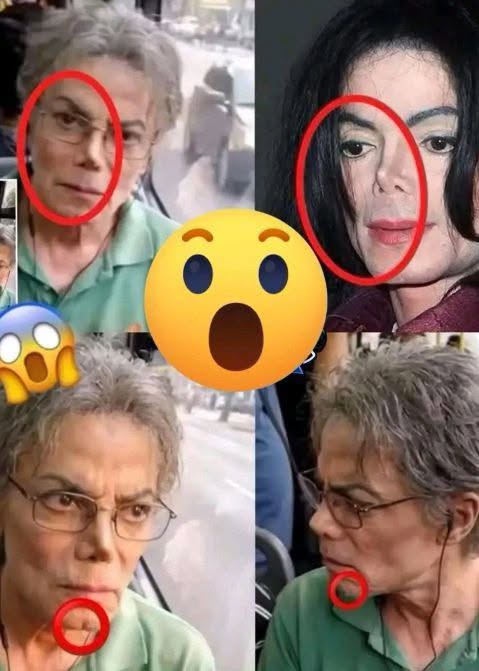
“Michael Jackson Is Alive”: The Photo That Started Another Internet Mystery
Every few years, the internet seems to discover a photograph that sends people into a frenzy.
One blurry image appears online.
Someone notices a familiar face.
A caption makes a dramatic claim.
Within hours, thousands of people are sharing it, commenting on it, and asking the same question:
“Could Michael Jackson really be alive?”
A recent social-media post follows exactly that formula. It claims that a photograph shows a person on the street who looks remarkably similar to the late pop superstar. The caption suggests that the image could be evidence that Michael Jackson survived his reported death in 2009.
It is the kind of claim that immediately grabs attention.
But there is a major difference between an intriguing resemblance and proof.
Michael Jackson died in June 2009 at the age of 50. His death was extensively documented, investigated, and reported around the world. There is no credible evidence establishing that he survived.
So why do photographs like this continue to create such excitement?
The answer has a lot to do with Michael Jackson’s extraordinary cultural legacy.
The Face Everyone Recognizes
Michael Jackson had one of the most recognizable faces in modern entertainment.
For decades, millions of people watched him perform on television, on concert stages, in music videos, and in photographs.
His appearance changed considerably throughout his life, but certain features remained familiar: his eyes, his distinctive expressions, his mannerisms, and the unmistakable way he carried himself.
That makes it surprisingly easy for someone with similar features to attract attention.
A photograph can also exaggerate a resemblance.
Lighting changes facial features.
Camera angles change proportions.
Distance removes detail.
Shadows can make someone’s face appear narrower or more familiar.
A low-resolution image can make the effect even stronger.
Suddenly, an ordinary stranger can look remarkably similar to a famous person.
The Power of a Caption
The photograph itself might not be particularly convincing.
But then someone adds a caption:
“Michael Jackson is alive.”
That sentence changes the way people look at the picture.
Instead of seeing an unidentified person, viewers begin searching for similarities.
The eyes look familiar.
The nose seems similar.
The hairstyle reminds them of Jackson.
The posture looks familiar.
And because people naturally search for patterns, the resemblance can begin to feel stronger with every second of examination.
This is an important psychological effect.
When someone tells us what we are supposed to see, we often become more likely to notice evidence that supports the suggestion.
The photograph hasn’t changed.
Our interpretation has.
The Mystery of the Blurry Image
There is another reason these rumors survive: poor image quality.
A crystal-clear photograph makes identification easier.
A blurry photograph does the opposite.
When details disappear, the viewer’s brain fills in the gaps.
A shadow might become a familiar cheekbone.
A dark area might appear to be recognizable hair.
A facial expression may seem familiar because there isn’t enough detail to show how different it actually is.
Ironically, the less information a photograph provides, the easier it can be for people to project an explanation onto it.
That doesn’t mean the person in the photograph is unimportant.
It simply means that resemblance alone cannot establish identity.
Why People Still Believe the Rumor
Michael Jackson’s death became one of the most discussed celebrity deaths of the modern era.
He had an enormous worldwide fan base, and many admirers struggled emotionally with the idea that the performer they had followed for decades was gone.
For some people, the idea that he might secretly be alive is emotionally appealing.
It transforms a tragic ending into an unfinished story.
Instead of saying goodbye, fans can imagine that their favorite artist simply disappeared from public life.
That is a powerful narrative.
It also fits perfectly into the structure of an internet mystery.
There is a famous person.
There is a mysterious photograph.
There is an unexplained resemblance.
And then there is a question:
“What if?”
The Internet Loves “What If?”
Social media is built around curiosity.
A post doesn’t need to prove something to become popular.
It only needs to make people curious enough to click.
That’s why captions often contain phrases such as:
“Look closely.”
“See more.”
“You won’t believe this.”
“Is this really him?”
“Someone finally spotted him.”
These phrases encourage viewers to investigate the image themselves.
The result is a cycle.
One person shares the photograph.
Another person comments that the person looks exactly like Jackson.
A third person shares the post with friends.
Someone creates a video analyzing the image.
The video receives thousands of views.
More people encounter the claim.
Eventually, the original photograph can become separated from its original context entirely.
What Would Actual Proof Require?
If someone genuinely discovered evidence that Michael Jackson had survived his reported death, a blurry photograph would not be enough.
Such a claim would require extraordinary evidence.
There would need to be independently verified information about the person’s identity.
Official documentation would have to be examined.
Medical and legal records would matter.
Independent experts would need to authenticate the evidence.
Reliable journalists would need to investigate it.
Multiple independent sources would need to confirm the same facts.
A photograph by itself cannot establish all of that.
This is particularly important when the person being identified is one of the most famous entertainers in history.
Famous People Have Look-Alikes
Celebrity look-alikes are nothing new.
There are people around the world who resemble Elvis Presley, Marilyn Monroe, Charlie Chaplin, Princess Diana, and countless other famous figures.
Some even build careers around their resemblance.
Michael Jackson has had numerous impersonators and look-alikes throughout the years.
Some have studied his appearance, clothing, gestures, and dancing so carefully that they can create an extremely convincing imitation.
If someone is photographed from a distance, it can become almost impossible for a casual viewer to distinguish the person from the celebrity they resemble.
That is exactly why context matters.
The Photo May Be Interesting Without Being Proof
There is nothing wrong with looking at the image and saying:
“That person really does resemble Michael Jackson.”
That can be completely reasonable.
The problem begins when resemblance becomes certainty.
A photograph can be fascinating without proving the extraordinary claim attached to it.
It can be a coincidence.
It can be a look-alike.
It can be an impersonator.
It can even be an edited or manipulated image.
Without reliable evidence establishing the person’s identity and the photograph’s origin, the safest conclusion is simply that the image is unverified.
Why the Story Refuses to Disappear
More than a decade after Jackson’s death, his music remains enormously influential.
Songs such as “Billie Jean,” “Thriller,” “Beat It,” and “Man in the Mirror” continue to be heard by new generations.
His music videos remain cultural landmarks.
His dance moves continue to be imitated.
His influence can be seen across pop music and performance.
In other words, Michael Jackson never really disappeared from popular culture.
His work remains everywhere.
Perhaps that is partly why stories claiming to have found him alive continue to attract attention.
The artist may be gone, but his image remains extraordinarily powerful.
The Real Mystery
The most interesting question may therefore not be “Is Michael Jackson alive?”
The available evidence does not support that conclusion.
A better question is:
“Why can one photograph make millions of people question something they thought they already knew?”
The answer involves psychology, celebrity culture, nostalgia, social media, and the extraordinary power of visual images.
We trust photographs because they appear to show us reality.
But photographs can mislead.
Perspective can mislead.
Lighting can mislead.
Captions can mislead.
And our own expectations can mislead us.
That is why unusual images should be approached with curiosity—but also with skepticism.
The mysterious photograph may continue circulating.
People will continue debating it.
Some viewers will remain convinced that they see Michael Jackson.
Others will immediately recognize a look-alike.
And many will simply enjoy the mystery.
But until credible evidence says otherwise, the photograph remains exactly that:
A photograph.
An intriguing image.
A remarkable resemblance.
And another internet mystery that demonstrates just how easily a few pixels can become a worldwide story.