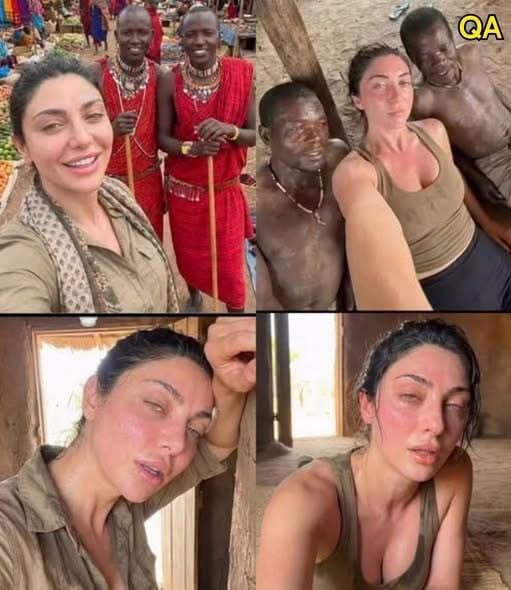
One Trip to Africa… And Her Life Was Never the Same
When Maya booked her flight to Africa, she expected a vacation.
She imagined beautiful landscapes, unfamiliar cities, memorable meals, wildlife, photographs, and a few weeks away from the routine of everyday life.
She expected to return home with hundreds of pictures and a collection of stories to tell her friends.
What she did not expect was to return as a different person.
Before the trip, Maya had fallen into a routine that felt increasingly empty.
She had a good job.
She had a comfortable apartment.
She had friends and family who cared about her.
From the outside, everything looked fine.
But privately, she felt stuck.
Every morning seemed identical.
Wake up.
Go to work.
Answer emails.
Attend meetings.
Come home.
Scroll through her phone.
Go to sleep.
Repeat.
She had spent years telling herself that she would eventually make time for the things she truly cared about.
One day, she would travel.
One day, she would learn something new.
One day, she would stop worrying about what everyone else expected from her.
Then her friend suggested something unexpected.
“Come with me to Africa.”
Maya laughed at first.
Africa had always seemed impossibly far away.
She had never traveled that far from home, and the idea of spending weeks somewhere unfamiliar made her nervous.
But the invitation stayed in her mind.
Eventually, she said yes.
The first day of the trip was overwhelming.
Everything felt different.
The sounds.
The streets.
The languages.
The food.
The pace of daily life.
Even the light seemed different.
Maya found herself paying attention to things she normally ignored.
People greeted one another warmly.
Children played outside.
Markets were filled with conversations and movement.
Traveling through unfamiliar places forced her to slow down.
At home, she was always rushing.
There was always another email.
Another deadline.
Another notification.
But during the trip, she began leaving her phone in her bag for longer periods.
She started looking around.
Really looking.
One morning, she watched the sunrise over a landscape that seemed to stretch endlessly toward the horizon.
She stood quietly for several minutes.
No emails.
No meetings.
No traffic.
No schedule.
Just the sunrise.
She later described that moment as the first time in years she had felt completely present.
But the most important part of the trip wasn’t the scenery.
It was the people she met.
Maya spent time with local residents, guides, families, and community members.
She discovered that the stereotypes she had unconsciously carried with her did not capture the complexity of the continent.
Africa was not one place.
It was dozens of countries, thousands of communities, countless cultures, languages, histories, traditions, and experiences.
Everywhere she went, she encountered something different.
She listened to stories about family.
Education.
Work.
Tradition.
Change.
Hope.
Challenges.
Dreams.
The conversations forced her to reconsider how little she had understood about the world outside her own routine.
One afternoon, Maya visited a community project that supported children through education and local programs.
She expected to spend an hour there.
Instead, she stayed most of the afternoon.
The children were energetic and curious.
They asked questions about where she came from.
They wanted to know what snow looked like.
They laughed when she tried to pronounce unfamiliar words.
They showed her games.
They told stories.
And eventually, Maya realized something.
She had traveled thousands of miles looking for an adventure.
Instead, she had found perspective.
Her own problems had not disappeared.
Her responsibilities had not vanished.
But her understanding of them had changed.
She began questioning the things she had previously considered essential.
Did she really need to spend so much time worrying about impressing people?
Did she need to buy everything she wanted?
Did she need to postpone happiness until some imaginary future date?
The trip encouraged her to rethink her priorities.
She began writing in a journal every night.
At first, she wrote about what she had seen.
Later, she started writing about herself.
What did she actually want?
What made her happy?
What was she afraid of?
Why had she been waiting for permission to change?
Those questions followed her throughout the journey.
One evening, she sat outside with several people she had met during the trip.
They talked about family and the future.
Someone asked Maya what she planned to do when she returned home.
She gave the usual answer.
“Go back to work.”
Then she paused.
For the first time, she questioned whether “going back” was what she really wanted.
The trip had shown her that changing direction was possible.
It didn’t mean abandoning everything.
It meant making deliberate choices instead of simply following the path she had been placed on.
When Maya finally returned home, her apartment looked strangely different.
Everything was exactly where she had left it.
The furniture.
The books.
The clothes.
The computer.
Nothing had changed.
Except her.
She unpacked her suitcase and placed her photographs on the table.
There were hundreds of them.
But she noticed something surprising.
The pictures she valued most weren’t necessarily the spectacular landscapes.
They were the ordinary moments.
A smile.
A conversation.
A meal shared with strangers.
Children laughing.
A sunrise.
A dusty road.
A quiet afternoon.
Those photographs reminded her to pay attention.
Within months, Maya made several changes.
She reduced unnecessary spending.
She spent more time with her family.
She started volunteering.
She began learning about cultures beyond her own.
She also stopped postponing experiences simply because they were inconvenient.
She realized that life could not be measured entirely by productivity.
There was value in curiosity.
There was value in rest.
There was value in relationships.
And there was enormous value in seeing the world from perspectives different from your own.
Eventually, people began asking her the same question.
“What changed you?”
She always gave the same answer.
“I went somewhere expecting to see the world, and I ended up seeing myself.”
That became the real meaning of her journey.
Africa had not magically solved every problem in her life.
Travel does not work that way.
Poverty, inequality, cultural differences, and complex social realities cannot be understood through a short vacation.
But the experience had challenged her assumptions.
It had encouraged her to listen.
To observe.
To ask questions.
To become more curious.
And most importantly, to stop believing that the life she had always known was the only life available to her.
Years later, Maya would still talk about that first trip.
She would show people photographs.
She would describe the landscapes.
She would remember the food, the laughter, the long journeys, and the unexpected conversations.
But whenever someone asked about the most important thing she brought home, she never mentioned a souvenir.
She mentioned perspective.
Because sometimes a journey changes you not because the destination is magical, but because stepping outside your familiar world forces you to reconsider the person you have become.
Maya left home expecting a vacation.
She returned with something much more valuable.
A willingness to live deliberately.
A deeper respect for other people’s experiences.
And the courage to ask herself a question she had avoided for years:
“If I could start again, what kind of life would I choose?”
She never forgot the answer.