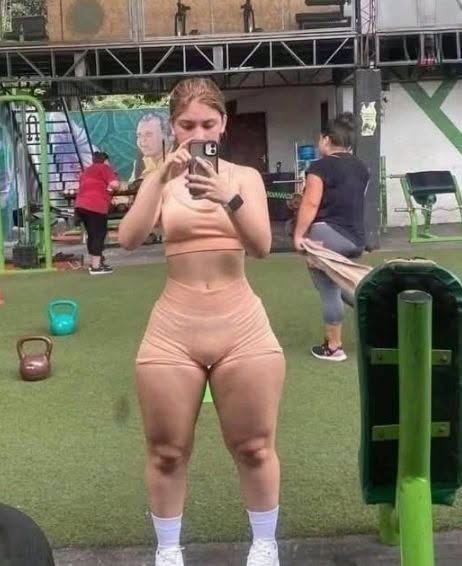
The headline “The separation between a woman’s legs means that she is… See more” is designed to make readers believe that one physical feature can reveal something important about a woman’s personality, sexuality, or past. Headlines like this are common on social media because they create curiosity. They leave the sentence unfinished, encouraging people to click to discover the supposed secret.
But the truth is much simpler: the natural space between a person’s thighs does not reliably reveal anything about their sexual history, personality, morality, or attractiveness.
Human bodies come in many different shapes and proportions.
Some people naturally have space between their thighs when standing. Others do not. Some may have a noticeable gap because of the angle of their hips and the structure of their legs. Others may have thighs that naturally touch. Neither is an indication that something is right or wrong.
The shape of the human body is influenced by many factors.
Genetics plays an important role. People inherit different skeletal structures, including differences in hip width, pelvis shape, leg alignment, and the angle at which the femur connects to the pelvis. These differences can influence how the legs appear when someone stands naturally.
Muscle mass can also affect appearance.
A person who participates in sports, dancing, running, cycling, strength training, or other activities may develop different muscles in the legs and hips. However, even people who perform the same activities can have completely different body shapes.
Body-fat distribution also varies naturally.
Some people store more fat around their thighs and hips, while others store more around their abdomen, arms, or other parts of the body. These differences are normal and do not provide a simple way to judge someone’s health or lifestyle.
Even posture can change how the legs look.
Standing with the feet together, standing with the feet slightly apart, shifting weight from one leg to another, or changing the position of the hips can all affect the appearance of the space between the legs.
That is why trying to determine someone’s personality or sexual behavior from this feature is unreliable.
There is an important lesson here about how social media presents the human body.
Online content frequently takes an ordinary physical characteristic and gives it a mysterious meaning. A headline might claim that the shape of someone’s eyes reveals their personality, that the length of their fingers reveals their romantic behavior, or that the shape of their body proves something about their private life.
These claims can sound convincing because they are presented as secrets.
But a confident headline is not the same thing as scientific evidence.
The idea that a person’s body can reveal their sexual history is particularly misleading.
There is no simple physical feature that can tell you how many relationships someone has had, whether someone is sexually experienced, or what their preferences might be. Those are personal aspects of someone’s life that cannot be reliably determined by looking at their body.
This matters because physical appearance is often judged much more harshly when these myths are repeated.
A young woman may see a social-media post suggesting that her body shape means something negative about her. She might begin comparing herself with photographs online and wondering whether her body is “normal.”
There is no single normal body shape.
Human variation is normal.
Two sisters can have completely different body proportions despite sharing much of their genetics. Friends who have similar heights can have different hips, legs, shoulders, and waistlines. Athletes can have different body structures even when they train in the same sport.
The idea of a universal ideal body is therefore unrealistic.
Images on social media make the situation even more complicated because photographs are often influenced by posing, lighting, clothing, camera angles, lenses, editing, and filters.
A person may look completely different in one photograph compared with another.
That does not mean their body changed dramatically.
It means photographs can change perception.
This is one reason people should be careful when comparing themselves with images online.
A body is not a mathematical formula.
There is no requirement that everyone’s legs, hips, waist, or shoulders should look the same.
Another misconception is that a thigh gap is necessarily a sign of fitness.
It is not that simple.
Some naturally thin people do not have one because of their skeletal structure. Some people with significant athletic ability do not have one. Some people naturally have one without exercising regularly.
Fitness cannot be determined by one visual characteristic.
A better measure of physical well-being includes things such as strength, cardiovascular fitness, mobility, nutrition, sleep, and overall health—not whether two parts of the body touch.
The same principle applies to attractiveness.
Beauty standards change across cultures and generations.
A physical feature that is considered desirable in one period may become less fashionable in another. Social-media trends can create intense attention around certain body types, only for the trend to disappear later.
This is another reason not to attach too much meaning to temporary beauty standards.
The body is not a trend.
It is part of who a person is.
Another important point is that physical appearance should not be used to make assumptions about someone’s character.
A person cannot be judged as kind, intelligent, loyal, dishonest, confident, shy, experienced, or inexperienced based on the shape of their legs.
Character is revealed through behavior.
Trust is built through actions.
Personality becomes visible through communication and relationships.
Those qualities cannot be measured by body proportions.
The same applies to sexuality.
Someone’s private life belongs to them. Physical appearance does not give strangers permission to create stories about it.
This is especially important when photographs of people are shared online without context.
A person may post a picture simply because they like the photograph. Others may immediately begin commenting on their body or inventing stories about their life.
That can turn an ordinary photograph into an uncomfortable experience.
People deserve to be treated as individuals rather than as collections of physical features.
So what does the separation between a woman’s legs actually mean?
In most cases, it means exactly what it appears to mean: her legs have a particular natural structure and position.
It does not provide a secret code.
It does not reveal her past.
It does not determine her personality.
It does not prove anything about her relationships.
And it does not establish whether she is attractive or unattractive.
The most useful response to headlines like this is to replace speculation with understanding.
Instead of asking what a body feature supposedly “means,” ask why bodies naturally differ.
Instead of comparing yourself with someone else, recognize that physical variation is normal.
Instead of believing an anonymous internet claim, look for credible medical or scientific information.
And instead of judging another person based on appearance, remember that there is always a human being behind the photograph.
The internet is full of mysterious headlines promising to reveal hidden truths about the human body.
Some are harmless entertainment.
Others can create insecurity and spread misinformation.
Knowing the difference is important.
The human body is wonderfully diverse, and there is no single shape that everyone is supposed to have.
A space between the legs is simply one of countless natural variations.
It is not a measurement of morality.
It is not a measurement of sexuality.
It is not a measurement of worth.
And it certainly is not a secret that allows strangers to know someone’s private life.
The real story is much less sensational but much more valuable: every body is different, and appearance alone cannot tell you who a person truly is.