Trump Touts Historic Drop in Crime as FBI Releases 2025 Report
President Donald Trump stood alongside senior law-enforcement officials this week and celebrated new FBI statistics showing a dramatic decline in crime across the United States in 2025.
The figures provide Trump with a powerful political message heading into the November midterm elections. According to the FBI’s newly released 2025 crime report, murder and non-negligent manslaughter fell by an estimated 18.1%, while overall violent crime declined by 9.3%. Robbery dropped 18.5%, rape declined 7.6%, and aggravated assault fell 7.2%.
The national murder rate fell to approximately 4.1 killings per 100,000 people, a level tied with 1955 and 1956 for the lowest recorded rate since the FBI’s historical data began. Property crime also declined by 12.4%, while motor-vehicle theft fell sharply.
For Trump, the statistics offered an opportunity to argue that his administration’s emphasis on law enforcement, immigration enforcement and public safety is producing results.
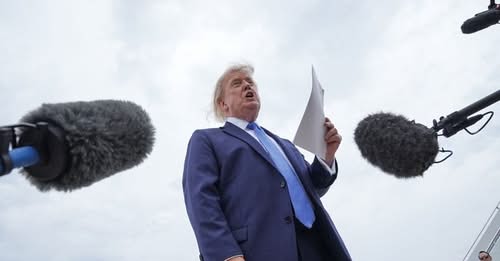
During an appearance at the Nassau County Police Academy on Long Island, Trump praised law-enforcement officers and highlighted the dramatic reduction in killings and other offenses. FBI Director Kash Patel and Attorney General Todd Blanche were among the senior officials accompanying him.
Trump has repeatedly presented public safety as one of the central accomplishments of his administration. The new FBI numbers give his political operation a significant set of statistics to point to as Republicans prepare for a difficult midterm campaign.
But the numbers have also generated an important debate.
The decline in crime is real. The question is why it happened.
Criminologists and other experts caution against attributing the entire national decline to one president or one set of policies. The reduction in violent crime began before Trump returned to office, with significant decreases already recorded in 2023 and 2024.
That does not necessarily mean Trump’s policies had no effect.
It means the available data cannot establish that his administration alone caused the nationwide decline.
Crime is influenced by many factors, including policing strategies, economic conditions, demographics, community programs, prosecution policies and changes in criminal behavior. Different cities have experienced substantial declines while operating under very different political leadership and law-enforcement policies.
That complexity is likely to become part of the political debate during the months ahead.
The Numbers Are Striking
There is little dispute that the FBI’s 2025 figures represent a remarkable improvement from the years immediately following the pandemic.
The United States experienced a major increase in homicides during 2020. The national murder rate subsequently declined, and that downward trend continued through 2025.
The latest FBI report shows just how significant the improvement became.
Murder and non-negligent manslaughter fell 18.1% in one year.
Robbery declined by 18.5%.
Rape fell 7.6%.
Aggravated assault dropped 7.2%.
Overall violent crime declined 9.3%.
Property crime declined 12.4%.
Those numbers represent millions of people living in communities where crime has become less common.
For families who remember the uncertainty and fear of the pandemic-era crime surge, the improvement is welcome news.
Trump Takes Credit
Trump has argued that his administration’s approach to public safety helped produce the results.
He has emphasized stronger immigration enforcement, support for police and the use of federal resources in cities experiencing crime concerns. The administration has also deployed National Guard personnel in certain circumstances, including Washington, D.C.
At the Nassau County event, Trump framed the statistics as evidence that his law-and-order agenda is working.
Republicans are likely to use the same argument during the midterm campaign.
Crime has traditionally been an issue that can motivate voters, particularly when candidates can point to specific statistics showing changes in homicide, robbery or violent offenses.
The FBI report gives Republicans a large collection of numbers to highlight.
Democrats, however, are expected to challenge Trump’s interpretation of those numbers.
A Trend That Started Earlier
One of the most important details in the story is the timeline.
The national decline in violent crime did not suddenly begin when Trump returned to the White House.
Crime had already been falling during the final years of President Joe Biden’s administration.
That makes it difficult to determine how much credit should be assigned to Trump’s policies.
Experts quoted in recent reporting have emphasized that the nationwide decline has occurred across jurisdictions with different political leadership and different approaches to policing.
In other words, the numbers tell us what happened, but they do not automatically tell us why it happened.
That distinction is important.
If a city experiences a major decline in homicide, several things may have contributed. Police departments may have changed their strategies. Community violence-intervention programs may have expanded. Economic conditions may have improved. Criminal groups may have changed their behavior. Prosecutors may have altered enforcement priorities.
The national trend can therefore have multiple causes.
Why the Report Matters Politically
The timing of the report is particularly significant.
The 2026 midterm elections are approaching, and control of Congress will be at stake.
Trump and Republican candidates are looking for issues that can motivate voters and demonstrate the administration’s accomplishments.
Public safety is an obvious choice.
Trump’s appearance with law-enforcement officials also allowed him to connect the crime statistics with his broader political message.
He has repeatedly criticized Democratic leaders over crime and accused some Democratic-run cities of failing to protect residents.
The new FBI statistics give Republicans an opportunity to argue that the national situation is improving.
Democrats can respond that the decline began before Trump took office and that the administration should not claim exclusive credit.
That disagreement is likely to continue throughout the campaign.
The FBI’s Role
The FBI’s annual crime report is based on information collected from thousands of law-enforcement agencies around the country.
The 2025 report drew data from more than 17,000 agencies covering nearly 329 million people, according to the Associated Press.
That makes the report one of the most important sources for understanding national crime trends.
However, national statistics can sometimes conceal significant differences between communities.
A nationwide decline does not mean every city experienced a decline.
Some communities may still have serious homicide or violent-crime problems even while the national average improves.
That is why local statistics remain important.
A family deciding whether its neighborhood is safe is usually more interested in what is happening nearby than in the national murder rate.
A Historic Low
Perhaps the most striking statistic in the new report is the homicide rate.
At approximately 4.1 killings per 100,000 residents, the 2025 rate was tied with 1955 and 1956 for the lowest level recorded since 1900.
That is a remarkable change from the pandemic period.
Homicides rose sharply in 2020, producing widespread concern among law-enforcement agencies and communities.
The subsequent decline has now continued for several years.
For Trump, that trend represents an opportunity to tell voters that the country is becoming safer.
For researchers, however, the more interesting question is what combination of factors produced such a dramatic reversal.
More Than Just Murder
The FBI report also demonstrates that the improvement extends beyond homicide.
Robbery declined by 18.5%.
Aggravated assault fell 7.2%.
Rape declined 7.6%.
Property crime decreased 12.4%.
Motor-vehicle theft fell particularly sharply after reaching elevated levels in 2022 and 2023.
That broad-based decline is important because it suggests the improvement is not limited to one category of crime.
People are reporting fewer violent and property offenses overall.
Still, experts caution that crime statistics should be interpreted carefully.
What Happens Next?
The debate over the FBI numbers is unlikely to end with Trump’s speech.
Republicans will point to the figures as evidence that their policies are working.
Democrats will emphasize that crime had already been falling before Trump took office.
Researchers will continue examining the data to determine why the decline has occurred across such a wide range of communities.
And voters will ultimately decide which interpretation they find most convincing.
What is clear is that the FBI report represents significant news.
The United States experienced a substantial decline in violent crime in 2025, and the national homicide rate reached a level not seen in roughly seven decades.
For people who have spent years worrying about crime, that is encouraging.
For politicians, it is an opportunity.
And for researchers, it is a complicated question that deserves careful examination.
Trump has chosen to present the numbers as proof that his administration is making America safer.
Whether voters agree that his policies deserve the credit may become one of the important political questions of the 2026 election.
For now, the numbers themselves are striking: murder fell 18.1%, violent crime fell 9.3%, and the nation’s homicide rate reached one of its lowest points in modern American history.